








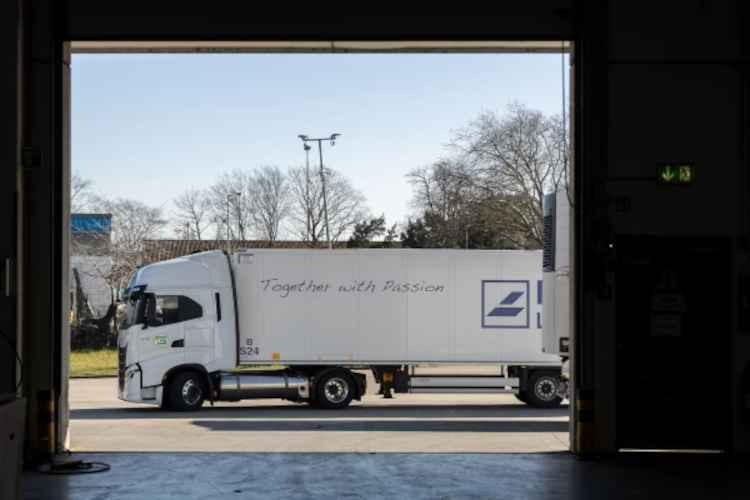
The international logistics expert, Rhenus, is streamlining its groupage road transport solutions in Europe. Following a successful test phase in Germany, the newly organized structure will apply across the entire European network from January 8, 2024. Rhenus will enable its customers to benefit from significantly shorter delivery times, thanks to daily connections and departures across the continent. The main goal of the concept, called Groupage Network 2.0, is to increase efficiency.
Thanks to the new cross-border traffic structure, Rhenus will now handle daily departures from every region in Europe to any destination on the continent – regardless of where the customer is based.
As global supply chains become increasingly time-sensitive, transporting goods from point A to point B is a key factor for most companies. For this reason, the Rhenus Group has developed a new road freight service known as Groupage Network 2.0. The goal is to offer its customers daily pickups and departures to any location in Europe, regardless of where they are located. In the past, Rhenus offered this type of daily groupage freight service only in highly industrialized regions with high potential for tightly synchronized departures. Until now, Rhenus provided lower departure frequencies for shipments, e.g., twice a week in less industrialized regions. Thanks to the new structure for cross-border traffic, Rhenus will now handle daily departures from every region in Europe to any destination on the continent – regardless of where the customer is located.
The new Rhenus groupage transport network has been designed to ensure fast and reliable delivery of shipments to and from destinations across Europe. A hub structure, covering various countries, will ensure the possibility of daily import and export processing. Shipments will initially arrive at a national hub, which will act as the main regional transshipment point in the respective countries as a first-mile logistics service. From there, Rhenus will transport the goods to a central European hub, where the cargo will be consolidated according to its destination and sent on its way. “After conducting an analysis of the center of gravity of our network’s volume, we selected Hilden as the strategic and geographical center to serve as a pan-European transshipment point. By using this solution, we can ensure short, efficient line-haul connections and optimal first- and last-mile logistics,” comments Carsten Hölzer, Managing Director of Rhenus Road Freight, explaining this development.
The higher frequency of freight deliveries in the groupage sector means there will no longer be “blank spots” on the map of Europe where customers have to accept long transit times. After a two-month test phase, during which minor inconsistencies in the process were eliminated or significant structural changes were introduced, the transition to Groupage Network 2.0 is now ready to be launched across Europe. In practice, this means that Rhenus will be able to transport its customers’ goods on trade routes across Europe much faster than in the past via its pan-European road traffic network, which includes over 150 Rhenus locations. Compared to 2023, transit times for groupage freight traffic are estimated to fall by 34 percent. Customers will also benefit from significantly greater network transparency and the same commitment to quality at every business location.
An additional advantage of daily services for shipments is the ability to combine transport solutions with local warehousing and transshipment options. Rhenus offers this service as “Transport-Related Warehousing” in all European countries. This means that customers have access to local storage space that is located very close to their supply chains. As a result, both options together enable much more flexible logistics operations with efficient scaling up and down, depending on the customer’s needs.