








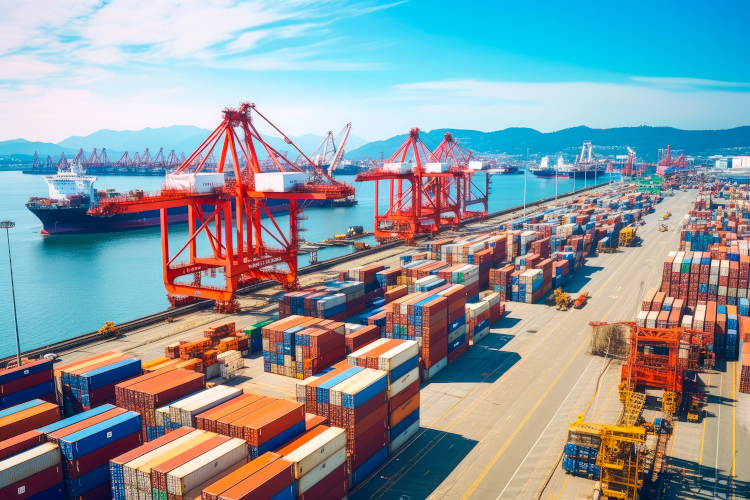
December is an intense time for importers fulfilling orders from the Middle Kingdom. Although the Chinese New Year in 2024 begins on February 10, this is the hot period for final orders before a nearly four-week standstill. Importers must also account for longer delivery times, as due to the uncertain geopolitical situation, more companies are abandoning routes through the Red Sea.
The Chinese New Year is one of the most important holidays in the Middle Kingdom. There is a statutory week off from work (February 9-15, 2024), but traditional ceremonies and rituals last until February 24, when the Lantern Festival takes place. Consequently, importers must expect many difficulties related not only to production in factories and manufacturing plants but also to transport or customs clearance of goods in ports.
Added to this is the uncertain geopolitical situation: after the Danish shipping company Maersk, the German Hapag-Lloyd, and the French CMA CGM, the shipping group Mediterranean Shipping Company recently announced that it is directing its ships away from the Red Sea. The reason for these decisions was attacks by Yemeni rebels on ships sailing to Israel. As a result, delivery times to Europe will be extended.
- Chinese New Year celebrations last about 2 weeks, but the downtime in manufacturing plants can extend up to 4 weeks;
- Importers must expect terminal congestion and an increase in freight rates;
- The geopolitical situation has caused shipowners to abandon passages through the Suez Canal.
Congested terminals and the “cut and run” policy
Downtime in Chinese factories usually lasts three or even four weeks due to employee vacations and the time needed to resume the production process. The last freight from China usually departs at the beginning of February.
– The end of December is the final deadline for Polish importers to place orders if they are carrying out shipments from China. The goods must leave the warehouse and be loaded onto the ship with sufficient lead time; otherwise, one must expect significant delays or the cargo will not leave the port at all until the holiday period ends – says Joanna Porath, owner of the customs agency AC Porath.
China is still considered the “factory of the world,” which is why the period before the Chinese New Year is always intense. Due to the increased volume of orders, not only do freight prices rise, but terminal congestion also occurs. It may happen that they will not be able to keep up with handling cargo waiting to leave the port.
– Additionally, ships may apply a “cut and run” policy, meaning they only unload import goods and do not take those intended for export, or they only take high-paying cargo. Furthermore, transshipment may occur, meaning reloading at an intermediate port, and the container sits at the terminal waiting for the next ship – adds Joanna Porath.
Pay attention to goods documentation
Before the Chinese New Year, special attention should be paid to the documentation of goods. Because Chinese factories are fulfilling an increased volume of shipments, they have significantly less time and manpower to monitor issues related to the technical specifications of goods and quality control.
– It is best to prepare the documentation for goods well in advance, both for export clearance from China and import clearance once the goods reach Polish ports. It is also recommended to conduct increased quality control on-site. To have time for all this, it is best to plan supply chains in advance, taking into account the limitations of Chinese suppliers resulting from the specifics of their holiday period – adds Joanna Porath.
Source: AC Porath