









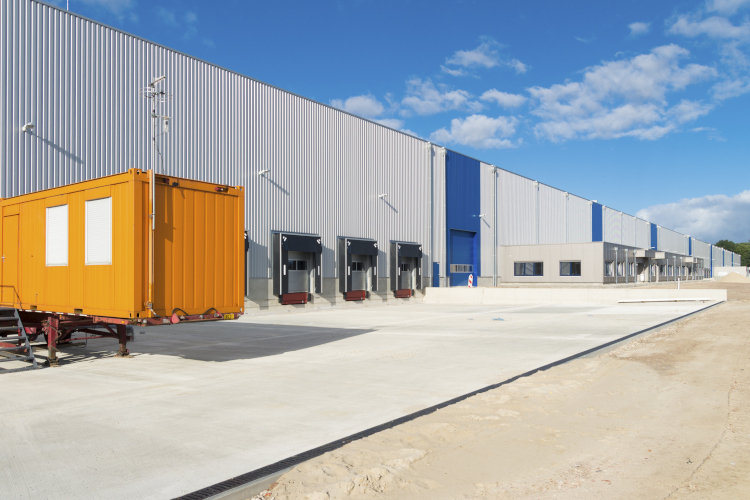
In 2023, the warehouse real estate sector in Poland experienced a slowdown, but the market is hopeful for a rebound in 2024. After the peak of activity in terms of demand and supply during the so-called COVID period between 2020 and 2022, the logistics and production market has returned in many metrics to levels observed in 2018-2019.
The future of demand for warehouse space
Estimated forecasts summarizing total tenant activity in 2023 indicate that gross demand should stabilize at approximately 4.7-5 million sqm. As usual, the final quarter of the current year will prove crucial in this aspect, as it is historically when the most transactions are closed. Nevertheless, the last 18 months in the Polish warehouse market have been a time of challenges related to a weaker economic climate, political uncertainty linked to the war in Ukraine, rising energy prices, and high inflation. All these factors negatively affected tenant activity, although, as we predicted, the logistics sector, retail chains, and manufacturing proved to be the industries with the greatest stability and resilience to the unfavorable macroeconomic situation. A visible improvement was also noted for the e-commerce segment.
Characterizing the last 12 months in the Polish warehouse market in terms of demand, it is impossible not to mention the large number of renegotiations and a noticeable trend of extending decision-making processes regarding the lease of new space. This last factor definitely influenced the stabilization of rents observed at the end of Q2 2023. Due to relatively high rates and the risk of losing employees, clients decided to renegotiate contracts (approx. 35% and growing) more often than in previous years instead of choosing new locations. In line with our predictions, the share of manufacturing companies, which accounted for approx. 20% of completed transactions, increased during this more demanding period.
A good place for nearshoring and friendshoring
Global analysts point out that in the medium and long term, Poland will play a significant role in trends such as nearshoring and friendshoring. We are already one of the largest producers of large household appliances and play an important role in the automotive sector. Our location on the map of Europe and professional, qualified staff who built their experience working in or for foreign corporations remain our constant assets. However, it should be remembered that processes related to greater regionalization of supply chains and moving production to Europe require time.
The trend of leasing large spaces
Once again, individual transactions for over 100,000 sqm were closed on the Polish warehouse market. In the ending year, these were a new contract with a retail company for 120,000 sqm in DL Psary/Czeladź and the lease of 110,000 sqm by Raben in CTPark Warsaw West (Wiskitki). Thus, we are maintaining the trend from the last two years. In turn, the regions with the highest tenant activity will most likely be the Masovian, Silesian, and Lower Silesian voivodeships.
ESG and investment financing
Financing is definitely the word of 2023 in terms of developer activity, as they had to face increased bank requirements regarding pre-lease agreement security. Equally important in the context of the whole year was meeting ESG-related guidelines. Bank analysts note that Poland differs from other Central and Eastern European countries in terms of the number of decisions refusing to grant loans due to failure to meet ESG criteria.
Which regions are the most popular?
Despite the challenges during the economic slowdown, investors and developers focused on opening projects in major markets characterized by high liquidity, a large consumer market, and an extensive network of connections with other areas of the country and Europe. It should be assumed that the total resources of the Polish warehouse market at the end of 2023 will likely amount to 31.5 million sqm, which will allow for maintaining a growth dynamic of approx. 15%. Developer activity at the end of 2023 should reach a level of 3.6-3.7 million sqm, although it should be noted that 60% of this space consists of projects delivered in Q1 of this year, i.e., investments started in the first half of 2022 under different market conditions. Nevertheless, it is worth emphasizing that almost 2/3 (approx. 20 million sqm) of the existing total market resources have been created since the beginning of 2017.
From the Big 5 to the Big 8
The warehouse market in Poland is entering another phase of maturity, in which the previous group of five main regions has been expanded to eight, including Warsaw and its surroundings, Łódź, Upper Silesia, Greater Poland, Lower Silesia, as well as the areas of Szczecin, the Tri-City, and Kraków. Particular attention should be paid to the last two markets, whose importance has increased significantly in recent years, and they have exceeded the threshold of one million square meters of total resources. The Lubusz voivodeship is among the aspiring regions, although the litmus test for this market will be the high competitiveness from Szczecin, Greater Poland, and Lower Silesia. As a result of the uncertain geopolitical situation, most developers were, and we expect they will remain, passive in taking action in the eastern part of Poland.
Less speculative space under construction
In 2023, weakened demand resulted in fewer speculative projects, the share of which in space under construction fell from 61% in Q2 to 53% in Q3 2023. Due to higher requirements related to obtaining financing, we expect this trend to continue in 2024 and the share of projects without signed lease agreements in new supply to decrease by the end of the first half of next year. This situation, along with lower demand than in previous years, may contribute to a decrease in vacancy levels in 2024.
Developer strategies for the coming months
We predict that in the first months of 2024, developers will decide on a safe investment strategy, focusing mainly on projects with a significant share of pre-lease agreements and delivering BTS-type projects. The potential improvement in the economic climate announced for the second half of next year may result in a change and a renewed increase in the number of speculatively implemented investments, exceeding the current level.
Warehouses as the leader again
After a one-year break, the warehouse sector will again become the leader in the investment market in Poland in 2023. The transaction of the year was the acquisition of an 80% stake in 7R S.A. by the Scandinavian investment fund NREP. The majority owner gained access to investments with a total area of approx. 4.2 million sqm, consisting of existing warehouse parks and a land bank with projects to be built.
Trends for 2024 in the warehouse market
We expect that, in line with analysts’ predictions, the improvement in consumer sentiment announced for the second half of 2024 will influence the change in the economic and macroeconomic situation, which will be a reason for increasing Poland’s attractiveness and starting the construction of new investments. For this reason, we assume that the return of investors and an increase in market liquidity will occur no earlier than in the final months of 2024. Until then, we will witness a two-speed market in the investment sector. The first group will consist of funds interested in so-called prime assets, although the lack of high-quality products heralds another phase of waiting for a better moment and, consequently, a smaller number of transactions. The second group, in turn, will include owners in a more difficult situation and value-add projects, which will be sought after by opportunistic investors. In 2024, we expect a predominance of investors from Europe, including smaller local entities rather than large Asian platforms. So-called investment vehicles composed of several smaller entities should also be formed on the market in order to invest in sectors with good fundamentals, e.g., warehouses or retail parks.
Source: AXI IMMO