








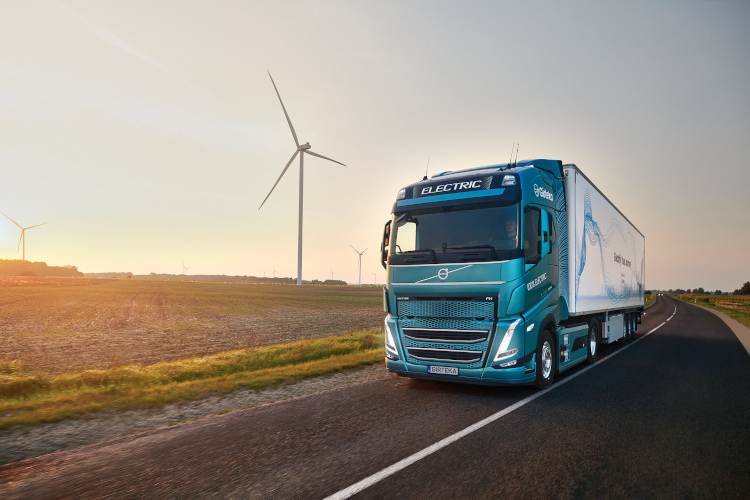
Girteka, the largest road freight carrier in Europe based on digitalization, is committed to implementing innovative solutions that support fleet decarbonization and is investing in the purchase of electric trucks. This approach also sets a new direction for the future of the driver profession, presenting them with new challenges and opportunities. How do they assess these changes themselves? Odd Thore, a professional driver at Girteka, shares his experience of driving an electric truck.
From diesel to electric
Odd Thore works in Norway on a daily basis, making deliveries for Thermomax, a company belonging to the Girteka Group. For 15 years, he drove diesel-powered trucks. Now, as the company focuses on implementing sustainable transport solutions, he has switched to an electric Volvo truck.
– Switching from diesel to electric drive brings a lot of joy, new experiences and skills, as well as the need for different behavior and changing habits – says Odd Thore – At first, I was curious, maybe a little skeptical. How will these electric giants perform on the roads in conditions like we have in Norway?
Advantages – silence and driving style
What caught Odd Thore’s attention right from the start was the silence in the cabin, which contrasts sharply with the sounds of diesel engines he was used to. The electric truck, although it resembles the interior of its diesel counterparts, provided a sense of calm. The driver was also impressed by how quickly the vehicle warmed up.
– The silence was deafening – says Odd Thore – I was used to the roar of a diesel engine, but this… this was something else. I felt like I had stepped into the future. Being on the road constantly makes the conditions in the vehicle very important for the quality of my work – he emphasizes.
Another advantage the driver pointed out is the smoothness of acceleration, and thus the impact on an eco-friendly driving style. Electric trucks allow drivers to consciously control energy consumption during acceleration and braking by using kinetic energy, which is more difficult to achieve in diesel vehicles equipped with cruise control.
– I usually took eco-driving training to understand how my reactions and driving style affect fuel consumption and exhaust emissions. Now, with an electric car at my disposal and access to instant information, I can perform an analysis myself, checking the reactions and effects of every pedal press – emphasizes Thore.
Challenges – two-axle design and longer charging time
The transition from a diesel-powered vehicle to an electric one was not without its difficulties. As Odd Thore points out, a major challenge for him was the two-axle design of the truck and the associated concerns about overloading, safety, and driving capabilities, especially on the snow-covered roads of Norway.
– The two-axle design is a bit puzzling, especially since the drive axle is easily overloaded. I got used to driving with three axles, which gives me a better feel for the truck on the road when it is fully loaded – says Odd Thore.
Another challenge was the battery charging process itself in an electric car, which requires more time compared to refueling diesel vehicles. This, as Thore emphasizes, required him to adapt and make changes to his daily routine.
Electromobility will change the driver profession
According to Odd Thore, electric trucks, and especially the driving comfort (lack of engine noise) and the rapid development of related technologies, may influence the future of his profession.
– I remember when I started working as a truck driver. Back then, those trucks were great, but comparing them now with what the future may bring gives hope that the driver’s job is also on the verge of change. Knowledge of the latest technological solutions, such as AI-based route planning tools, cruise control assistance systems, and all steering functions, as well as probably many others that I cannot even imagine, are a real argument for young people to convince them to join this profession. And if you add to that working for a company that invests in the latest tractors, like Girteka, you get nothing but benefits – emphasizes Odd Thore.
Interestingly, similar conclusions come from a survey conducted in June 2023 for ECTA. Its goal was to gather professional drivers’ opinions on driving electric trucks on European roads. In their opinion, driving comfort (clean and tidy interiors) and shorter working hours (work-life balance) can increase the attractiveness of this profession among the younger generation and convince women to join it.
Looking to the future, Odd Thore is optimistic – I believe we are only at the beginning. Electric trucks will become more advanced and better adapted to our needs. I can’t wait to see where we are heading.
In pursuit of low emissions
Girteka is among the European pioneers in applying sustainable solutions, investing in building a low-emission fleet and implementing innovative solutions. It is worth recalling that in 2022, the company signed a partnership agreement with the Swedish car manufacturer Scania for the delivery of 600 electric trucks equipped with the new Scania Super powertrain, which reduces fuel consumption by 8 percent. The cooperation between the companies also includes the construction of charging infrastructure. This year, Girteka implemented an interesting solution in Norway, which is based on an innovative strategy of combining electric vehicles with intermodal transport. Over a distance of 150 km, deliveries are carried out by electric trucks, and then by rail in an intermodal system. Girteka is already preparing to implement further innovations supporting the decarbonization of road transport.