








Warsaw will introduce a clean transport zone as early as 2024. This was decided by city councilors during yesterday’s meeting. Thus, the capital will become the second Polish city to opt for changes aimed at improving air quality and reducing traffic-related smog. It was decided that until the end of 2027, residents of the city who are registered and pay taxes in the capital will be exempt from the rules applicable in the CTZ. The zone will also be much smaller than in the version presented after consultations.
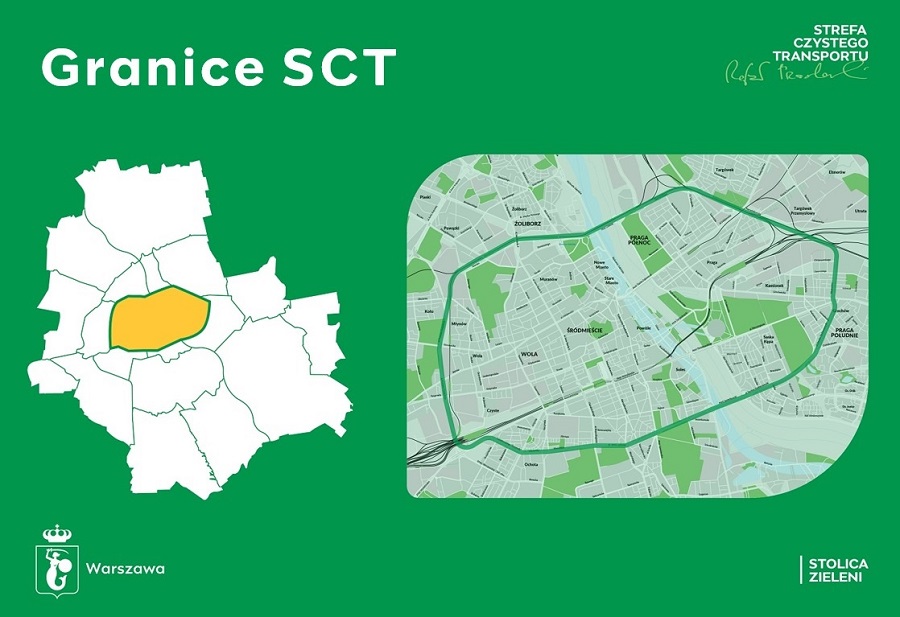
The voted-through proposal (along with 2 amendments) assumes a significant reduction of the clean transport zone (CTZ) compared to the latest version of the project. As a result, the CTZ will cover 7% of the city’s area – the entire Śródmieście district and parts of the central districts. Its boundaries will coincide with major roads and railway lines, which will not be included in the zone, and will be marked by: al. Prymasa Tysiąclecia, Al. Jerozolimskie, ul. Kopińska, ul. Wawelska, al. Armii Ludowej, al. Stanów Zjednoczonych, ul. Wiatraczna, and then the railway tracks along the northern railway bypass – up to al. Prymasa Tysiąclecia.
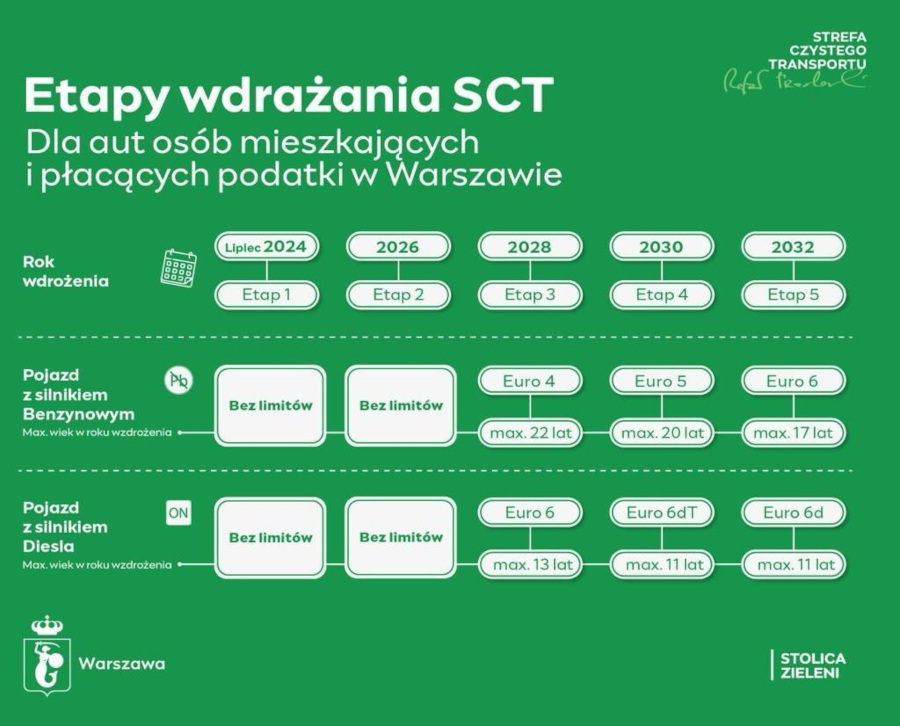
The implementation of the zone is planned in five stages. The first is to take place on July 1, 2024. From that moment on, vehicles with gasoline engines (including LPG) with an emission standard lower than Euro 2 or manufactured before 1997 (maximum vehicle age of 27 years) and Diesels not meeting Euro 4 or manufactured before 2006 (maximum 18 years) will not be allowed to enter the indicated districts of Warsaw. The second implementation stage is planned from 2026. At that time, the maximum age of vehicles subject to restrictions will be 25 years for gasoline variants (minimum Euro 3 and production no earlier than 2001) and 16 years for Diesels (minimum Euro 5 and production no earlier than 2010).
– Voting through the resolution on the clean transport zone is undoubtedly a step in the right direction. Zones are a proven instrument for combating air pollution, the effectiveness of which is confirmed by numerous studies. More than 320 such areas already exist in Western Europe. Eliminating the most emission-intensive vehicles means a significant reduction in the concentration of particulate matter, nitrogen oxides, and other toxic components originating from transport. These substances contribute to as many as 50,000 premature deaths in our country annually. At the same time, the restrictions on entering the zone will cover a small number of cars – in the initial two stages, the oldest and most polluting vehicles of visitors – emphasizes Agata Wiśniewska-Mazur, Deputy Director of Development at PSPA.
Warsaw councilors decided to implement a grace period for people living in the capital and paying taxes there. They will have 3.5 years from the launch of the zone to adapt to the new rules. This means that only in 2028 will they have to meet the requirements regarding the CTZ (entry only for vehicles meeting at least the Euro 4 standard and a maximum age of 22 years – vehicles with gasoline engines, and Euro 6 and a maximum age of 13 years – vehicles with diesel engines). The resolution also includes an additional exception for seniors, i.e., people who will turn 70 by the end of 2023, provided they were owners of their vehicles before the resolution was adopted.
Warsaw plans to introduce two methods of verifying vehicles entering the zone area. For most vehicles, it will be possible to determine this through access to data from the Central Vehicle Register. However, for vehicles that do not meet the criteria for entering the Zone and belong to people using exemptions (e.g., residents of the capital or seniors), it will be mandatory to display special stickers.