








Wage pressure, rising fuel and energy prices, inflation, and unstable interest rates – these are the challenges currently facing the TSL (transport, forwarding, and logistics) industry. Its problems are reflected in the National Debt Register database. The arrears of companies in this sector have increased by PLN 155 million over the past year to nearly PLN 1.3 billion. There is, however, a flip side to the coin – the TSL industry is securing its own transactions and checking the financial credibility of its contractors before providing services. By doing so, it is limiting its own financial risk.
The report “Road Transport in Poland 2023,” prepared by SpotData on behalf of the Transport and Logistics Poland Employers’ Association, shows that road transport is the industry that contributes most to the country’s economic development. However, the functioning of the TSL market is limited by high driver wages, inflation, and energy price fluctuations. The sector entered 2023 with declining demand for transport and shrinking prices for transport services. In the coming years, both logistics and transport companies will face an even greater staff shortage than before, which is a result of demographics.
Fewer orders, more financial problems
Market data indicates that 2023 will leave its mark on European road transport, which is so important from the point of view of Polish operators. Last year, they accounted for 20 percent of transport in the entire European Union. However, according to Statistics Poland (GUS) data, fewer goods were transported in Poland in the first quarter of 2023 than a year earlier. Across Europe, freight availability fell by 25 percent year-on-year. This means less work for Polish carriers. In such a situation, rising operating costs, especially maintaining a vehicle fleet, become a challenge.
– This year, compared to 2022, the demand for transport services is clearly lower. Depending on the company, the declines range from 15 to even 20 percent. This translates into financial problems for the sector. Our database reflects this trend, because in just one year, the debt of TSL companies has increased by 155 million zlotys – explains Adam Łącki, President of the Management Board of the National Debt Register Economic Information Bureau.
The total debt of the TSL industry amounts to PLN 1.3 billion. On average, one company in this sector has PLN 44.3 thousand to pay. This is PLN 4.4 thousand more than a year earlier. During this time, 670 entities with financial problems have also been added. Today, there are 29.3 thousand debtors in the KRD involved in transport and warehousing.
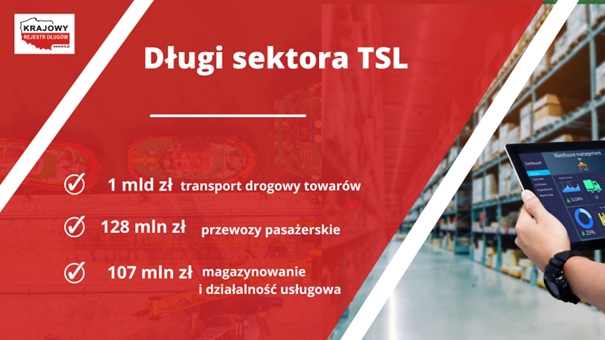
The bulk of the arrears burdens companies involved in road transport of goods – they owe one billion zlotys. These debtors are also the most numerous – almost 21 thousand. The debts of companies involved in passenger transport amount to PLN 128 million. 4.4 thousand entities have them. Warehousing and service activities supporting transport account for just over PLN 107 million. The number of debtors in this segment is 2.2 thousand entities.
Transport companies less tolerant of payment delays
– Rising fuel and energy prices, driver wage pressure, and high inflation have reduced tolerance for unpaid invoices in the TSL industry. Fearing a loss of financial liquidity, companies want to receive payment for their work as soon as possible and are commissioning debt collection faster than even last year, when economic conditions were not as extreme as they are now. We are also observing a new trend: the pursuit of claims for the transport of coal and grain from Ukraine. It is clear, therefore, that companies are keen to recover their remuneration so as not to lead to payment bottlenecks. This is a threat to honest companies and a serious burden for the entire economy – notes Jakub Kostecki, President of the Management Board of the debt collection company Kaczmarski Inkasso.
The most difficult situation among companies involved in transport and warehousing is in the Masovian Voivodeship, where they have PLN 268.3 million in outstanding liabilities. They are followed by companies from Silesia with an amount of PLN 158.1 million, and the podium is closed by entities from Greater Poland, which have accumulated PLN 148 million in arrears.
Among debtors from the TSL industry, the largest group consists of sole proprietorships. This should not be surprising, as this sector has for years been considered one of the most fragmented. Small companies are in debt for PLN 854.8 million, and this sum is spread across 21.8 thousand entities.
Companies involved in transport and warehousing have the most unpaid liabilities to financial institutions – banks, factoring, leasing, and insurance companies – as much as PLN 500 million. Second in line to recover money are securitization funds, which bought debts from original creditors, primarily banks. They are waiting for the return of PLN 392 million. TSL companies should also pay PLN 120 million to the trade industry, including PLN 32.7 million for wholesale fuel sales. They owe PLN 56 million to other transport companies.
The number of checked clients in the TSL industry is growing
The economy is a system of communicating vessels, so TSL companies themselves are also creditors. Clients should pay them over PLN 381.2 million for services. This is almost 1/3 of what they themselves have to pay to contractors.
A form of protection against unreliable clients is the verification of business partners in economic information bureaus. The TSL industry downloads more and more such reports from the KRD every year. In 2021, it was 319 thousand reports, and a year later 342 thousand. This year, which has not yet ended, companies from the transport industry have already downloaded 329 thousand reports on contractors. Every 7th verified contractor turned out to be a debtor. Increasingly, the transport industry uses not only simple verification of the tax identification number (NIP) of a potential client, which gives an answer whether they are currently a debtor or not, but also reaches for payment credibility analysis, which allows assessing the credibility of any company in Poland based on a number of available sources of information and using machine learning.
– TSL is one of the most complicated industries when it comes to settlements with clients. And this does not only apply to delaying payment, but to avoiding payment altogether. Unfortunately, many carriers let themselves be cheated in a veiled way, which results from the enormous competitiveness in the TSL market. They accept orders behind which dishonest contractors are hiding, and it is increasingly difficult to distinguish a scammer from a normal potential client. Therefore, before establishing cooperation, verification of principals is crucial. But it is worth not only checking whether a given company is in debt now, but what is the probability that it will be entered into the National Debt Register within the next six months. Such an analysis takes into account not only the situation of a given company, but also the industry in which it operates, or the voivodeship in which it is headquartered. Transactional risk is, of course, part of doing business, but it can be reduced – comments Tomasz Gadziński, an expert on the transport market at the National Debt Register Economic Information Bureau.