








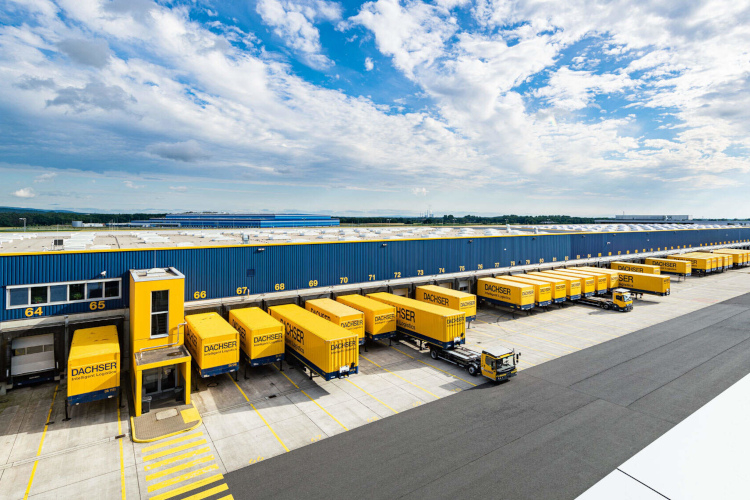
In a world that seems to be constantly accelerating, predictability and transparency are becoming key business challenges. This also applies to logistics operators who transport a variety of products across Europe on behalf of their customers. To this end, DACHSER has equipped the swap bodies and trailers used in groupage transport with intelligent 5G/LPWAN-enabled tracking devices and connected them to its IT systems.
From the Spanish Andalusia to Norway, from Portugal to Turkey – 8,500 swap bodies and 3,500 trailers from DACHSER travel thousands of kilometers across Europe every year. These transport containers carry, among other things, clothing, cosmetics, food, automotive components, as well as groupage cargo and chemicals, including hazardous goods. Every year, DACHSER transports over 80 million shipments. Monitoring delivery delays caused by traffic jams or route changes and informing customers about them is a particular challenge for both people and telematics systems, especially in the groupage industry.
Real-time tracking
Swap bodies are not tied to any specific tractor unit but can be quickly and easily lifted, transported, and set down by various vehicles. In long-haul transport, they are often exchanged between transit terminals and continue their journey with a different BDF chassis in what is known as relay traffic. Sometimes they wait for the next trip, supported on their legs in a yard at one of the 239 Road Logistics branches, at a customer’s loading point, or in a parking lot. As a self-supporting system designed for a long service life, the swap body does not share energy or information with the tractor unit.
“Combining real-time location and visualization is a decisive step forward in tracking and controlling shipments within our groupage network. Our employees are supported in capacity planning, allowing them to optimize transport utilization and increase handling efficiency,” says Alexander Tonn, COO Road Logistics at DACHSER.
However, this flexibility comes at a price: the routes and locations of swap bodies must be individually identifiable at every stage, from the starting point to the final destination. After all, if you know where the swap body is, you know where the loaded shipments are. That is why every swap body is equipped with innovative intelligent tracking devices. By using the Internet of Things (IoT), containers can be tracked in real-time, which allows for precise calculation of arrival times. A central platform “connected” to shipment data in the company’s transport management system collects all information regarding positions – including those from trailers and tractor units.
Using so-called telematics dashboards, employees can call up current vehicle position data for analysis. Much like a navigation system, they track traffic in real-time and display the exact location of the vehicle or equipment on a digital map. This enables employees to plan ahead: the exact delivery time to customers or transit terminals, as well as loading and return trips. The dashboards also provide information about upcoming maintenance deadlines for transport units. This data forms the basis for reliable solutions designed for maximum transparency. They enable better monitoring of operational processes, early detection and elimination of errors, and continuous optimization of procedures. The benefits for groupage logistics are obvious: the combination of real-time location and visualization improves shipment tracking and management within the network. This has a positive impact on transport capacity utilization and efficiency at the transit terminal. In this way, even despite decreasing capacity, it is possible to raise quality requirements.
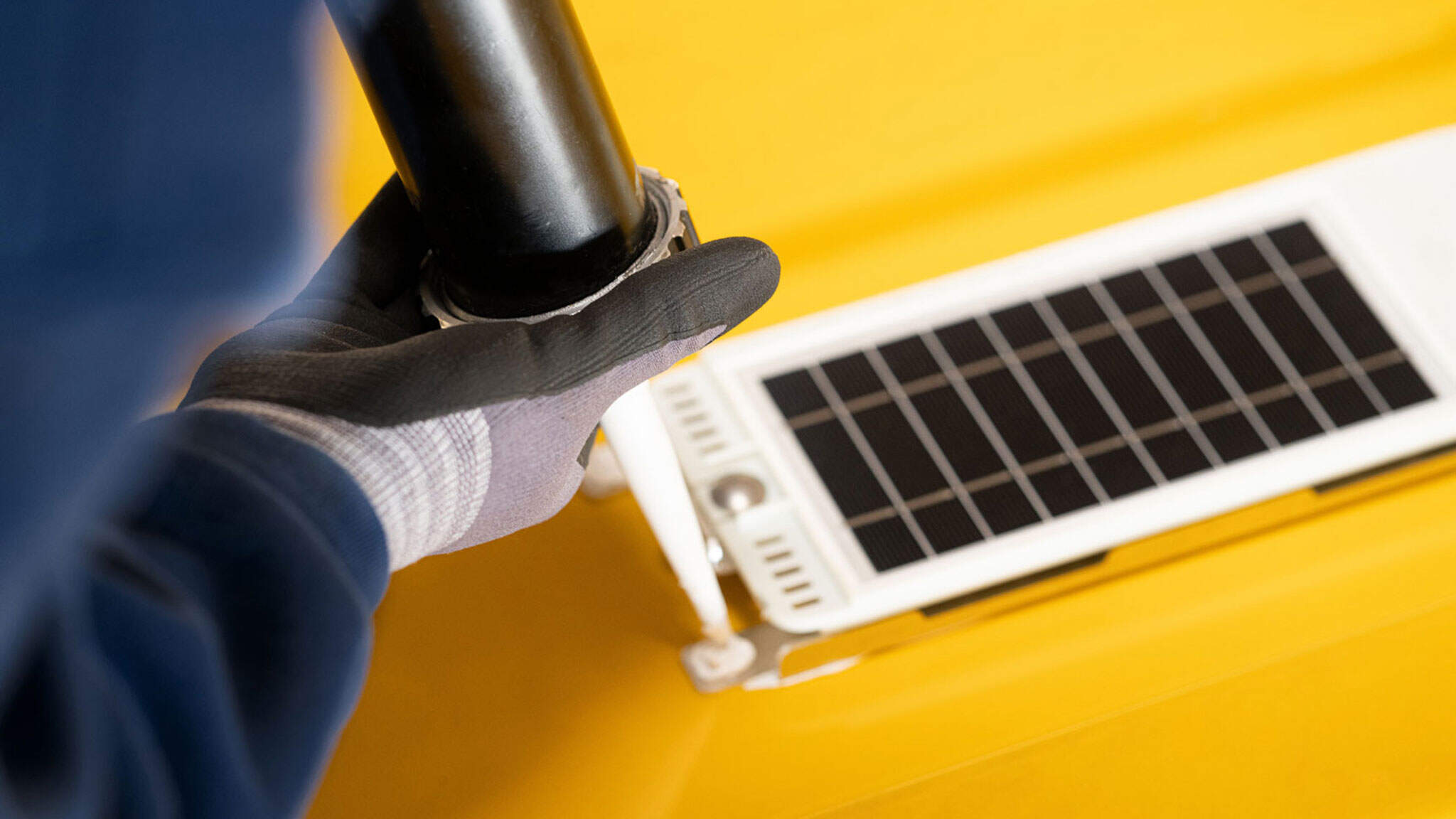
Newly developed telematics systems improve the quality and efficiency of groupage logistics. Photo: DACHSER/Matthias Sienz
Technology where it is needed
Customers using the logistics operator’s services also benefit from increased supply chain transparency. Thanks to access to real-time information, users gain more precise data on exactly when their goods will arrive. Furthermore, the centrally managed IT system allows for the monitoring of high safety and quality standards, e.g., in the case of chemical goods, in all areas.
In collaboration with Deutsche Telekom and other technology companies, DACHSER has developed innovative, intelligent tracking devices for use in swap bodies. They use high-end SIM cards from Deutsche Telekom, which consist of an energy-efficient, solar-powered battery. Particularly durable and weather-resistant, they can withstand temperatures from -40°C to +105°C, and thus operate in any climate zone where they are needed. A charging efficiency of about half a year means that even winter months or long periods with little sunlight are not a problem. Location determination is possible thanks to modern satellite positioning technology, such as GPS or Galileo, and wireless modules based on new 5G/LPWAN (LTE-M) networks. To ensure continuous reception, other wireless standards that are still in common use are also utilized. The integrated solution is designed to withstand the entire twelve-year service life of the swap body without the need for maintenance.
Transforming the idea of cost-effective and reliable swap body tracking into a real solution required a great deal of research and development work at the DACHSER Enterprise Lab. Researchers from Fraunhofer IML and logistics practitioners from DACHSER have been working together there on concrete solutions since 2017. Their goal is to turn research into innovation and launch practical pilot programs that can then be cost-effectively scaled for the entire DACHSER groupage network. In this case, the research teams identified the new LPWAN wireless technologies at an early stage. Together with Deutsche Telekom, they managed to translate research into practice and achieve concrete benefits for the logistics company, and especially for its customers. The focus was on safety and quality, because in groupage logistics – from the Strait of Gibraltar to the Arctic Circle – these are what count the most.
Source: Dachser