








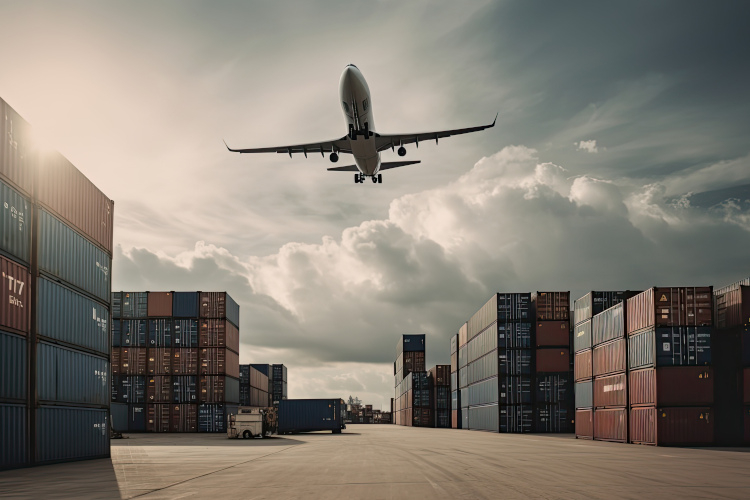
Choosing the right mode of transport is a key element of global supply chain management. If speed or high-value cargo that needs to be delivered from different corners of the world is a priority, then air transport is most often the choice. Experts from Hillebrand Gori, a global logistics operator specializing in serving the beverage industry, discuss its importance for the delivery of sensitive products, such as wines and other beverages.
From biplanes to global jet supply chains
According to the Airports Council, air cargo or air freight refers to all goods transported by air, excluding mail and passenger baggage. Cargo is carried either on board cargo aircraft (freighters) or in the holds of passenger aircraft. As a curiosity, the first commercial air cargo delivery took place in 1910, when Philip Parmalee transported about 32 kg of fabric across Ohio on board a Wright brothers’ plane.
Today, air transport is a key link in global supply chains. Forecasts indicate that the air cargo market will grow at a rate of 4% per year over the next two decades.
This is also important for the development of international wine trade. It enables importers to reach new markets inaccessible by sea, which allows for expanding the range of offered wines to include those from the most remote corners of the world.
Greater reach, time, and delivery security
Aircraft reach an average speed of about 900 km/h, which means that this transport route has the shortest delivery time compared to others. Speed and long range mean that transported cargo, including wine, can reach thousands of airports around the world in less than 24 hours. Moreover, in emergency situations, it is also easier to redirect aircraft to other routes.
Another advantage of this transport option is the high level of security. Airports, where loading and unloading of goods take place, are high-security areas with a low risk of theft and minimal handling, which reduces the risk of damage. In the case of sensitive or high-value cargo, such as wines and other spirits, appropriate handling methods and protective packaging are provided, and additional security protocols apply, including those regarding surveillance and storage. To protect against weather conditions, freight forwarders and carriers use temperature-controlled containers or thermal foils applied to pallets. These must comply with IATA Temperature Control Regulations (TCR) and guarantee quality preservation.
Payload is no longer a limitation
For importers, aircraft payload is important. Although it may seem lower compared to sea transport, it also allows for the organization of large shipments. Precise planning and execution of transport are essential. A good example is the express delivery of 160 tons of wine and other spirits from Le Havre and Cognac (France) to New York (USA), organized by Hillebrand Gori. The biggest challenge was not only the short delivery time – just one week from receiving the client’s request to completion – but also the weight of the cargo itself. The solution was to organize two dedicated round-trip flights using a chartered Airbus A340-300 aircraft. Additionally, because the entire cargo did not fit on board, part of it was transported in the baggage holds of four scheduled United Airlines flights.
Air transport and the environment
Air transport is not optimal in terms of ecology, but the industry is still taking new initiatives to reduce its environmental impact. Airlines and IATA are working on solutions aimed at reducing CO2 emissions by 1.8 gigatons and achieving net-zero CO2 emissions by 2050. Freight forwarding companies are also joining these efforts. For example, DHL, of which Hillebrand Gori is a part, has introduced the GoGreen Plus service for air transport. It provides the opportunity to reduce or offset CO2 emissions through the use of sustainable aviation fuel (SAF).
Choosing a partner is important
As Hillebrand Gori experts emphasize, air transport can be a very good solution for transporting high-value, perishable wines or those requiring fast delivery. And it is worth emphasizing, in any quantity, from a single bottle to a full air freight load. What you should pay attention to is choosing a freight forwarding company with experience in air freight, supported by a network of branches around the world, located in all countries and regions where wine is produced. It is important that it cooperates with proven carriers and has the necessary IATA permits and certificates. For organizing international deliveries, knowledge of customs regulations is essential, which ensures timely shipment clearance, as well as the ability to manage transport and warehouse processes in real time. Importers should also pay attention to cargo insurance in case of damage or potential delivery delays.
Source: Hillebrand Gori