









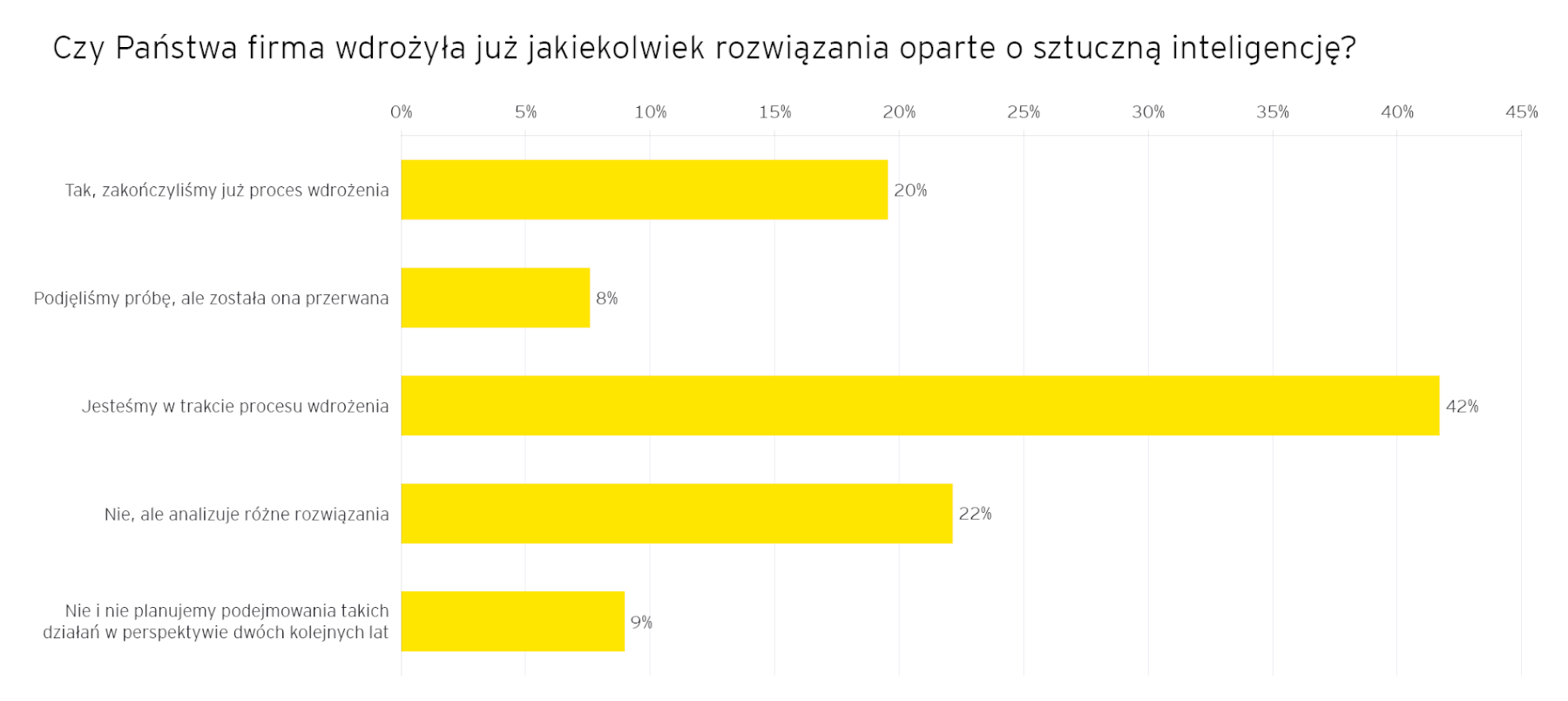
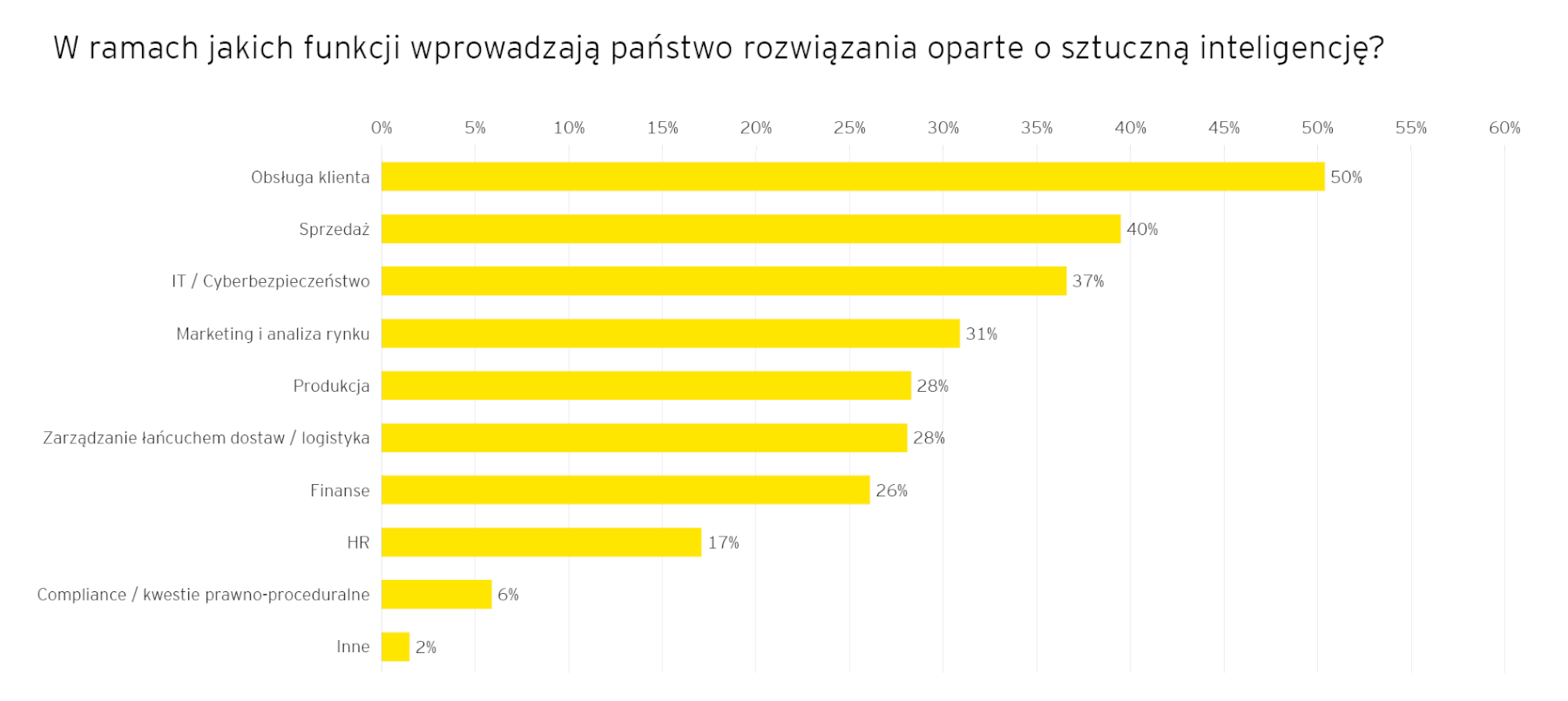
The EY survey results – How Polish companies are implementing AI – show that domestic enterprises are very open to introducing tools based on artificial intelligence. 20% of organizations have already completed this process, and another 42% are in the process of doing so. Companies are primarily focusing on solutions in the areas of customer service (50%), sales (40%), and IT (37%). The models are based on customer data (54%), transactional data (53%), and text data (46%). Over the next 18 months, a significant increase in spending on AI-based tools is expected in 18% of organizations, and a slight increase in 41%. Crucially, companies that have completed the implementation process are twice as likely to declare an increase in their spending.
The results of the EY survey – How Polish companies are implementing AI – indicate that the transformation of domestic organizations towards artificial intelligence is gaining momentum. 20% of organizations have already completed this process, and 42% are in the process of doing so. Among companies that have gone through the entire implementation procedure, as many as 80% confirmed that they had achieved their intended benefits, and in 2/3 of cases, the entire process involved the need for a broader transformation. Enterprises that abandoned the attempt to implement AI solutions (8% of respondents) point primarily to technological difficulties (42%) and high costs (37%).
– Polish companies have embraced the development of AI-based tools with great optimism, recognizing that efficient adoption enables faster building of a competitive advantage. As the survey commissioned by EY shows, the openness of management boards goes hand in hand with prudence. This is due to the fact that the implementation of AI solutions is a complex undertaking, and the entire implementation process affects many functions within the organization. That is why it is so important to clearly define the goal that the introduced solution is to serve and the expected benefits of the implementation – says Jacek Kędzior, Managing Partner at EY Poland.
Priorities in AI implementation
The main motivator for implementing artificial intelligence solutions for companies in Poland is the improvement/automation of internal processes (40%) and the ability to better reach customers (34%). The least frequently indicated factors were concerns about decreasing talent availability (3%) and competitor actions (7%). Given these business priorities, it is not surprising that AI solutions are primarily implemented within functions focused on customer service (50%), sales (40%), and IT (37%). The HR area (17%) ranked relatively low on the list, which may indicate that in this field, organizational leaders still place their trust in actions performed directly by humans rather than algorithms. The list is closed by legal and procedural issues (6%), which, despite obvious automation benefits, were rarely mentioned among the priorities.
The effectiveness of artificial intelligence tools largely depends on the quality of the data provided. To build AI solutions, companies in Poland primarily use customer data (without personal identifiers) – 54%. Further down the list, though still in the top tier, were transactional data (53%) and text data (46%). Audio (15%) and video (18%) data received the fewest indications. This clearly indicates that for the moment, organizations are basing their efforts on their basic business data contained in numbers and documents. However, it can be expected that over time, companies will increasingly open up to supplementing AI solutions with other types of data.
The process of implementing AI-based tools itself is primarily based on one of three schemes: implementation entirely by an external company (32%), by an internal department in cooperation with external suppliers (29%), and based solely on internal resources (26%). Such a closely distributed range of options indicates that enterprises in Poland are still at the testing stage. They are verifying various solutions in order to choose the one best suited to their own capabilities in the future. However, the survey results indicate that as they gain experience, companies are more willing to seek the support of external experts who possess broader expertise.
– In terms of artificial intelligence, companies in Poland are at the beginning of a technological journey. They approach these solutions with great openness, but also with a pragmatism that forces a certain caution. This translates into gradual experimentation and adaptation in selected areas of the company’s operations. In the coming months, we should expect a dynamic development of the process of introducing artificial intelligence solutions into companies, especially among organizations that have their first experiences behind them. Once the foundations are shaped, many enterprises, seeing the real benefits of the changes introduced, will want to take the next step – says Ewa Nowakowska, Partner in the Technology Consulting team, EY Poland.
Further growth in investment
The results of the EY survey – How Polish companies are implementing AI – leave no illusions: budgets will grow. As many as 63% of companies in Poland plan to increase their spending on AI-based tools in the next 18 months. 22% of surveyed companies will do so to a significant extent, and 41% to a slight extent. In 23% of cases, spending will remain at an unchanged level. 3% of organizations plan to reduce their AI budget significantly or slightly, and 12% of companies have not yet specified their exact plans. Importantly, in the case of companies that have already completed the implementation process, the propensity to significantly increase investment is twice as high as in the case of enterprises in general. This is a clear signal that as they achieve their first business goals with the support of AI tools, companies are more willing to increase their budgets.
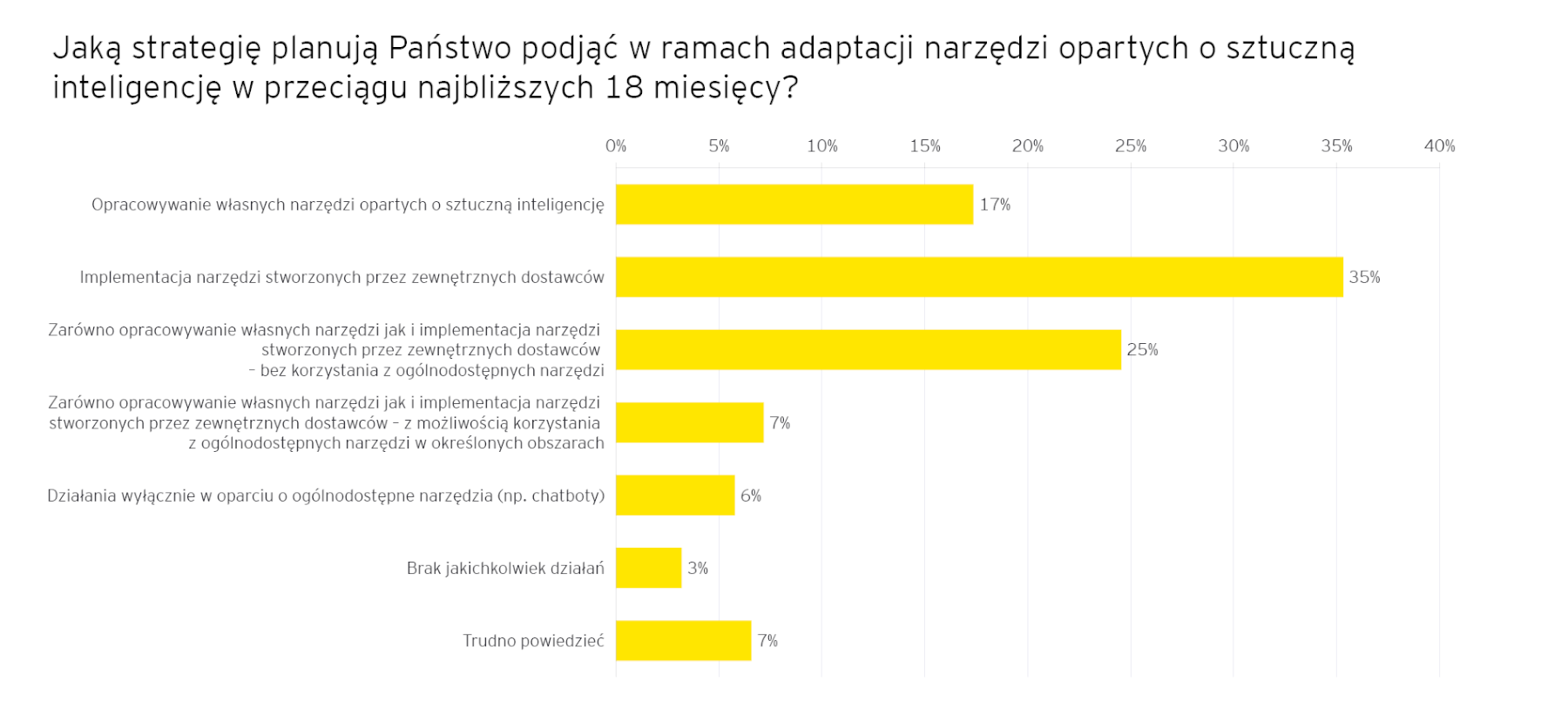
However, what is particularly important is that Polish enterprises are increasingly recognizing the need to develop tools tailored to the individual needs of a given organization. Only 6% of companies plan to rely solely on publicly available tools, and another 7% will enable their use even while developing their own technologies. For comparison, 35% intend to implement tools created by external suppliers, and 17% to develop them in-house. 25% of organizations will use a combination of both options – but without the possibility of using publicly available tools.
– Companies in Poland realize that using artificial intelligence tools can increase their efficiency. After an initial period of testing publicly available solutions, entrepreneurs are beginning to see the need for individualization, particularly in terms of using their own data. At the same time, those managing IT or innovation areas in organizations are aware that sharing data by employees carries serious risks. Therefore, companies will increasingly decide on dedicated tools, adapt them to their needs and requirements, and restrict access exclusively to their own organization’s area. A shift in this direction will entail the need for further investment – concludes Ewa Nowakowska.
About the survey
The survey – How Polish companies are implementing AI – was commissioned by EY Poland and conducted by Cube Research between August and September 2023 on a sample of 501 large and medium-sized enterprises operating in the manufacturing, service, and trade sectors.
Source: EY