









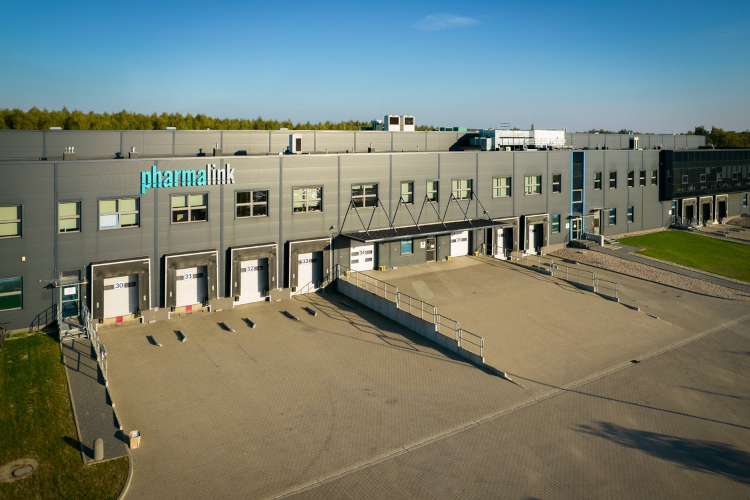
Logistics companies play a key role in ensuring the safety and timeliness of medicinal product deliveries; therefore, an uninterrupted supply chain is essential for ensuring the quality and availability of medicines and other medical devices. Consequently, logistics operators providing services for the pharmaceutical industry must comply with numerous procedures related to the storage and transport of such products, the most important of which include controlling all stages of this complex process and operating in accordance with pharmaceutical law regulations and provisions.
Control at every stage of the logistics process
Aspects related to safety, delivery timeliness, and the quality of medicinal products are common concerns for clients. After all, medicines and medical devices are products that save health and often the lives of patients. Therefore, ensuring that they reach a given medical facility in perfect condition and on time is a significant issue for those responsible for managing such products in pharmacies, hospitals, veterinary offices, or beauty clinics. By outsourcing logistics services to a company that possesses the know-how, experience, a perfectly developed storage and transport infrastructure, and trained personnel, one can be sure that the continuity of the supply chain will be maintained. In turn, medicinal products will reach the end recipient in full value, completely safe, of the highest quality, and importantly – on time.
– The logistics operator’s responsibility for medicinal products begins the moment the driver picks up the shipment from the client. Depending on the temperature range declared by the sender, the driver loads the shipment into the appropriate cargo space with conditions prepared for transport. It is at this and every subsequent stage of transport that drivers must be ready to confirm that the vehicle meets the appropriate conditions required by the specification of the given products included at the time of generating the waybill. Next, the shipment goes to the central transshipment chamber, where it is distributed to various routes across Poland. Once the package reaches the chamber, responsibility for the goods passes from the driver to Pharmalink employees. There, the shipment is sorted and placed in a location that meets its requirements. Once all goods have been sorted, the next stage is loading and sealing the vehicle that will deliver the medicinal products to the chamber responsible for distribution in a given region of Poland. Additionally, before setting off on the route, employees verify that all shipments dedicated to a given direction have been loaded and scanned – explains Piotr Gawle, Deputy Logistics Director at Pharmalink.
For pharmaceutical companies, it is also extremely important whether the logistics operator acts in accordance with regulations, pharmaceutical law provisions, and Good Distribution Practices (GDP). This testifies to safety, but also to maintaining the highest quality of shipments containing medicines and medical devices, which is of paramount importance in the case of such products.
Timeliness is the foundation
A logistics operator providing services for the pharmaceutical industry should be reliable and deliver medicinal products always on time. This is the foundation of its business.
– In the case of transporting medicines and medical devices, timeliness is crucial. Pharmalink can boast an OTiF indicator for on-time delivery of shipments at a level of 99.6%. We are proud of such a result, but we also realize how much work and heart the entire team puts in every day to ensure that all logistics processes are carried out in accordance with procedures, safely, and on time. As Pharmalink, we have a Central Transshipment Chamber (CKP) in Łódź and a system of seven cross-docks across the country, which additionally contributes to the fact that the effective implementation of logistics processes within 24 hours and in “cito” mode up to 6 hours is possible for us – adds the Pharmalink expert.
The perfectly developed storage and transport infrastructure remains significant. Equipping warehouse facilities and vehicles with appropriate devices and modern technologies, enabling the control of temperature and humidity, allows for providing medicinal products with the conditions required by their specifications. The logistics operator’s vehicles should additionally be equipped with a vehicle alarm system and GPS monitoring, enabling effective tracking of transport. It is best if medicinal products are transported in an active supply chain in dual-chamber vehicles, as offered, for example, by Pharmalink. This translates into even greater safety for such shipments. It is worth adding that at any stage of the process, there may be a need to hold, withdraw, or redirect a shipment depending on the client’s needs. Situations such as vehicle breakdown or adverse weather conditions preventing operations according to plan are also possible.
– In the pharma-logistics industry, it is important to be prepared for various emergency situations and to have the ability to manage risk. Thanks to the development of action plans in case of undesirable situations and training employees on them, one can perfectly cope in all conditions and, despite random events, deliver the shipment safely and on time to the medical facility – adds the Pharmalink expert.
Taking into account the advanced technologies used in the transport and storage of medicines, the great responsibility for the entrusted goods, which often save human life, and the specialized knowledge in the field of pharmacy possessed by the logistics operator’s employees, it is not surprising that such a logistics service may be more expensive than a standard courier. This is typical for most specialized industries. However, the pharmaceutical market is already mature enough that manufacturers know well that it is worth paying more for specialized logistics services, but having the certainty that medicines and medical devices are under the best care of an operator in this regard. Thanks to this, they reach recipients in an intact condition.
Modern logistics companies increasingly offer integrated solutions that include both transport and storage of medicinal products. This allows for the optimization of the entire logistics process while maintaining the continuity of the supply chain.
In summary, the most important issues related to supply chain continuity according to Pharmalink are:
- Appropriate conditions for medicinal products.
- Perfectly developed storage and transport infrastructure, including a modern fleet of vehicles adapted to the requirements of the transported medicinal products.
- Ongoing supervision of goods.
- Timeliness of deliveries.
- Cost of services proportional to the responsibility for the goods and the quality of services provided.
Source: Pharmalink