








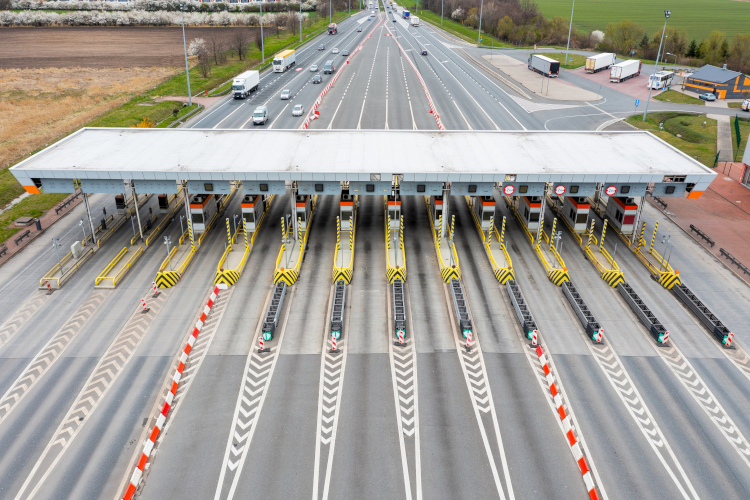
The toll system for heavy goods vehicles using roads and motorways in the European Union is changing. The rates will no longer be determined solely by infrastructure maintenance costs and the country’s economic situation, but also by environmental issues, the drive for decarbonization, and the use of eco-friendly technologies and alternative fuels. Germany is introducing new road tolls on December 1, and the proposed increases could raise carrier costs by as much as 80%. Girteka, the largest European road carrier based on the digitalization of services, explains how this will affect the operations of transport companies and the entire industry.
The road to eco-friendly transport
Let us recall that road tolls in the EU were introduced by the 1999 Eurovignette Directive (1999/62/EC). Their collection system was based on two principles: vignettes, i.e., a fixed amount allowing the use of roads for a specific period, and section-based tolls dependent on the distance traveled. In 2011, amendments to Directive 1999/62/EC were adopted, according to which road and motorway tolls should reflect the environmental impact of road transport. Toll rates were adjusted to pollution levels to encourage companies to use eco-friendly alternatives and shift cargo flows to rail and waterways.
Further changes were enacted this year. Directive 2022/362, which entered into force on March 24, 2023, introduced a gradual change to the road toll model, basing it on distance and CO2 emissions. By 2024, road toll rates must be differentiated according to the CO2 emission class of vehicles in EU countries. Furthermore, all heavy goods vehicles with a gross vehicle weight (GVW) exceeding 3.5 tons will also be subject to road tolls (currently, Germany, Denmark, Sweden, and Luxembourg exempt some or all heavy goods vehicles with trailers with a GVW of 3.5 to 12 tons). Finally, as of March 25, 2030, vignettes are to be phased out across the entire Trans-European Transport Network (TEN-T), except in justified situations.
– Changes to the road toll system will not remain without impact on the costs of conducting transport operations. Encouraging the use of more eco-friendly trucks while discouraging the use of less efficient vehicles will affect the total cost of vehicle ownership, as well as decisions related to fleet procurement – explains Mindaugas Pasilauskas, CEO of Girteka Europe West.
Record increases in Germany starting December 1
Germany is the first to introduce road toll increases according to the new rules. The rates they propose could increase transport operating costs by as much as 80%. On January 1, 2023, the German government presented a draft amendment to the Federal Road Toll Act, differentiating toll rates based on vehicle weight and the number of axles. Greater emphasis was placed on costs related to air pollution and noise. The increase in road tolls will therefore be particularly severe for Euro 5 vehicles and older. An additional partial rate for CO2 emissions will come into effect on December 1, 2023.
As of December 1, 2023, Germany also intends to add a CO2 emission surcharge of 200 euros per ton of CO2 emissions to road tolls for heavy goods vehicles, including extending it to vehicles with a gross vehicle weight exceeding 3.5 tons from July 1, 2024. Currently, heavy goods vehicles that emit high levels of CO2 are subject to higher road tolls if they weigh more than 7.5 tons. The amount of the new road tolls in Germany will depend on one of five vehicle classes (classified for six years from the date of first registration):
- Class 1: highest CO2 emissions and correspondingly the highest possible surcharge. Initially, all vehicles are automatically classified in this class, which can be changed at the vehicle owner’s request (for vehicles with a registration date of July 1, 2019, or later).
- Classes 2 and 3: assigned after entering the relevant vehicle data into the Toll Collect portal (if a Toll Collect On-Board Unit – OBU is used), according to the vehicle’s specific CO2 emission levels.
- Class 4: applies to low-emission heavy goods vehicles, such as those powered by natural gas (NGV).
- Class 5: applies exclusively to zero-emission heavy goods vehicles, in particular battery-electric or hydrogen-powered vehicles. They are completely exempt from road tolls until December 31, 2025, after which they will be subject to 25% of the road toll rate for infrastructure costs.
How does this look in practice? Currently, the road toll rate in Germany is 0.19 euros/kilometer. Under the new system, the fee will almost double to 0.34 euros. This means an increase of 0.15 euros per kilometer for vehicles with a GVW over 18 tons, 5-axle and larger. The German Ministry of Transport estimates that the changes in road tolls will generate additional revenue of 7.62 billion euros annually.
– In the near future, one must count on greater pressure for road toll increases. The pressure to decarbonize transport is enormous, and we will not escape it. Achieving CO2 emission reduction targets is becoming a priority, regardless of company size. Every enterprise will have to include costs related to environmental protection in its operations. For transport companies, this means a change in approach. Because the use of digitalization and an appropriate fleet development strategy will play a key role in competitiveness in this already very demanding market – emphasizes Mindaugas Pasilauskas, Girteka Europe West.
Girteka as a leader in low-emission transport investments
Girteka has long been increasing investments in the development of a modern fleet, service digitalization, and eco-friendly solutions. Currently, its fleet numbers over 8,000 trucks, all of which are EURO 6 standard with an average age of 2 years. Last year, Girteka signed an agreement with Scania for the delivery of 600 electric trucks. Girteka is also implementing telematics systems and artificial intelligence (AI)-based tools, such as AI Planner, which support the planning of international routes while considering opportunities to reduce exhaust emissions and minimize empty runs.
Girteka’s eco-friendly solutions also include intermodal services, using rail transport as an alternative to full-truckload road deliveries and connecting it with an extensive and dense network of road transport routes.
Source: Girteka