









According to data from the end of August 2023, a total of 48,533 passenger and commercial battery electric vehicles (BEVs) were registered in Poland. In the first eight months of this year, their number increased by 15,137 units, i.e., 67% more than in the same period of 2022, according to the Electromobility Meter launched by PZPM and PSPA.
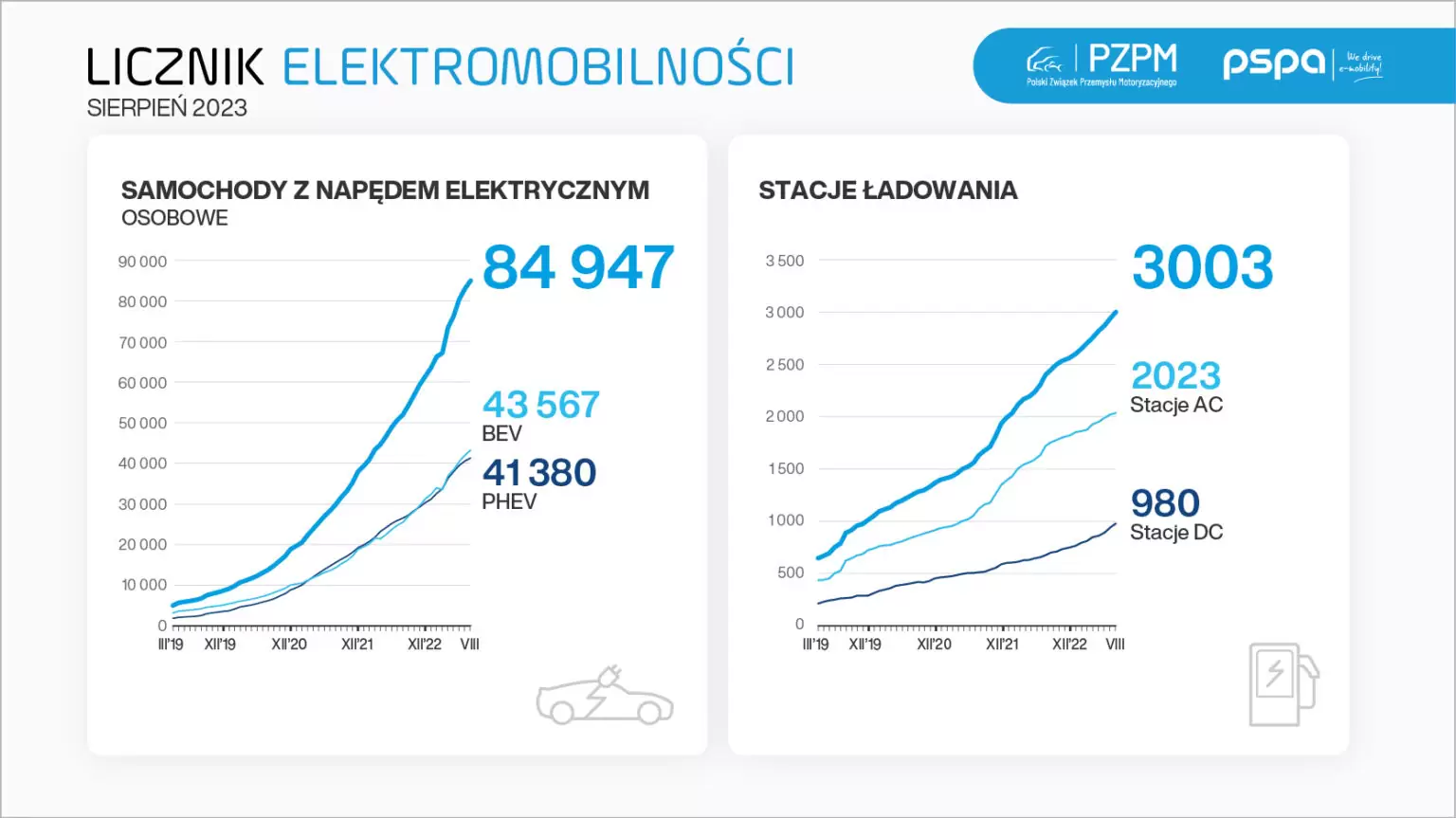
At the end of August 2023, there were 84,947 electric passenger cars on Polish roads. The fleet of fully electric passenger cars (BEVs) numbered 43,567 units, and the fleet of plug-in hybrids (PHEVs) amounted to 41,380 units. The number of electric delivery and heavy-duty vehicles was 5,010, of which BEVs accounted for over 99%. The fleet of electric mopeds and motorcycles is also constantly growing, consisting of 18,506 units at the end of August, as is the number of hybrid passenger and delivery vehicles, which increased to 600,742 units. By the end of last month, the electric bus fleet in Poland had grown to 984 units.
Parallel to the fleet of electric vehicles, charging infrastructure is also developing. At the end of August 2023, there were 3,003 publicly accessible electric vehicle charging stations (6,006 points) in Poland. 33% of them were fast DC charging stations, and 67% were slow AC chargers with a power of 22 kW or less. In August, 50 new public charging stations (122 points) were launched.
– Usually, round numbers are a reason to celebrate, so we are happy because the latest data gives us such an opportunity. Soon, 50,000 of all types of battery-powered cars will be driving on Polish roads – including 5,000 delivery and heavy-duty vehicles, 1,000 buses, 200 hydrogen vehicles, 600,000 hybrids, as well as 18,500 motorcycles and mopeds. Added to this are 3,000 stations with 6,000 public charging points. Of course, compared to such developed countries as France or Germany, we still have a lot to do, but the growth dynamics clearly show that low- and zero-emission is the direction in which the Polish automotive industry will head. However, we must do everything today to ensure that this trend does not lead to a two-speed Europe, in which Poland remains in the group of countries developing more slowly in this area – says Jakub Faryś, President of PZPM.
– In the 15 cities with the highest number of public charging stations, there are almost half (1,337) of all such devices in Poland. In Warsaw alone, there are more stations than in the Świętokrzyskie, Lubelskie, Lubuskie, Podlaskie, and Podkarpackie provinces combined. Instruments that help reduce disparities between individual regions of Poland in terms of expanding charging infrastructure will be one of the topics we will discuss among key stakeholders (including representatives of public and local government administration, DSOs, and leading operators) during the New Mobility Congress starting today – says Maciej Mazur, Managing Director of PSPA.