








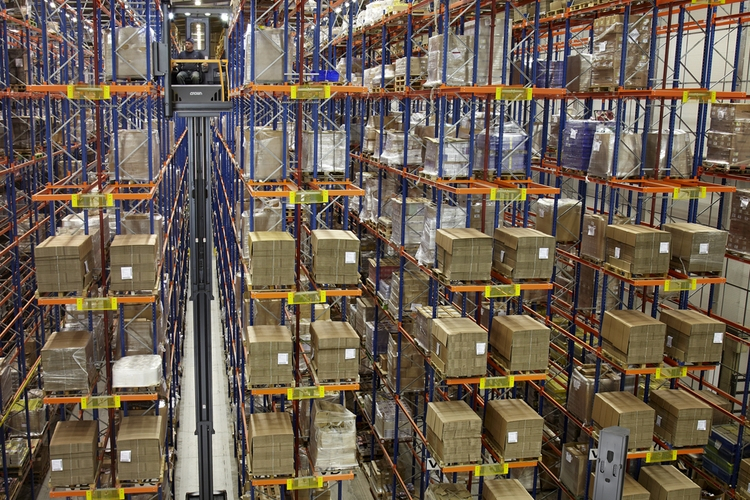
In times when e-commerce is booming and warehouse space is worth its weight in gold, logistics facilities are striving to increase efficiency and maximize space utilization. In a standard high-bay warehouse, reach trucks are typically used. However, at a certain stage of intralogistics development, such a technological solution ceases to be sufficient to achieve the set goals. Warehouse automation can be a solution, but it imposes certain limitations on process flexibility. And this is where the VNA (Very Narrow Aisle) system truck comes in.Reach truck type high-bay forklifts.
The first reach trucks appeared in the 1950s. This equipment, commonly used today, has evolved over time – performance parameters have been successively increased and operational safety improved. A modern Crown ESR reach truck can handle loads at a maximum height of 13.6 meters, and the built-in Gena IoT system provides management with the ability to monitor the machine’s technical condition or how it is being operated.
VNA system forklifts
System trucks have established their position on the market, and in times of shifting priorities, where more and more companies are carefully looking at operating costs, they represent serious competition for standard reach trucks. This is a relatively modern solution – the first VNA implementations in Poland date back to around 2010. Currently, more and more companies are opting for system trucks – especially those planning the construction of a new warehouse.
What is a VNA system truck? A VNA truck is a type of specialized forklift designed to work in Very Narrow Aisles. During operation, the operator is lifted along with the load to the height of the pallet location. The forks on a system truck rotate 180 degrees, eliminating the need to maneuver the vehicle in the working aisle.
Individual suppliers provide the possibility of semi-automating the storage process using VNA trucks. The Crown TSP system truck offered by WDX is equipped with an APS system, which can be integrated with a Warehouse Management System (WMS) to automate individual sequences. How does this translate into warehouse operations? Tasks to be performed are assigned directly from the WMS. The operator’s role is limited to pressing a button and picking up the load from the destination. Everything that happens between pressing the button and picking up the load is performed automatically by the truck – it selects the optimal route and the lifting curve for the operator compartment. In this way, we reduce the risk of errors and increase efficiency by an additional 20%.
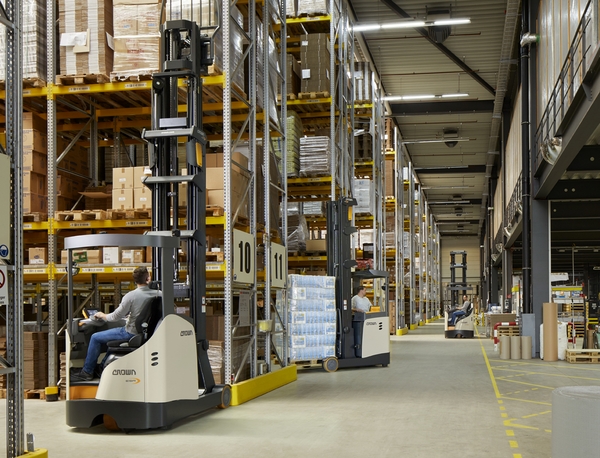
Comparison of a reach truck with a system truck – summary
The width of the working aisle is the basic parameter to consider when comparing a standard reach truck with a system truck. In the case of a reach truck, it is about 3 meters, while a VNA truck can safely operate in a 1.7-meter aisle. From the perspective of a warehouse manager, this means up to 25% more pallets in a VNA layout.
When analyzing the operation of trucks in working aisles, the level of safety in the warehouse must be taken into account. Operating a reach truck requires hiring experienced operators who will ensure efficient load handling at great heights. The training path for VNA is relatively short – the machines move along the racks following an induction loop that is “embedded” in the warehouse floor.
A system truck can handle twice as many loads per hour compared to a reach truck. From the point of view of operating costs, the size of the fleet dedicated to high-bay racking can be reduced by half.
Implementing VNA can prove problematic if we do not take this option into account when planning and designing the warehouse. A system truck is heavier than a standard reach truck and requires a floor with a specific load-bearing standard.