








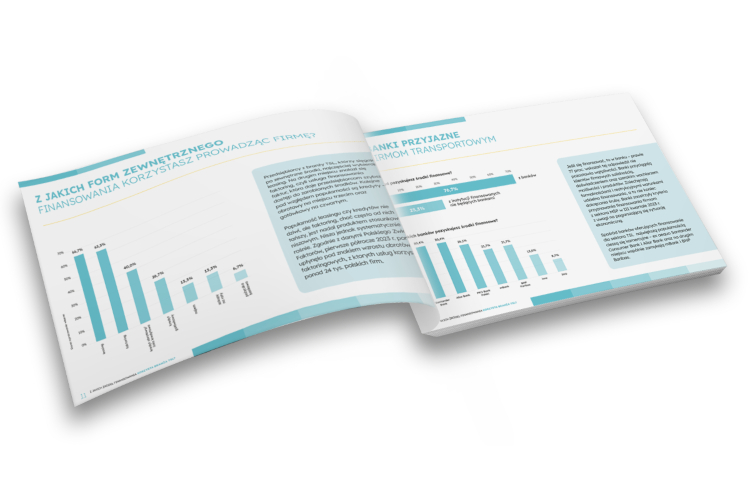
A definitive increase in operating costs over the last year was declared by 69.1% of participants in a survey conducted for the Transcash.eu report “What financing does the TSL industry choose?”. Leasing, factoring, and revolving credit are the most popular forms of external financing indicated by the respondents. Despite the market recession, nearly 55% of those surveyed admitted that they maintain operations solely with their own funds and do not reach for external financing.
The last year in the TSL industry has been marked by recession. A decline in the number of freight orders, correlated with falling rates, was accompanied by the entry into force of the Mobility Package and its economic consequences. It is estimated that the changes forced by EU law could have increased driver employment costs by as much as 20 percent. At the same time, we experienced high inflation in the EU, the effects of which were felt particularly acutely in Poland. A sharp rise in interest rates, from zero to nearly 7 percent, translated into higher costs of liabilities. The Transcash.eu report “What financing does the TSL industry choose?” examined the attitude of TSL industry representatives toward external financing during times of recession. The vast majority of them were owners of small transport companies operating on the international market.
– Since the COVID-19 pandemic, many things have happened that have strongly affected the TSL industry. High inflation has caused a drop in the number of orders, and recent information coming from China speaks of the closure of many factories, which may also hit the transport industry – says Dr. Eng. Justyna Świeboda, President of the Management Board of the Polish Institute of Road Transport, in a commentary to the Transcash.eu report – The China Report cites a figure of 460,000 businesses closing quarterly across China. This all has a huge impact on the situation in Europe, which imports a lot of goods from the Middle Kingdom that require further transport once on the continent. A reduction in purchases could therefore also hit the TSL industry.
Nearly half of the industry uses external financing
Despite the increase in financing costs, more than 44% of participants in the survey conducted by Transcash.eu reach for external funds to conduct business. At the same time, nearly 70% declare that the increase in costs over the last year has significantly affected their economic situation. In the opinion of our respondents, this was driven primarily by inflation, fuel prices, and rising employee wages. Only about 35% of respondents admitted that the rising costs of liabilities significantly affected the economic situation of their business.
Subsequent sections of the report analyze the respondents’ preferences related to the choice of financing. We asked, among other things, about their attitude toward the source of funds (banks vs. financial institutions) and the criteria they follow when choosing a specific offer.
– Clients from the TSL industry looking for external financing are pragmatic; the economic calculation must add up – comments Agnieszka Nosal, Director of Sales and Marketing at Transcash.eu – Most of our respondents declared that they prefer to finance themselves in banks, and when choosing an offer, they look solely at costs, which can tip the scales in favor of a financial institution. Such an attitude in times of recession is understandable for clients who must keep their budget in check.
Leasing and factoring on top
When asked about preferred financial products, respondents pointed primarily to leasing, but right behind it was factoring, i.e., the invoice financing service, to which we devote a separate chapter in the report. In our study, about 60 percent of respondents declared using it, and they are by far most willing to use factoring on an ad-hoc basis to finance individual invoices (66.7 percent of indications). Revolving credit took third place in this category.
We also asked the survey participants about how they use external funds in the context of financing specific elements of their operations, such as vehicles, wages, or administrative costs. Diversification in this regard is specific to the industry and concerns the purchase and maintenance of vehicles, which is largely based on external financing. We asked Maciej Richter, Financial Director at the LTP-Logistyka Group, for a comment on this part of the report.
– Unlike many other companies in the industry, the increased cost of leasing did not stop the process of expanding and renewing the vehicle fleet at the LTP-Logistyka Group. However, we are very strongly focused on the optimal selection of the currency on which the financing is based, and we also analyze the difference between a leasing offer prepared with a fixed and a variable interest rate – says Maciej Richter.
Regardless of economic conditions, external financing remains important for the operations of companies in the TSL industry. The Transcash.eu report “What financing does the TSL industry choose?” showed that products taking into account the specifics of the industry, such as leasing (demand for vehicles) or factoring (long payment terms), already largely influence the shape of company budgets today.
The report is available at the link.
Source: Transcash