








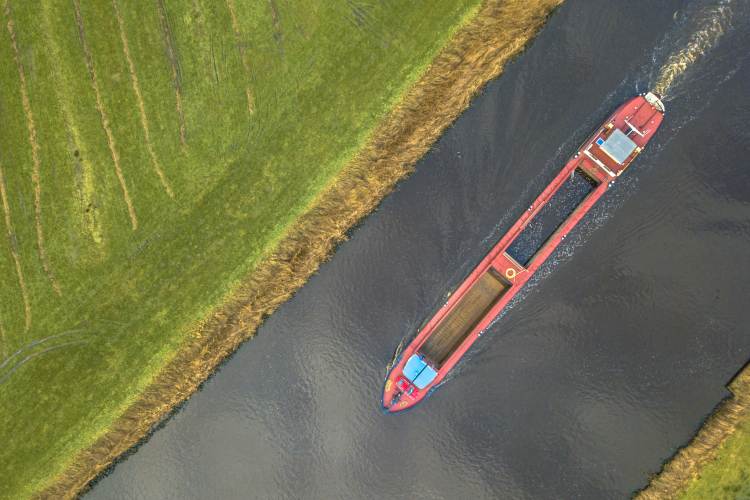
The layout and length of inland waterways in Poland have remained at a similar level for years, while the volume of cargo transported by Polish shipowners via inland navigation is decreasing. Among the factors that have a direct impact on the decline in cargo transport and transport performance in inland navigation, one should mention the insufficient development of waterways and unfavorable navigational conditions that determine the basic design parameters of the fleet, i.e., the relatively low carrying capacity of barges. This translates directly into the volume of transported cargo. Given the small scale of inland waterway transport, the volume of transported cargo measured in tons is subject to large fluctuations resulting from the nature of these transports.
Inland waterways
The main factors determining the efficiency of inland waterway transport are the navigability of waterways and the adaptation of their navigational conditions to the level appropriate for waterways of international importance.
The length of the inland waterway network in Poland in 2022 amounted to 3768 km (unchanged compared to 2021), of which 2523 km were regulated navigable rivers, 656 km were canalized river sections, 335 km were canals, and 255 km were navigable lakes. 3549 km (94.2%) of navigable waterways were operated by shipping. In 2022, 5.5% of the length of waterways (206 km) in Poland met the requirements for waterways of international importance[1] (classes IV and V). The remaining network of waterways consists of roads of regional importance (classes I, II, and III), the total length of which in 2022 amounted to 3562 km.
Inland navigation fleet
In Poland in 2022, the number of pushers and tugs constituting the towing fleet of inland navigation amounted to 124 units, i.e., the same as in the previous year. The passenger fleet numbered 116 units, i.e., 4 fewer than a year earlier. The number of self-propelled barges decreased by 9 units (to 62), while the number of non-self-propelled barges (push barges) increased by 3 units (to 177). In the type structure of the barge fleet, units used in the pushed system dominate (74.1% of the total barge fleet), which transported 943.6 thousand tons of cargo in 2022 (45.4% of the total goods transported by inland navigation). In the barge fleet group, floating units with weaker design parameters prevailed, requiring lower technical standards of water infrastructure.
A larger part of the inland navigation fleet is decapitalized and requires replacement. Its age significantly exceeds the normative period of use, and further operation is possible only thanks to constant modernization. According to data for 2022, the majority of pushers used (68.4%), more than half of push barges (53.7%), and all self-propelled barges were produced in the years 1949–1979.
Inland navigation transport
The insufficient development of navigable waterways in Poland, both in terms of character (canalized rivers, free-flowing rivers, canals) and navigational parameters (lock dimensions, depth and width of the route, bridge heights), affects the specificity of inland navigation and causes it not to play a significant role in the Polish transport system.
In 2022, 2076.4 thousand tons of cargo were transported by inland navigation, and in terms of transport performance, 445.1 million t∙km were performed. These values were lower than a year earlier by 40.1% and 9.7%, respectively. The largest annual decline in cargo transport and transport performance was recorded in the second quarter (by 46.5% and 13.7%, respectively).
In 2022, the average transport distance of 1 ton in international transport was 294.7 km (a year earlier – 259.7 km), and in domestic transport – 44.8 km (compared to 22.8 km). Compared to 2021, a decrease in cargo transport by 61.1% (to 667.7 thousand tons) and transport performance by 23.5% (to 29.9 million t∙km) was recorded in domestic transport. A decrease in cargo transport was recorded in almost all cargo groups, including the largest in the groups: wood and wood and cork products (excluding furniture), metal ores and other mining and quarrying products, hard coal and lignite, crude oil and natural gas. An increase was recorded only in the groups of machinery and equipment not elsewhere classified and coke and refined petroleum products.
In 2022, more than half of the goods transport carried out by inland navigation by Polish shipowners took place within the framework of international transport (67.8%). Compared to the previous year, a decrease in the volume of transport between foreign ports was recorded (by 16.7%), although their share in total international transport remained dominant and in 2022 amounted to 82.2% (an increase of 2.7 percentage points). Exports (by 25.5%) and imports (by 45.2%) decreased. Exports accounted for 14.4% of total international transport, and its main destination was Germany. The share of transport in this relation amounted to 81.0% of all goods exports by inland waterways.
In the structure of transported cargo in 2022, similar to previous years, goods from the group of metal ores and other mining and quarrying products; peat, uranium, and thorium dominated (29.6%).
In 2022, in tourist traffic, 116 inland navigation passenger ships transported a total of 1100.9 thousand people, and the transport performance amounted to 13548.7 thousand passenger-kilometers, i.e., more than a year earlier by 11.6% and 4.8%, respectively.
Inland transport remains one of the safest branches of transport. In 2022, 12 accidents were recorded in the shipping accident registers kept by the relevant inland navigation offices, none of which were related to the transport of dangerous goods.
The full report is available at the link.
[1] Classification of inland waterways approved by the UN Economic Commission for Europe and the ECMT in 1992.
Source of data: Statistics Poland (GUS).