








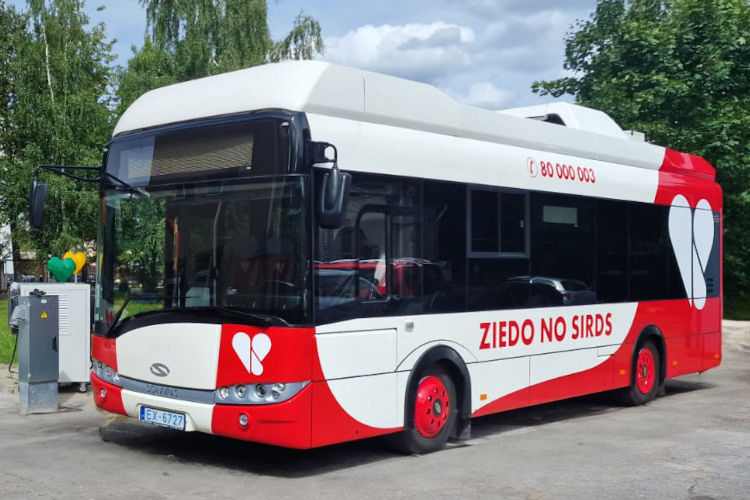
Last week, the fleet of electric vehicles in Latvia grew thanks to Solaris buses. Two Solaris Urbino 12 electric buses were delivered to the SIA “VTU” company in Valmiera. Meanwhile, the Valsts Asinsdonoru Centrs company from Riga took delivery of a Solaris Urbino 8.9 LE electric bus, which serves as a mobile blood donation station.
The two buses purchased by the “VTU” carrier from Valmiera are part of a project financed by European Union funds. The twelve-meter electric buses are equipped with Solaris High Energy batteries with a capacity of over 420 kWh. Their energy will be replenished via a plug-in connector, and in the future, also via a pantograph. Among the interesting additional solutions, the vehicles feature so-called ADAS systems, i.e., advanced driver assistance systems, such as special cameras instead of mirrors that detect blind spots and objects around the vehicle, monitoring, or the eSconnect system, which remotely collects and monitors the parameters of the bus and individual components. The electric Urbino buses delivered to Valmiera in recent days are not the first Solaris buses in this city. In 2020 and 2021, VTU purchased 10 hybrid Urbino 12 models.
The second contract completed in Latvia is the delivery of one Solaris Urbino 8.9 LE electric unit to the Valsts Asinsdonoru Centrs company. The equipment of this vehicle, which is a mobile blood donation station known from, among others, Polish blood donation and blood treatment centers in Katowice or Poznań, is extremely interesting.
While not differing on the outside from a standard city bus, the electric Solaris Urbino 8.9 LE blood donation point has been adapted to specialized medical requirements. In response to the client’s needs, Solaris equipped the bus with two mobile zones for blood donors, a doctor’s office, a reception area, and a small catering point. Additionally, the vehicle has a number of amenities, such as blinds, external awnings, and LED lighting. The air-conditioned passenger cabin, along with Wi-Fi access and conveniently located USB ports at the donor zones, ensures comfortable conditions for donors.
The electric Solaris blood donation bus has been designed to enable its operation in city centers, shopping malls, sports halls, and similar places where traditional combustion vehicles do not have access. The bus’s battery capacity, exceeding 260 kWh, enables completely emission-free operation, including heating, air conditioning, and all onboard equipment. The vehicle is equipped with a charging station. Solaris has previously delivered a similar blood donation station to the same entity. However, that one was built on a coach platform. Now, the transformation towards electromobility has also covered the fleet of mobile blood donation stations.