








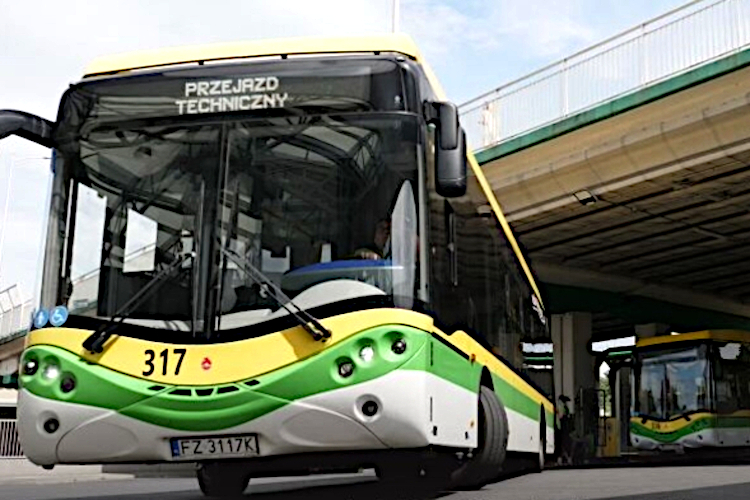
By the end of this year, more than 80 percent of buses in Zielona Góra will be powered by electricity, and further investments are already being planned. “We will be one of the few cities in Europe to rely on electric buses,” says Dariusz Lesicki, Deputy Mayor of Zielona Góra. “We are becoming a showroom for medium-sized cities,” he adds.
To implement the project “Integrated low-emission public transport system in Zielona Góra,” city authorities secured EU funding of over PLN 167 million, with PLN 38.5 million coming from the municipal budget.
– We applied to the European Union’s zero-emission project and managed to obtain 85 percent funding. With this, we replaced 80 percent of our buses, built a depot, rebuilt the passenger service center, and constructed 11 bus chargers at termini. We started with 47 buses, which we bought for about PLN 100 million, and spent another PLN 100 million on building infrastructure and upgrading existing facilities – lists Dariusz Lesicki, Deputy Mayor of Zielona Góra for Economic Affairs, in an interview with the PAP Local Government Service.
– By the end of this year, we will have over 80 percent electric buses. We will spend another 50-60 million to finish this project, and then we will be one of the few cities in Europe that will be 100 percent based on electric buses – he concludes.
As Jacek Newelski from MZK Zielona Góra points out, currently, out of 85 buses used by the municipal carrier, 55 are electric – all equipped with AED defibrillators.
– Depending on the vehicle type, the lowest range of electric buses is 50 kilometers, and the highest is over 100 km. We have over 30 fast-charging stations located throughout the city, and buses simply recharge their batteries at the termini during breaks, allowing them to complete subsequent routes. They have already covered over 12 million vehicle-kilometers, and we have been operating them for practically 5 years now – said Newelski.
He emphasizes that residents are satisfied with the investment, especially those living near main roads and bus termini, because electric buses are quiet and emission-free.
As part of the city project, the fleet management system in the Zielona Góra MZK dispatch center has also been revolutionized. This involves managing the movement of municipal vehicles, electric bus charging stations, schedules, and drivers.
– The dispatcher tracks bus movements in real-time, supervises the accuracy and history of schedule execution by the driver, but also, for example, the battery charge level. From a special map to which they have access, traffic control staff can view images from bus cameras in real-time – this is useful, for example, in the case of any incidents – not necessarily related to public transport – also outside – said Oskar Suchodolski, Chief Specialist for Schedules, MZK Zielona Góra.
During the reconstruction, the MZK depot gained a roof, on which photovoltaic panels are to be installed to generate electricity for the electric buses.
– An element that we are assuming and which we are already partially implementing is energy independence, meaning we want the Municipal Transport Company in Zielona Góra to also be a producer of electricity from renewable energy sources. This energy will be stored so that in 3-4 years we can say that our transport does not pollute the environment – explained Deputy Mayor Lesicki.
– We are becoming a showroom for medium-sized cities because we can show that practically the entire functioning public transport system is based on electric buses. These are not just single lines, but the entire system; we have had this well mastered for several years now, and many cities from Poland and Europe come to see what it looks like from the inside – he added.
Zielona Góra is another local government we visited as part of the “Cohesion Policy in the Regions” project. As part of the series of video reports on EU funds, we will show twenty places that have changed thanks to cohesion policy and funding from the European Union.
Zielona Góra obtained funding for low-emission transport from the Cohesion Fund under the Infrastructure and Environment Operational Program 2014–2020.
Source of information: PAP Local Government Service/PAP Mediaroom