








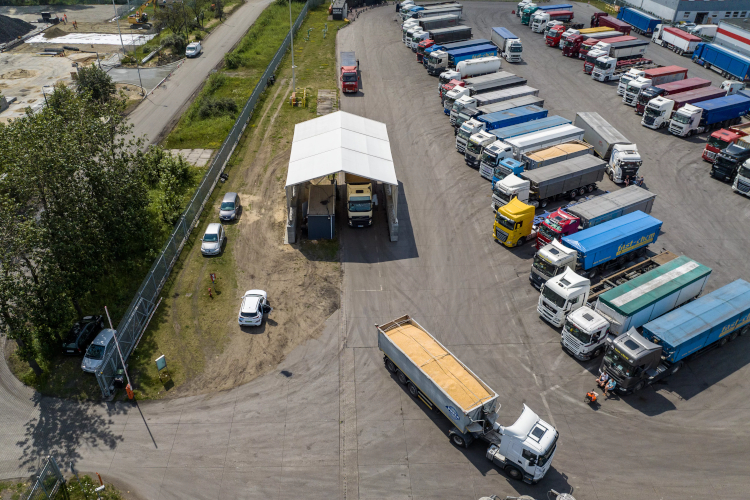
The Port of Gdańsk is successively commissioning new parking spaces for trucks. In total, there are already 850 so-called drop-off points in the Port of Gdańsk area. And there will be even more. Rakorafs, which are devices for sampling grain, are located at four parking areas (at Budowniczych Portu Północnego, Ku Ujściu, Śnieżna, and Załogowa streets). To ensure that grain testing can also take place during rainfall, ZMPG S.A. has erected lightweight tent halls. Samples are collected 24 hours a day.
During the first half of this year, nearly 1.4 million tons of grain (especially corn) were exported through the Port of Gdańsk, which represents a 52 percent increase compared to the same period last year.
Due to the increased needs related to grain transport to the port, new J.S. Hamilton rakorafs have been placed at two additional points. Truck drivers can drive to the buffer yards at Ku Ujściu and Budowniczych Portu Północnego streets to have grain quality tests performed. Employees from the J.S. Hamilton laboratory are waiting for them there.
In total, grain samples are collected at four locations within the Port of Gdańsk – the truck parking areas at Budowniczych Portu Północnego, Ku Ujściu, Śnieżna, and Załogowa streets. This is a response to the increased demand among grain exporters.
– Operators are able to handle more trucks because the queues of waiting drivers have been reduced – explains Łukasz Malinowski, President of the Port of Gdańsk.
The Port of Gdańsk is the only port that has roofed rakorafs. Thanks to this, grain testing can take place in adverse weather conditions.
How does a rakoraf work? The device is used for the automatic sampling of grain from open truck trailers. A probe is inserted into the cargo, the sample is forced into an internal chamber, where it is transported by an air stream through a flexible hose to a container. Subsequently, the samples are transported to the laboratory. Material for testing can be collected from any place and depth of the trailer, which additionally ensures greater precision of the results.