








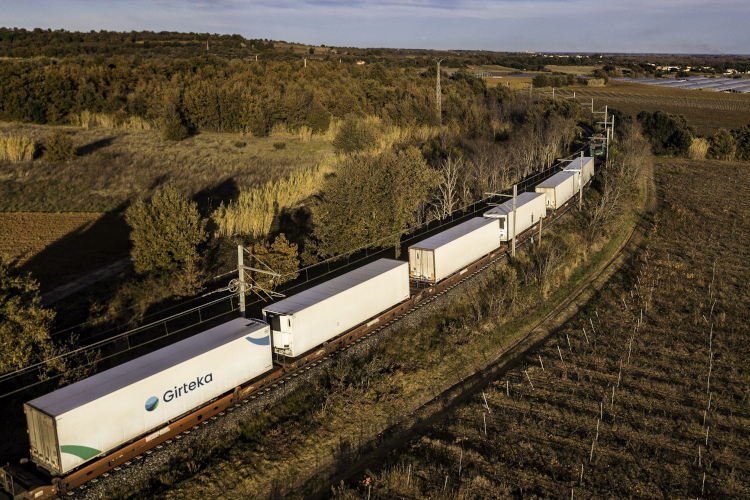
Girteka, a leading European road freight carrier, is strengthening its offer and developing intermodal services as a sustainable alternative to Full Truck Load (FTL) deliveries. Girteka, already the largest carrier of refrigerated containers, forecasts a 40% increase in intermodal transport capacity and announces further investments in this service segment.
Why intermodal services?
Intermodal transport using rail is one of the most environmentally friendly ways to move cargo over long distances. It is estimated that without reloading goods when changing from road to rail, transporting goods by electric-powered trains can save up to 90% of CO2 emissions.
In a situation where the use of electric and hydrogen-powered trucks is not yet widespread, the use of the rail network is an excellent solution that can support the road transport sector in reducing emissions. This is why Girteka continues to invest in rail transport as part of its commitment to sustainability, which is an integral part of its long-term strategy.
In 2021, by transporting over 16,100 trailers by rail and covering a distance of over 15.2 million km in the EU, Girteka saved over 14.4 million kg of CO2 emissions. In 2022, savings increased by 16% to over 16.7 million kg of CO2 over a distance of 16 million km.
The importance of intermodal transport is growing along with the implementation of EU climate goals and the introduction of new ESG reporting rules, which will force companies to look for new sustainable development options.
– More and more customers are turning to us asking about our intermodal network and our ability to organize this type of delivery. We deliberately choose routes with fast transit times that are the most optimal and reliable. Moving cargo in an environmentally friendly way is important to us, our customers, and our community – says Larisa Senkevičienė, Project Manager at Girteka Europe West, a company of the Girteka Group.
Girteka has been developing intermodal services for 6 years
Girteka established a dedicated service department and began its first intermodal deliveries in 2017. Currently, within the Group, it has an extensive network of rail connections in Western Europe, which includes 5 main routes, including Luxembourg-France-Poland and Germany-Italy-Austria. Approximately 550 FTL units are transported on the tracks weekly.
– Our main goal is to increase transport on the lines we use, as they cover the most important markets for us, Spain and Italy. We have made a strategic decision to develop rail lines in all directions where we see the largest shipment flows. This year we plan to include Poland, which is our third key market – announces Larisa Senkevičienė.
In 2021, for the second time in a row, Girteka Europe West doubled its intermodal transport capacity. Last year, the development of services was slowed down by several factors: the war in Ukraine, geopolitical tensions, and economic uncertainty resulting from the energy crisis in Europe. Additionally, major rail lines in Europe began implementing infrastructure projects, which limited traffic on some sections. Despite this, Girteka Europe West recorded an 8% growth in transport compared to 2021.
Rail partners, including Helrom, CargoBeamer, and Lorry-Rail & VIIA Rail Motorways, play an important role in the development of Girteka’s intermodal services. Cooperation with VIIA is developing particularly dynamically. In 2017, both companies transported about 1,000 FTL loads; this year it is expected to be 13,500. Through cooperation with VIIA, Girteka Europe West has become the largest carrier of refrigerated intermodal cargo in Europe.
New rail connection from Poland important for serving the Spanish market
In 2022, out of 16,555 full-load transports carried out in the intermodal system, the vast majority – 12,000 – were delivered from/to Spain. This year, Girteka plans to increase deliveries to this market to 13,500 FTL shipments. This is to be possible thanks to the relaunch of direct transport from Spain to Poland. In January, Girteka extended the route from Le Boulou (France) through Bettembourg (Luxembourg) to Poznań. This provides exporters and importers from Poland with greater reach of rail connections and CO2 emission savings.
Further development and ambitious plans
Planning the development of intermodal transport services, Girteka is in talks with rail partners about the possibility of launching further routes. The main challenge is rail capacity, which limits the planning of new connections on routes with high demand. This year, Girteka forecasts a 40% increase in intermodal transport capacity compared to 2022. The goal the company has set for itself is to transport 20% of FTL shipments using rail transport by 2025, while ensuring high-quality service to customers looking for sustainable and reliable transport options.