









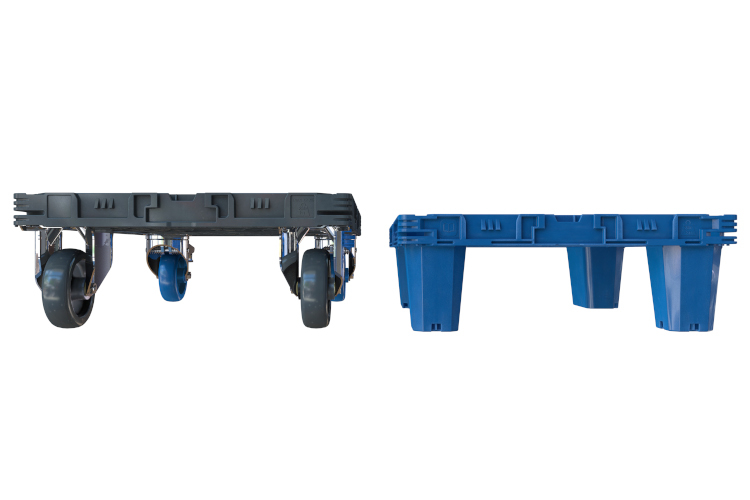
CHEP, a global leader in pallet pooling and an expert in sustainable supply chains, announces the launch of its improved Q+ display quarter pallets. This new version is the first-ever pallet made entirely from post-consumer plastic waste[1]. This is a crucial step towards a more sustainable way of promoting products at points of sale. By designing a product based on circular economy principles, CHEP has created an innovative solution that addresses the problem of plastic waste.
“CHEP’s priorities are excellent customer service, innovation, and the high quality and functionality of our products. The durability of the new Q+ display pallets has been thoroughly tested at the renowned Fraunhofer Institute in Germany and the CHEP Innovation Center in Orlando, USA. We spent two years developing and testing the new product. Many prototypes were created, culminating in the final version of the model. It represents a key stage in our journey towards regenerative supply chains, where products not only minimize their negative environmental impact but also contribute to the well-being of our planet,” says Daniel López, Director of Product Management and Innovation at CHEP Europe.
Because the scale of plastic pollution is immense, the European Commission and legislators are encouraging companies to reduce their use of single-use plastics. CHEP is taking action in this area by designing products based on eco-friendly solutions. At an early stage of production, waste that would otherwise end up in landfills is upcycled. This allows for the creation of even more valuable products that function within a circular economy, reducing waste and CO2 footprint throughout their entire service life.
The circular nature of the Q+ display quarter pallets is embedded in their DNA, as they are based on CHEP’s core values: sharing and reusing products, and they are now made from 100% post-consumer plastic waste[2] and are EUCertiPlast certified to validate the process of incorporating upcycled plastic content[3].
The quarter pallet first appeared in Germany over 30 years ago. The impulse for its creation was the need to replace single-use wooden quarter pallets. Retailers wanted to reduce wood waste, minimize their carbon footprint, and increase the efficiency of product packaging, transport, and in-store operations. CHEP, known for its expertise in circular pallets and containers, worked with retailers, FMCG manufacturers, and industry partners to develop the first reusable plastic display pallet. Since its launch in Germany in 1992, this model has been used in major European Union countries and the UK, and is now accepted by all major European retailers.
The new, improved 2023 version of the Q+ pallet is a unique product on the market made entirely from renewable raw materials. The idea of material regeneration lies at the heart of CHEP’s 2025 sustainability program, which aims to exceed the goals of the “zero strategy” (zero emissions, zero waste, zero deforestation) and expand collaboration and the circular model to more partners across all markets. Redesigning the Q+ display pallet is intended to help achieve the company’s 2025 goal: using at least 30% upcycled materials in new products, paving the way for even more ambitious targets.
The company’s eco-friendly approach regarding the Q+ is complemented by solutions such as Blue Click®, a patented system for connecting cardboard displays to the pallet. It reduces packaging time, ensures secure attachment, and minimizes the risk of product damage during the transport of displays to the store.
To date, CHEP has produced one million Q+ pallets, thereby utilizing 2,250 tons of plastic waste. The robustness and eco-friendly nature of the materials are due to the rigorous control CHEP exercises over the supply chain of the post-consumer plastics it sources.
The re-launch of the Q+ display quarter pallet means that both the wheeled version (re-launched in 2020) and the static version are leading products in CHEP’s improved product offering for the FMCG industry, as both pallets are now made from 100% post-consumer plastic waste. All of this is the result of the company’s ongoing commitment to supporting customers in displaying products at their points of sale in a more sustainable way.
[1]Descriptive term covering materials generated by end-users of products that have fulfilled their intended purpose or can no longer be used (including materials returned from the distribution chain). The term “post-use” is sometimes used as a synonym. (Source: ISO 15270:2008).
[2]The new static Q+ pallet is made of 70% upcycled polypropylene material, and the remaining 30% comes from damaged and recycled CHEP quarter pallets at the end of their service life in the retail market.
[3]Used post-consumer material, usually from household and commercial recycling programs, to create a circular-designed product of higher quality or increased functionality than its previous use.