








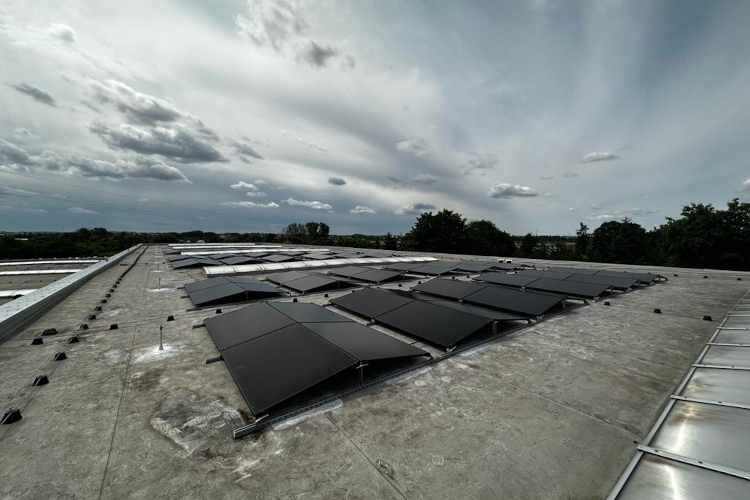
Out of concern for the natural environment, Wielton is beginning the installation of photovoltaic panels on the roofs of three production plants located in Wieluń. Additionally, to reduce electricity and natural gas consumption, the cataphoresis painting process has been modernized.
Reducing electricity consumption and producing energy from renewable sources is important not only due to government commitments to EU directives, but above all because of the dynamic development of industry, long-term and intensive exploitation of non-renewable resources, and high air pollution, which has an adverse effect on the health and quality of life of society. Searching for, testing, and introducing innovative solutions into production processes that reduce energy consumption and pollution levels has long been a daily routine at Wielton. An example of such activities is the recuperation system installed in the paint shop, which allows for heat recovery from production processes and its use for heating rooms.
Until now, Wielton’s plants used electricity and natural gas exclusively from external suppliers. In 2022, Wielton’s total electricity consumption amounted to 84,729 GJ. In 2023, in order to reduce the negative impact of production plant operations on the natural environment and increase the use of renewable energy sources, Wielton began installing photovoltaic panels on the roofs of its Wieluń plants. The completion of the first stage will take place at the end of August this year. The finalization of construction and the launch of the target installation are planned for June 2024. The implementation of the project will reduce electricity consumption by approximately 13% annually relative to the current consumption of the plants.
– We want the construction of the photovoltaic installation to cover all Wielton company plants. After signing the contract with the contractor, work began on the roofs of our plants, and in about 2 months, the first installation should be operational. If everything goes according to plan, this time next year the installation should already be producing electricity on a larger scale, generating the intended savings and reducing our carbon footprint – said Dawid Papierski, Project Manager at Wielton S.A.
Out of concern for the environment, the Wieluń-based manufacturer also modernized the cataphoresis (KTL) painting installation located at Plant No. 2. The main assumption of this initiative was to limit electricity and natural gas consumption by balancing the airflow supplied to the thermal oxidizer from the drying chamber. The process parameters, i.e., the temperature of volatile compound combustion and the drying temperature, remained unchanged. In this area, since the implementation of changes in March this year, a total of almost 35% less electricity and about 17% less natural gas have been consumed over the first 3 months.
– A few months after the modernization of the installation, its results are clearly visible in the form of generated savings. Thanks to the introduced change, in addition to reducing electricity consumption, natural gas consumption by the KTL furnace has been reduced by about 17% per month. Moreover, reduced energy consumption also means lower gas emissions into the atmosphere, which is also very important to us – said Krzysztof Lesiak, Maintenance Manager at Wielton S.A.
To ensure the best anti-corrosion protection for products, a multi-stage process is used at Wielton. Its essential point is the application of a protective coating using the phenomenon of cataphoresis. It consists of immersing the structure in eleven tanks, each of which plays its important role in giving the trailer chassis resistance to corrosion. Cataphoretic paint consists of 97-99% resin, pigment, and water. Additionally, a cycle including ultrafiltration in the last two tanks allows for the recovery of excess paint layers. In order to reduce the energy intensity of the cataphoresis painting process, frequency converters were installed in the installation for pump sets transferring liquid to the tanks with paint, UV, activation, degreasing, and phosphating. In this way, electricity consumption was limited, and the carbon footprint of the plant’s production process was also indirectly reduced. The modernization was carried out in May and June of this year. According to preliminary analyses and calculations, the installation of frequency converters will reduce electricity consumption by KTL pump sets by approximately 25%.