








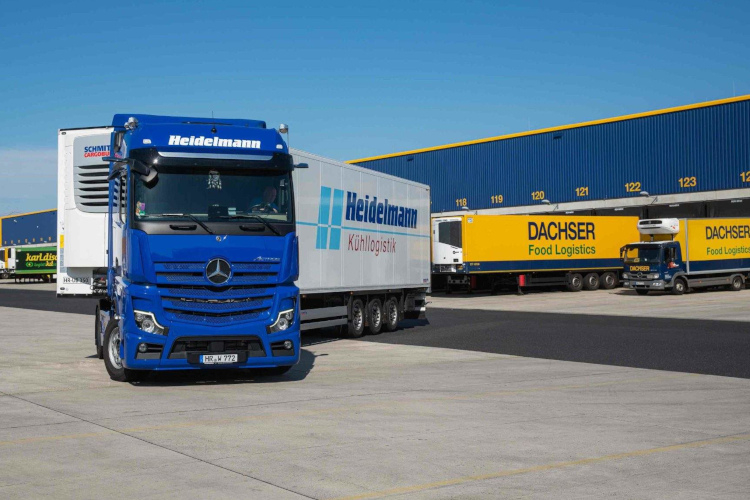
Ten years of the European Food Network – since 2013, the European partner network specializing in temperature-controlled groupage transport has been successfully developing and building a strong market position. It currently consists of 23 partners operating regular connections between 34 European countries.
For many people, food is more than just satisfying hunger. It is about pleasure and health, culture, diversity, and sustainability. Preparing regional and international dishes requires the availability of many products, and customers take it for granted that the necessary ingredients and fresh fruits and vegetables are delivered by retailers from their region, Europe, and the world.
Producers and retailers are interested in meeting more demanding consumer nutritional trends. This explains why they no longer think in national categories, as they have for decades, especially in the food industry. They expect reliable logistics services on an international scale, comprehensive service in individual countries, and uniform standards in the physical supply chain and information logistics. The overarching goal of the entire process is to ensure that food shipments in Europe are transported quickly, regularly, and with high quality, so they reach end customers with maximum freshness.
These are the very principles behind the European Food Network, a European network for the delivery of fresh food products, which is celebrating its tenth anniversary this year. In 2013, twelve established food logistics providers from across Europe, including DACHSER, joined forces to create the European Food Network. Their goal was to merge the regional know-how and strengths of successful family businesses and integrate them into a pan-European logistics network.
A network that never sleeps
The network enables dumpling producers in Germany to supply their customers in France just as reliably as their local distributors and retailers. In the same way, producers of Spanish specialties deliver products of the same quality to their partners in Austria as they do to traders in Poland. The European Food Network also provides significant efficiency gains. Under the operational leadership of DACHSER, the network uses the vivengo product line for temperature-controlled groupage transport. With fixed transit times, logistics service providers collect export shipments from their customers, pass them on to other partner companies, and simultaneously distribute their export shipments in their own region to retailers, restaurants, wholesalers, and the processing industry. The product range is large and diverse. Transported products include meat and cold cuts, dairy, wine and spirits, bakery and confectionery products, convenience products, and specialty foods and groceries.
Over the course of ten years, the European Food Network has been continuously expanded and refined. It now counts 23 member companies connecting the markets of 34 countries.
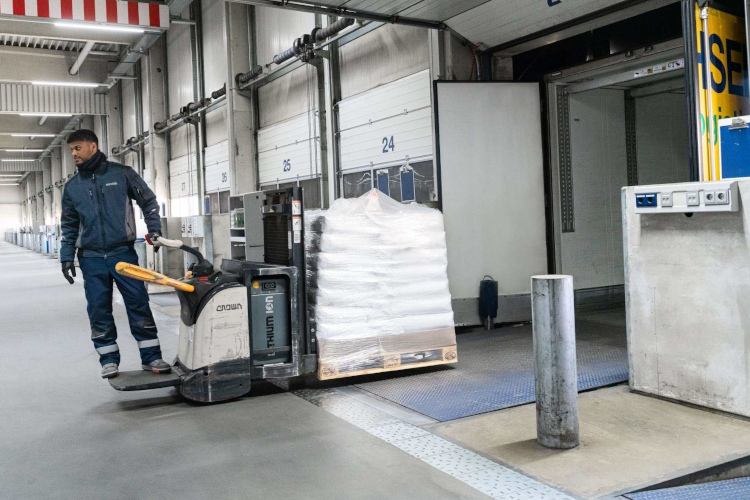
One of the milestones was the launch of the European food hub at DACHSER Erlensee near Frankfurt am Main in 2016. Thanks to its central location in the Rhine-Main region and terminal handling operations running from Monday to Saturday, DACHSER Erlensee is an important hub for trans-European food shipments. This has allowed for the optimization of transit times, meaning that goods are in transit on average one day less – a significant time saving for fresh products. Moreover, DACHSER Food Logistics also collects goods from customers on Saturdays as part of a weekend service. Goods are delivered on the next business day: another way to optimize transport time.
In addition to the physical network, the technical skills of logistics operators, and specially trained drivers, the immense strength of the network stems from uniform standards and interconnected IT systems. On this basis, the partner company receiving the goods can seamlessly take over export shipments as an order, regardless of whether these goods are destined for Lisbon, Katowice, or Edinburgh. The high quality standards in the European Food Network are a strong unifying element. Temperature-controlled food transport – from very fresh to room temperature – is subject to comprehensive quality management by qualified personnel under the control of integrated IT-controlled processes at over 200 warehouse locations certified for food storage in Europe.
On the way to 34 countries
Thanks to the high density of the network, with 2.31 million m2 of space dedicated to food storage and approximately 12,000 refrigerated vehicles, each of the 23 network partners can offer their customers regular connections with fixed transit times between 34 European countries. Every year, more than half a million food shipments are delivered cost-effectively within the network to retailers, restaurants, wholesalers, and processing companies in the food industry.
“Together we are stronger!” This networking principle applies particularly in unique and difficult times. Take Brexit, for example, when Europe’s trade relations with the UK began to be subject to new regulations. Not to mention the pandemic, when disrupted supply chains, lockdowns, and temporary border closures also put pressure on pan-European food logistics. The European Food Network proved its worth in these difficult conditions and was able to continue delivering products of the expected quality.
Alfred Miller, Managing Director of DACHSER Food Logistics and co-founder of the European Food Network, believes that in its anniversary year, the network is also very well prepared to consolidate food logistics in Europe – We are convinced that food exports will continue to offer very large growth opportunities, and the market – that is, European food producers, distributors, and retailers – requires high-quality and cost-effective services. It is precisely in this area that the European Food Network can and will continue to serve as a strong and reliable business foundation.
Source: Dachser