








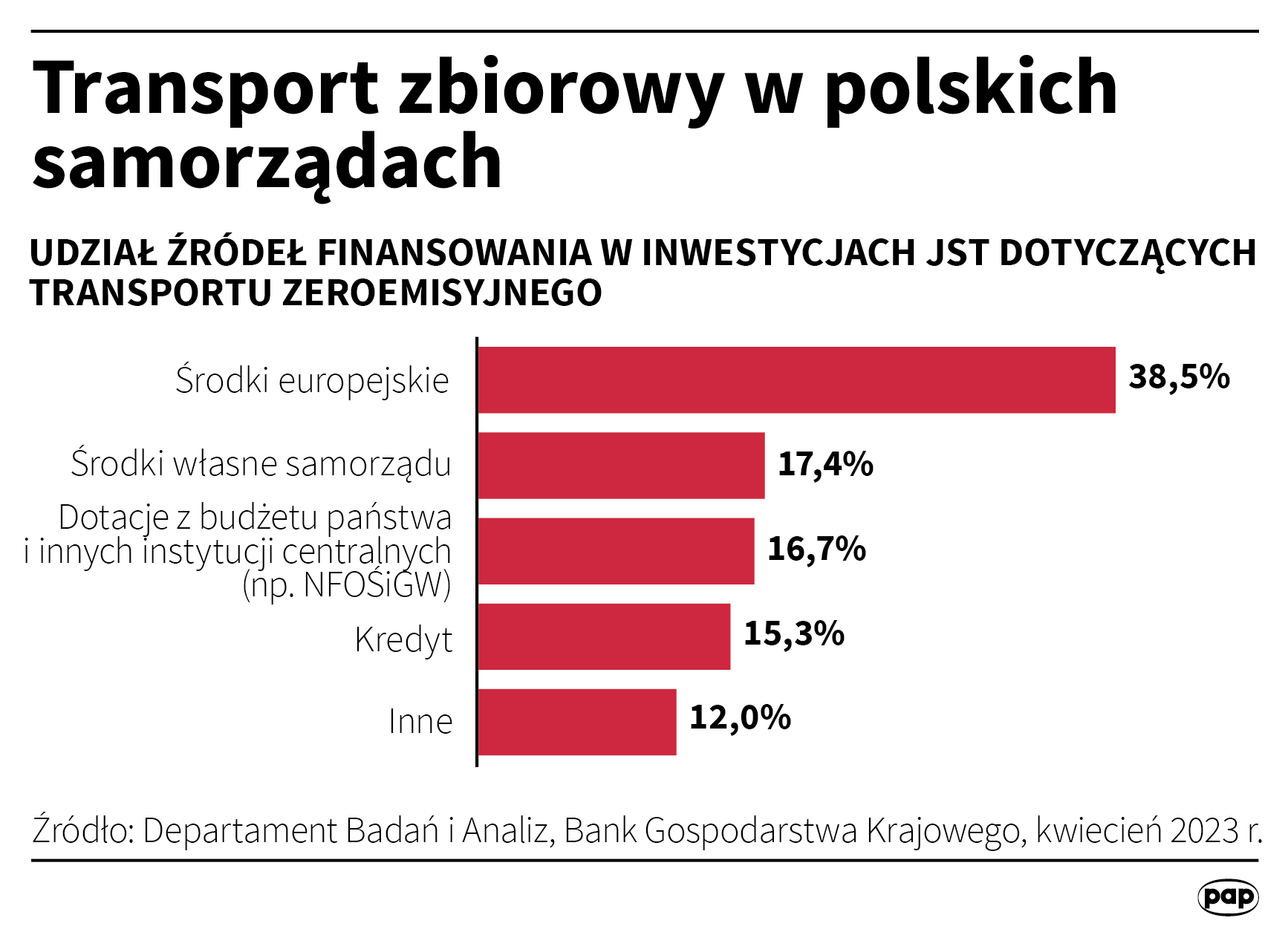
European funds are the most important source of financing for zero-emission transport in Polish local governments. The main drivers for green investments for local government units (LGUs) are the provisions of the act and environmental protection. Share of financing sources in LGU investments in zero-emission transport. In local governments, more investments in zero-emission transport were financed from EU funds than from the state budget and LGU own funds combined, according to the BGK report “Public transport in Polish local governments – current status and future plans”.
The BGK study shows that among the currently implemented LGU investments in zero-emission rolling stock and infrastructure, in terms of value, the most important source of financing is European funds (38.5 percent), from which more such purchases were financed than from state budget subsidies (16.7 percent) and LGU own funds (17.4 percent) combined. In the surveyed local governments, loans are in fourth place in the context of choosing investment financing (15.3 percent).
The authors of the report point out that at the same time, 71 percent of local governments that answered the question regarding the structure of implementing current zero-emission investments use their own funds, 63.8 percent admit that they use central budget funds, and one-third (33.3 percent) use European funds. 18.8 percent of the surveyed local governments resorted to loans.
Taking into account the popularity of individual sources of capital and their share in financing investments in zero-emission rolling stock and infrastructure, it can be concluded that while own funds and budget subsidies are used quite commonly, they finance a relatively small part of investments, and thus are used more intensively by units that implement smaller investments. It is different in the case of European funds, which are used by only every third local government, but they are used for larger investments, which is why this source finances 38.5 percent of current purchases of rolling stock and infrastructure.
Motivations of local governments to purchase low-emission vehicles
According to the Electromobility Act, local governments with at least 50,000 inhabitants are required from 2028 to have at least 1/3 of low-emission or biomethane-powered buses in their transport fleets. The regulation also provides for intermediate thresholds for the share of such vehicles, amounting to 1/10 of the fleet from 2023 and 1/5 from 2025, respectively.
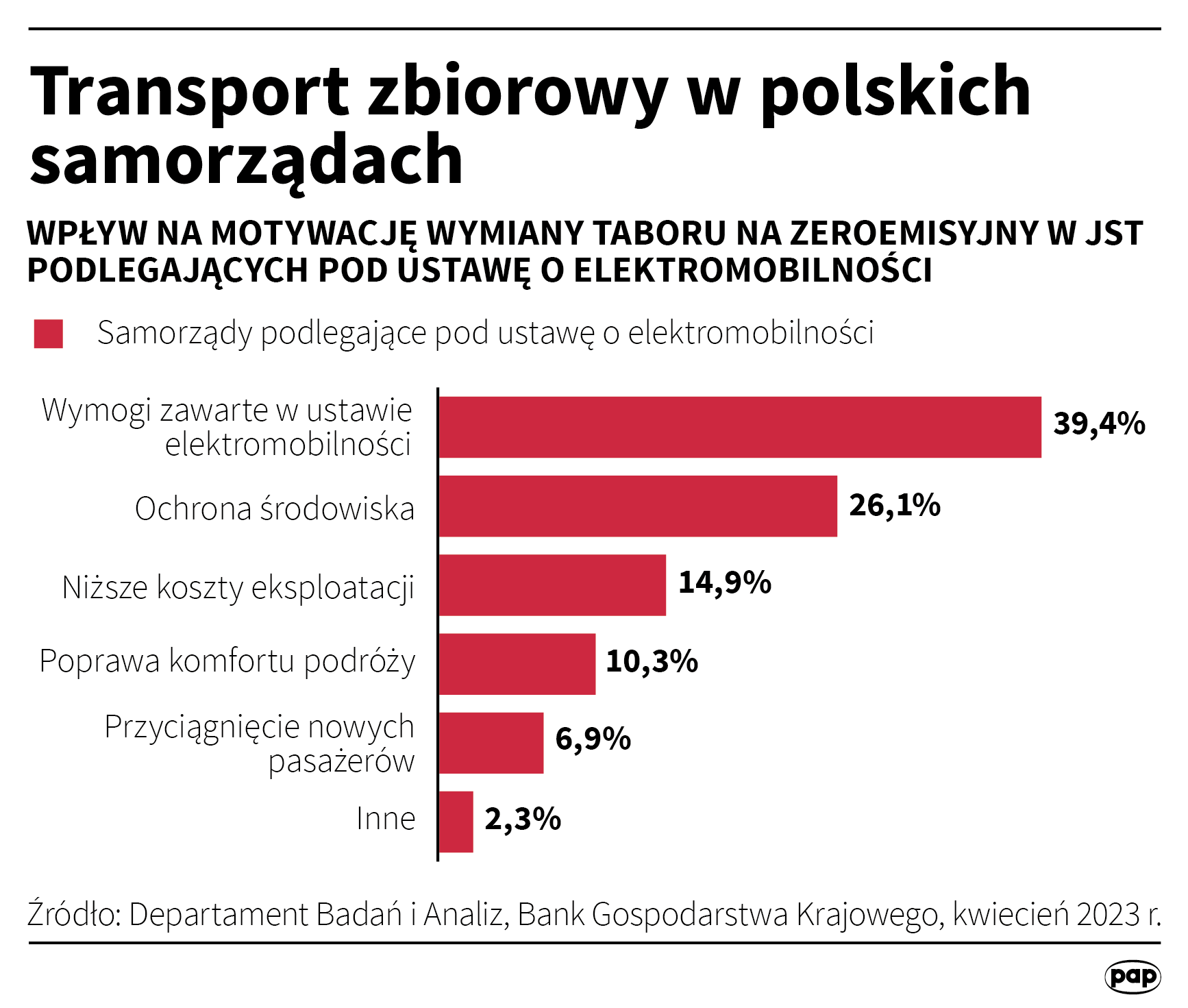
The BGK report shows that the provisions of the act are the main motivation for replacing rolling stock with zero-emission ones for the local governments subject to it (39.4 percent); in this group, environmental protection (30.5 percent) and lower operating costs of such vehicles (14.9 percent) are also important.
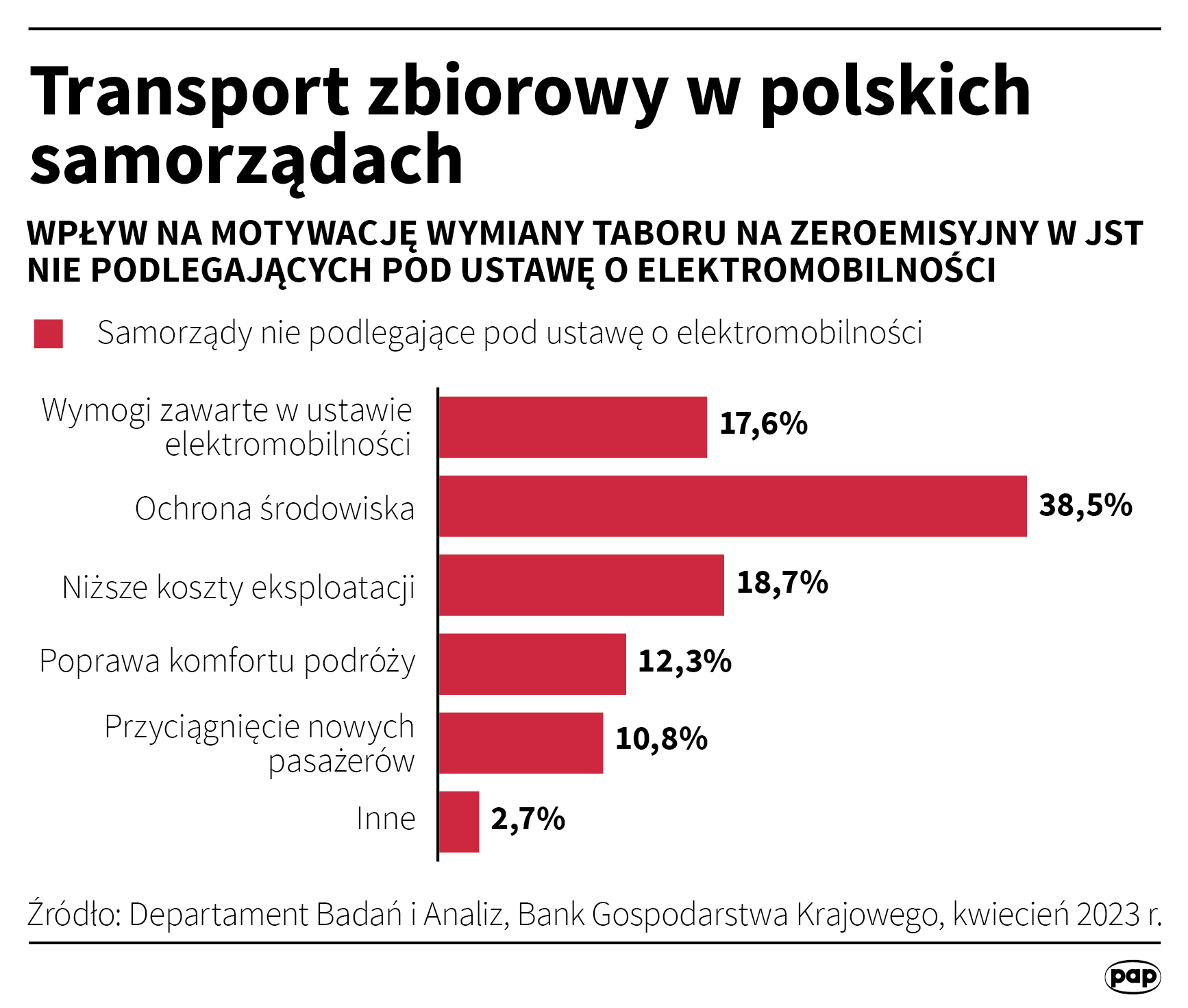
In the group of local governments that are not required to have a minimum share of zero-emission vehicles in their fleets, the main factor prompting replacement is environmental protection (38.5 percent), followed by lower operating costs (18.7 percent). Interestingly, among such local governments, the third most frequently indicated factor motivating the purchase of low-emission vehicles is the provisions of the Electromobility Act (17.6 percent).
According to the authors of the analysis, this may indicate that the current legal provisions also have an impact on the actions of local governments that are not covered by them, because they signal the legislator’s attitude and the potential direction of further legislative changes, which may result in the possible extension of the obligation to include ecological vehicles in the fleets of subsequent local governments.
According to the report, statutory requirements regarding transport fleets are the most important replacement factor in all surveyed local governments (31.4 percent) – both those subject to the regulation and those not covered by it.
Vehicles chosen by LGUs for their transport fleets
Among the local governments covered by the BGK study, 72.4 percent are currently investing in rolling stock.
Of these, 54 percent choose only zero-emission vehicles for their fleets, 14.3 percent invest in zero-emission and combustion or low-emission vehicles, and only 4.1 percent buy only machines powered by a combustion or low-emission engine (e.g., hybrid).
According to the responses of the surveyed LGUs, electric buses dominate the structure of vehicles that will be delivered as part of currently implemented investments (55.3 percent), even though they are on average more expensive than low-emission vehicles (according to local government declarations, on average 76 percent more expensive than hybrid and 130 percent more expensive than gas-powered). Electric trams were in second place (18.8 percent), 15.1 percent of surveyed LGUs buy diesel-powered buses, hydrogen buses – 5.8 percent, and those powered by LNG or CNG gas – 4.2 percent.
At the same time, according to LGU responses, electric buses dominate the structure of vehicles that will be delivered as part of currently implemented investments, even though they are on average more expensive than low-emission vehicles (according to local government declarations, on average 76 percent more expensive than hybrid and 130 percent more expensive than gas-powered).
The report shows that by 2028, about 500 electric buses, 50 hydrogen-powered vehicles, and approx. 170 new trams are to appear in the fleets of the surveyed local governments.
According to the authors of the study, the popularity of electric vehicles results primarily from the availability of non-repayable subsidies, which improve the profitability of investments in modern technologies, because the purchase of zero-emission buses can be partially financed from funds from available European and government programs; in other words, the possibility of obtaining attractive financial support offsets the higher price of zero-emission vehicles.
The responses of the LGUs that took part in the study show that hydrogen buses purchased as part of currently implemented investments are 48 percent more expensive than electric buses, 160 percent more expensive than hybrid buses, and as much as 241 percent more expensive than gas buses.
The high price of hydrogen vehicles, alongside problems with access to green hydrogen and the lack of infrastructure, is another barrier that hinders investments in solutions of this type. With the popularization of such vehicles, a so-called scale effect may arise – an increase in their production, the emergence of competition between suppliers, and consequently – a price drop.
The authors of the analysis noted that in parallel – apart from the development of hydrogen-powered vehicle technology, technologies for the production and storage of this fuel must also develop.
The BGK study was carried out from August 3 to October 14, 2022 – it covered local governments subject to the provisions of the Electromobility Act and several dozen LGUs that, although not covered by the act, had previously modernized their public transport fleets. Ultimately, the study analyzed responses received from 98 local governments, including 65 subject to the provisions of the Electromobility Act.
The full report is available at the link.
Source of information: PAP Local Government Service