









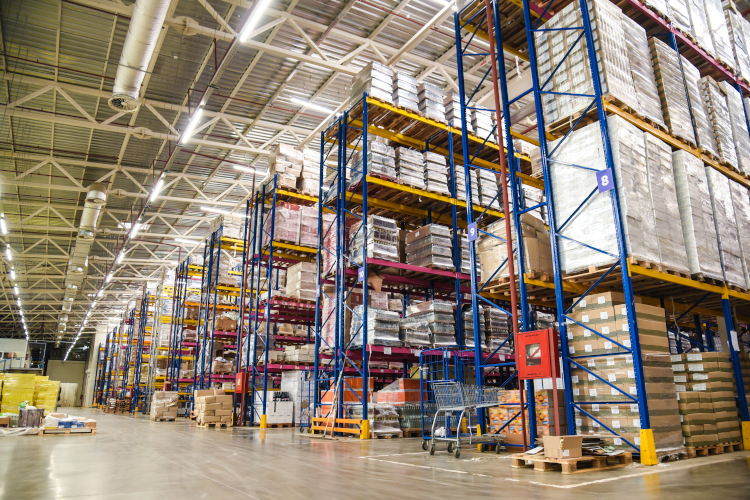
Interest in logistics and industrial space remains strong. Since the beginning of 2023, 1.9 million sqm of new warehouse space has been delivered, which is the highest value in the history of the Polish market. Consequently, the warehouse sector’s stock has reached 29.6 million sqm. Colliers experts estimate that the volume of new supply will be lower in the coming quarters.
3PL sector as the leader
In Q1 2023, the gross take-up volume amounted to 1.2 million sqm. Among tenants, companies from the 3PL (Third Party Logistics) sector leased the most space during this period – 39%. It is also worth mentioning the pharmaceutical industry, as it accounted for 10% of the gross take-up volume, which is an exceptionally high market share for this sector.
In terms of the lease agreement structure, a change has been visible for the last few quarters. In Q1 2023, 49% were new leases and as much as 45% were renewals, whereas in the same period last year, these shares were 66% and 27% respectively.
New warehouses and new space under construction
Among the largest investments completed in Q1 2023, one can point to the Zalando facility developed by Panattoni in Bydgoszcz (146,000 sqm), the next phase of Panattoni Park Wrocław Logistics South Hub (125,000 sqm), and CTPark Warsaw South (77,600 sqm) developed near Mszczonów.
However, a decline in the volume of space under construction is visible on the market. Currently, 2.2 million sqm is under development, while in Q1 2022 it was as much as 4.8 million sqm. This is the result of decisions by developers who have started fewer investments over the past year – at the beginning of 2022, the volume of newly started construction projects amounted to approximately 1.5 million sqm, while at the end of the year, new investments totaled only about 300,000 sqm.
– The decline in space under construction visible since Q2 2022 is caused by, among other things, investor uncertainty, difficulties related to financing investments, as well as unpredictable construction costs – says Maciej Chmielewski, Senior Partner, Logistics and Industrial Department at Colliers. – In Q1 2023, however, we see an increase in the number of newly started investments compared to Q4 2022. While at the end of last year it was 300,000 sqm, at the end of March 2023, their volume amounted to approximately 830,000 sqm. Among the facilities under construction, 48% of the space consists of projects built purely on a speculative basis, even though the possibility of implementing such projects is currently limited due to high requirements from financing entities.
Increasing vacancy rates
Since the beginning of 2022, an upward trend in the number of vacancies has been noticeable. In the period from Q1 2022 to Q1 2023, it increased by 3.1 percentage points, reaching 6.2% at the end of March, which is the highest value of this indicator since Q1 2021. Vacancies in facilities delivered in the first quarter alone amounted to as much as 31%. The occupancy level in facilities under construction is currently 47%, which is the lowest value of this indicator in the last decade. Colliers analysts forecast that 2023 will be characterized by a higher vacancy rate than 2022.
– This situation will be caused by lower net demand than in the previous year. The share of renegotiations in gross take-up may account for a higher percentage than in the last three years. The volume of space under construction should remain at a level between 2 – 3 million sqm. After high fluctuations in rental rates since the beginning of last year, the current year should bring their stabilization – explains Antoni Szwech, Analyst in the Advisory and Research Department at Colliers.
– The increase in the volume of unleased space was mainly caused by the delivery of a huge amount of new space in recent years, which was characterized by relatively high vacancy rates. However, their high ratio should not be a cause for concern, as this rate is still at a fairly low level and, with a limited volume of new supply, it prevents market shortages and positively influences market competitiveness – adds Maciej Chmielewski.