








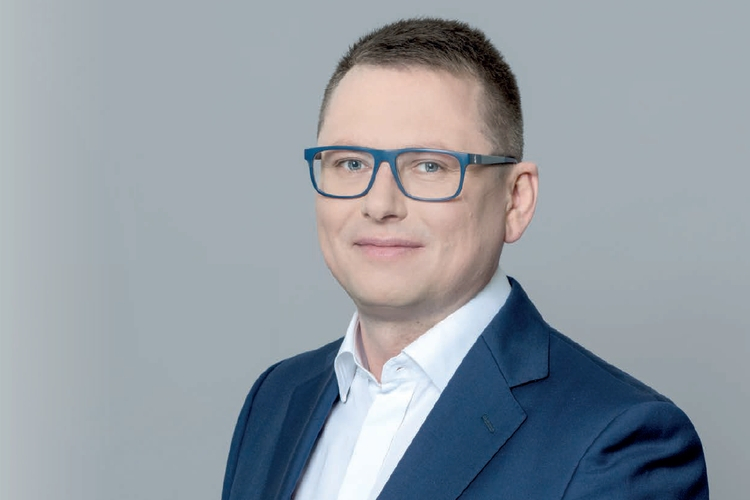
Sharing resources helps achieve economies of scale, reduce costs, minimize environmental impact, and provide a better overall experience for the end consumer – we talk to ŁUKASZ WOLSKI, Director of GXO logistics centers in Poznań.
Michał Koralewski: How is the logistics center in Poznań organized and what operations take place there? What area does the returns handling zone occupy?
Łukasz Wolski: GXO is developing its full potential in logistics worldwide, creating effective and sustainable supply chains for our clients. In Poznań, we have a facility with an area of 90,000 m2. Due to its location near major transport infrastructure, it is an important logistics hub on the map of Poland. We possess extensive knowledge and experience in restoring the full value of products through repairs and refurbishments. Due to the growth of reverse logistics, we have allocated a dedicated area for this service. Our facilities are ISO Stena Recycling certified, and BREEAM, the world’s leading building sustainability assessment system, has rated it as “very good.” Handling returned goods helps our clients increase their profitability and is also significant for achieving ESG goals. Notable environmental measures include greywater recovery, water extraction directly from the P3 source, a private water treatment plant, a 100% LED Dali lighting system, an electric vehicle charging station, and a rooftop solar panel system for water heating.
M.K.: How is the goods recovery process conducted?
Ł.W.: To streamline logistics and create excellent and sustainable solutions for order fulfillment, we reduce raw material consumption, reuse them, and process them. We believe that recovering goods can be a source of both efficiency and sustainability. Therefore, we support the circular economy through lower consumption of energy, packaging, and resources needed for inventory storage. We look for opportunities to restore the full value of products so they can return to sale, generating profit for our clients and relieving the environment. We are increasing the scale of recycling. This approach brings huge ESG benefits for GXO and our clients. The first stage of the recovery process is checking returned products for quality and compliance with standards. Depending on the inspection results, each item is assigned to the appropriate category, based on which further actions must be taken. If the item has no defects, we pack it and return it to the warehouse for resale. Goods with defects are sent to the recovery department equipped with on-site developed devices that improve goods recovery processes through sewing, odor removal, footwear repair, and steam stain removal. Thanks to our skills and experience, we can restore the full value of products, which regain high quality. We are constantly improving this process and testing new solutions.
M.K.: What percentage of returns are successfully recovered and directed for resale? What happens to the remaining returns?
Ł.W.: At GXO, we achieve up to a 96% resale rate for products from e-commerce returns. About 3% of goods are donated to charity, and less than 1% end up in landfills.
M.K.: Do you use shared warehouses? What are the benefits of such a solution?
Ł.W.: All GXO locations in Poznań are shared warehouses. We configure and operate our centers to meet client demand. Companies are increasingly looking for the unique benefits that a shared space solution provides. For example, shared warehouses allow for quick responses to demand changes, keeping costs at a growth level, and offering technology and services at lower costs. We can also support our clients in expanding sales to new channels, including e-commerce. Sharing resources helps achieve economies of scale, reduce costs, minimize environmental impact, and provide a better overall experience for the end consumer. By reducing the costs and complexity of logistics processes, we simplify and shorten supply chains. Shared warehouses are becoming a one-stop shop, providing both space and value-added services, as well as the leading technology that companies need to grow while exceeding their customers’ expectations. We offer such services to both well-known global brands and companies that are just at the beginning of their operations.
M.K.: Have you noticed an increase in the number of returns recently? What could be the reason for this?
Ł.W.: Reverse logistics is growing more and more. The rate of returned goods depends on many factors, including seasonality. For example, during the pandemic, there was a sharp increase in the number of returns. In some cases, they reached up to 40% of e-commerce purchases. These numbers also vary by country because consumers have different shopping habits. There are several reasons why consumers return their purchases. Most often, it is because they ordered or received the wrong product size, the color does not match, or they do not like the material it is made of. It also happens that the product arrived in a damaged condition. Together with our clients, we are working on solutions that allow for reducing the number of returned goods. A very accurate product description is of particular importance here, giving the customer as much information as possible before placing an order. Advanced quality control in warehouses ensures that shipped products are not damaged in any way and have been packed correctly. Appropriate tools and systems ensure that the right product is definitely sent to the customer who ordered it.
M.K.: What is the most difficult, most expensive process involved in reverse logistics?
Ł.W.: The most difficult process in reverse logistics is product classification, i.e., properly determining the condition of a given product, whether it can be returned to the warehouse as new, whether it can be refurbished in a cost-effective manner, or whether it is no longer suitable for resale. Qualified personnel are needed to perform this classification. Our employees undergo appropriate training and have extensive experience in restoring the full value of products. That is why it is worth entrusting such handling to operators who specialize in reverse logistics.