








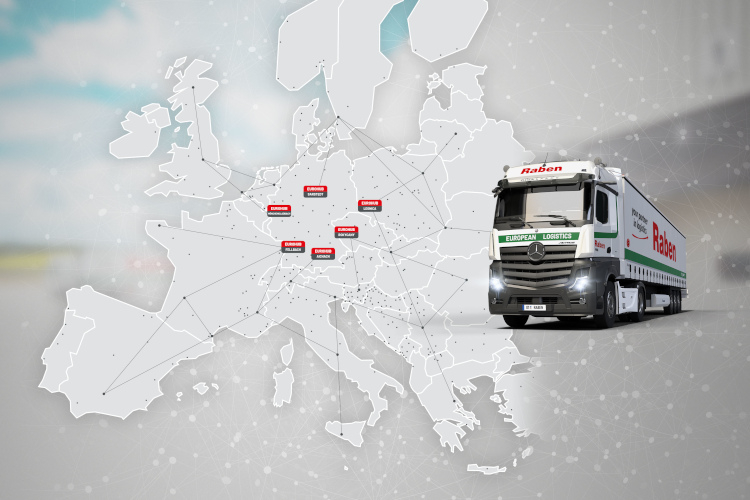
The first quarter of 2023 brought breakthrough changes to the structure of the Raben Group. Six locations in Germany, Poland, and the Czech Republic have been granted Eurohub status and the competence to manage transport across Europe. This step is a natural consequence of the logistics operator’s market position – its reach, the level of development of its national networks, and its operational excellence. Thanks to the consolidation of groupage shipments and faster, more efficient operational processes, Eurohubs effectively meet the needs of European customers.
The Raben Group has only just managed to close and summarize the year 2022, during which it entered its fifteenth European market, and it is already undergoing another revolution. This time, however, it is not about expansion, but about reorganizing the existing structure. Six warehouses have been assigned the function of Eurohubs – central points in the Raben network that will be responsible for consolidating groupage shipments for European line haul. They are intended to complement fixed, direct transport routes and guarantee strictly time-defined connections between all of the company’s European warehouses.
– The Eurohub structure allows us to react more flexibly to changes in transport volumes, and above all, to shorten lead times. We can offer all our customers added value, which is reaching all European destinations as quickly as possible – within 24 to 96 hours, depending on the distance. This organization of processes in accordance with the “lean” philosophy ultimately translates into a more efficient and reliable supply chain. We are closer to the customer and are designing a supply network characterized by greater resilience – explains Ewald Raben, CEO of the Raben Group. – An additional benefit is the reduction of CO2 emissions, which is also very important for us as a sustainable enterprise.
The new status has been assigned to the following locations: Sarstedt (handling connections to Scandinavia), Mönchengladbach (northern France, Benelux, UK, Ireland), Fellbach (Spain, Portugal, the rest of France), and Aichach (Austria, Italy, Poland, Czech Republic) in Germany, Legnica in Poland (connections within this market and to the Baltic countries), and Rokycany in the Czech Republic (South-Eastern Europe). The implementation of the Eurohub concept will further strengthen the logistics operator’s presence in Germany – one of the strongest economies in the European Union – while simultaneously securing the strategic role that this market has to play on the Raben company map.
Eurohubs are characterized by significantly greater capacity, excellent location, and infrastructure. The basis of operations and future success includes, among other things, over 130 direct connections between the mentioned points, a total of 600 connections per day, 40,000 m2 of cross-docking capacity alone, and full traceability supported by a single Transport Management System (TMS). This applies both to markets where Raben has its own network and those where the company operates through its reliable partners. All these changes were made possible by achieving milestones that the company has been working on for the last few years. Systematic acquisitions have resulted, on the one hand, in entering new markets (Austrian forwarder Bexity acquired in 2022; Greek logistics service provider Intertrans in 2021), and on the other hand, in strengthening and densifying national networks. This also applies to the region where Raben originated – at the beginning of April 2023, the fourth branch in the Netherlands was opened in the Maastricht area.
Four of the six Eurohubs are located in Germany – the largest market in Europe, where the Raben Group has been operating with its own groupage network since 2018. Infrastructure investments in this country have made a huge direct contribution to the creation of the Eurohub network. Sarstedt is a new and at the same time key warehouse of the Raben Group in Germany – the operator moved there from Langenhagen in 2022. With a total area reaching 27,000 m2 (5,500 m2 of space with 52 ramps for cross-docking needs), this facility has allowed for more than a tenfold increase in logistics capacity compared to the previous location. At the beginning of this year, a new branch was opened in Aichach, located northwest of Augsburg. The new location with an area of 25,000 m2 (of which 4,000 m2 with 42 ramps for cross-docking needs), operating from the very beginning as a Eurohub, is located directly next to the A8 motorway and is an important hub of the European Raben network used for daily connections with Southern and Eastern Europe. The situation is similar in the case of the Rokycany facility in the Czech Republic, which began its operations in April of this year. The warehouse covers 6,000 m2 of space for cross-docking needs and has 56 ramps facilitating the handling of goods, including those covered by the Convention on the International Carriage of Dangerous Goods by Road (ADR). This facility is located in close proximity to the D5 motorway and provides a fast connection to Germany and other European road networks. This location has the potential to significantly speed up and improve the flow of shipments, and also, thanks to its flexibility, to contribute to the future development of connections not only in the Czech Republic and Slovakia, but also in other Raben Group countries: Hungary, Romania, Bulgaria, and Greece.
The Eurohub concept is of priority importance for the Raben Group. At the moment, the company is not planning further geographical expansion, but intends to densify the existing network and invest in digitalization. The project of developing and reorganizing international lines in all fifteen countries of the Raben family is still ongoing:
– Through targeted and systematic consolidation of shipments, we want to stimulate the expansion of the network and the development of Eurohubs, as well as the comprehensive integration of all European regions. This will ensure better utilization of existing resources, and thus higher economic efficiency of our transport and greater environmental friendliness of logistics operations – concludes Ewald Raben.