








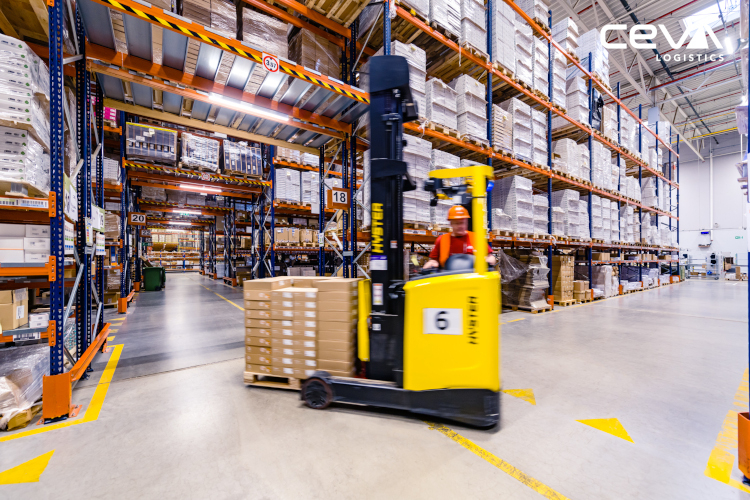
The perception of the role of logistics and the supply chain in the business model is changing; despite the high level of automation in warehouse operations, employee engagement remains important, and the significance of big data and simulations is growing. Generational differences and labor shortages are major challenges. CEVA Logistics presents the most important conclusions from an expert discussion dedicated to “Modern trends in supply chain optimization”.
The discussion “Modern trends in supply chain optimization”, organized by CEVA Logistics, featured: Dr. Shereen Nassar, Global Director of Logistics Studies at Heriot-Watt University Dubai, Ekim Sahan Dinc, a global expert from Leading Innovative Supply Chain Programs, and Jaco Knetemann, Vice President of Contract Logistics Operations for Europe at CEVA Logistics.
Changing the approach to the role of logistics and the supply chain
Ten years ago, most supply chain leaders focused on functional operational issues such as procurement, logistics, or production operations. Cost-cutting was seen as a value-add offered by partners. Today, in the modern business environment, the supply chain is viewed as a catalyst for change and a source of synergy between various departments, especially production, inventory management, delivery, operational excellence, and customer satisfaction. Supply chain leaders shape strategies around key customer-oriented operating models designed to improve inventory availability, resilience, and delivery speed. Many of them use large amounts of data in this process. To illustrate this, imagine a global electronics manufacturer with a strong position in the Asia-Pacific and European markets. In the past, for this company, the supply chain was primarily a cost tool aimed at minimizing expenses and ensuring timely product delivery to customers. In recent years, the manufacturer has been changing its approach and starting to see the supply chain as a source of benefits and revenue flow. This shift in thinking will allow for the expansion of the product offering, sales growth, and the provision of better shopping experiences, which will contribute to increased brand awareness and customer loyalty.
Business development requires redesigning the supply chain
As the experts participating in the discussion pointed out, a change in the supply chain model should be preceded by a thorough analysis of the current state. Key questions that companies should ask themselves include:
- has my organization conducted an analysis of the impact of individual products (SKUs) on revenue?
- do we review our product portfolio every year?
- what is more important – fast or reliable delivery?
Another key step in strategic supply chain planning should be global benchmarking.
– Europe and North America have invested significantly in automation and artificial intelligence, especially in warehouse operations. One of the factors driving the strategy is the labor shortage. During the pandemic in the Netherlands, for every 140 job vacancies in the logistics and supply chain sector, there were only 100 people available to fill them. Looking at countries like Japan, we ask ourselves questions. Is this where we will be in 20 years, and how can we optimize our supply chain models to remain responsive in the medium and long term? – explains Jaco Knetemann, Vice President of Contract Logistics Operations for Europe, CEVA Logistics.
A challenge for investment planning can be the lack of certainty from customers regarding short- and medium-term volumes. Another important question arises: “Could this hinder investment in supply chain optimization?” According to the experts, no, especially when a company conducts due diligence and regular supply chain assessments, and has a clear business development strategy. An excellent example of how a simple online bookstore can transform into a major global e-commerce player by rethinking and redesigning its supply chain is Amazon. Initially, it relied on a traditional supply chain for sourcing, production, and delivery to customers. The inefficiency of this approach limited its operations. The next step was to invest in technology, cloud-based business, and data analytics, which paved its way to becoming a market leader.
An example of modernizing contract logistics operations is the use of drones for inventory. The benefits stem from maintaining warehouse continuity, including receiving or shipping orders, speed (inventories can be carried out in a few hours rather than days), and the elimination of human error. The use of drones allows for cost savings of 20-40%. This inventory method is particularly effective in warehouses handling palletized clothing.

Big data and simulations
In today’s world, companies have unlimited access to data from various systems related to commodity or capital markets, international trade trends, etc. Based on this, forecasts and guidelines are prepared to help make the right decisions. Combined with cloud technologies, such as computer vision, machine learning, or simulations, they constitute a powerful tool. Access to data and related technologies is easier than ever before, but the transport and logistics industry still makes poor use of them. Currently, cloud technologies allow for simulations that help answer many questions. Although the problems that can be solved with the help of simulations are significant, common pitfalls associated with their effective use are the lack of efficient hardware and specialized labor.
Despite automation, warehouses need people
Progressive warehouse automation does not eliminate human labor. This can be shown by a specific example of a modern 80,000 sqm warehouse in Europe, operating 24/7, with a capacity of 500 units per day. It is equipped with an automated shuttle storage system connected to a pocket sorter, packaging machines, and kilometers of conveyor belts. On a daily basis, it is operated by 1,500 to 2,000 employees. During peak sales periods, when maximum capacity exceeds 700,000 units per month, the number of employees on a 24-hour shift almost doubles. Further automation is inevitable, however, given the labor shortage in Europe, growing consumer demand, and the volume of orders. Without it, to meet demand, the warehouse would require a 1.5-fold (or more) increase in labor and additional space. The value-add is that thanks to automation, employees can spend more time performing more complex tasks with a higher degree of difficulty.
Generational gap and lack of employees
The logistics industry and supply chains are undergoing transformations, becoming less dependent on workers such as truck drivers or forklift operators. In current market conditions, we are observing a trend where many positions in logistics require specialists with technical and engineering knowledge, ready to implement new solutions. Additionally, the baby boomer generation is still present in the labor market, possessing industry knowledge but usually not understanding new technologies and ways of operating based on large amounts of data. They work alongside millennials and members of Generation Z, who often have a different approach to how processes should or can work. The appropriate approach is to pass on industry knowledge to younger generations while giving them the freedom and flexibility to optimize the logistics and supply chain industry using new technologies and tools.
The goal of the discussion was to analyze the trends and strategies that companies must know to remain competitive in today’s rapidly changing logistics landscape.
Source: CEVA Logistics