










If the deglobalization of the world economy and the shortening of supply chains occur on the scale currently being declared, Poland will have a unique opportunity to compete for the favor of the dozen or so percent of companies that are announcing the relocation of production or supply sources to Europe. We have a decent starting position and great potential in the industrial and logistics sectors, but little time and still a lot to do.
Perhaps we are at the beginning of a long and complicated operation of decoupling Western economies, especially the US, from the Chinese economy. Since we are at the beginning, it is a good time to come to terms with the fact that despite the titanic work and efforts of the US, the gigantic production ship that has been docked in China for decades will not suddenly pull up its anchor and sail around the world in a few months, calling only at ports in Los Angeles, Rotterdam, or Gdansk. This will not happen even in the wildest visions of production defragmentation and supply chain decoupling, because the current network of global connections and economic dependencies is so dense, incredibly profitable, and multi-layered that in the event of a sudden isolation of China (e.g., as a consequence of an invasion of Taiwan), the world would certainly face another, this time apocalyptic, economic crisis. Yes, some industries may leave China in accordance with their own announcements, but this will not make the Asian giant an outsider in the global economy overnight.
Even if significant manufacturing potential voluntarily breaks away from the Middle Kingdom, firstly, it will not happen by the middle or even the end of this decade, but will take decades. Secondly, the next location for the world’s industrial base will likely be other Low Cost Countries (LCC). In the case of Asia, this will include Vietnam, while in the case of the US, Mexico will benefit from the split. In Europe, Poland could occupy a convenient position, at least that is what some analyses suggest. Thirdly, for decoupling to be realized in accordance with US ambitions, Europe should be on board the departing industrial ship. However, this goes against the vital interests of the largest European economies, which earn hundreds of billions of euros annually from trade relations with China, and this amount increases every year.
The current trajectory of decoupling does not fully align with the assumptions of its initiators either, which is well illustrated by last year’s US Reshoring Index, which tracks trends in production returning to the United States from 14 low-cost Asian countries. The latest report in this series, prepared by Kearney, showed that in 2021, dependence on production from LCCs deepened rather than weakened. The MIR (Manufacturing Import Ratio) index calculated by the company, which divides the import of industrial goods from those 14 low-cost countries by gross domestic production, was 14.49% in 2021 and, with few exceptions, has been growing continuously since 2008.
MIR therefore shows that nearly 14.5% of US production is due to the import of industrial goods from Asia, which in turn translates into a negative reshoring index, which in 2021 was minus 154 points, the worst result in the history of the study. This index reached positive values, i.e., favorable from the point of view of relocating production, only twice. The first time in 2011 (11 points positive), then in 2019 (98 points positive). Although the collected data contradicts this, Kearney points to the existence of clear signs that attitudes and strategies for relocating production are changing. This is to be confirmed by, among other things, a survey conducted among the management of American companies, which showed that 92% of the managers surveyed express a positive attitude towards reshoring, and 79% have already moved part of their operations to the US or plan to do so within the next 3 years.
The whole world is already talking about the risks of decoupling and reshoring strategies
The issue of supply chain fragmentation and the relocation of industrial resources is breaking through literally everywhere. This is true both in macroeconomic reports and in internal corporate materials. For example, data from corporate presentations and conferences analyzed by Bloomberg indicate that in Q2 2022 alone in the US, terms such as onshoring, reshoring, and nearshoring appeared as many as 181 times. For comparison, in Q1 2020 they were mentioned only 15 times, which means an increase of 1106% in two years.
Considerations in this regard are also taking place in the Union, and the European Commission in its economic forecast from February of this year pointed to the growing risk of fragmentation of global trade and supply chains. It paid particular attention to the growing number of harmful trade restrictions, which have increased radically since 2020. While in the years 2010-2019 the annual average of harmful trade-restricting measures was 71, in 2022 this indicator reached 530. Already in 2021, as much as 9.3% of the global import volume felt some kind of harmful sanctions.
Due to strategic rivalry with the US, China remains firmly in the crosshairs of sanctions, which, according to Global Trade Alert, was subject to the largest number of harmful interventions in trade in goods just last year. They reached the level of 1101, and adding to this harmful interventions in the area of investment, services, and migration, the ceiling increased to 1120. In 2021 there were even more, 1181, and in 2020 1124. This, of course, leads to a gradual weakening of the Middle Kingdom’s position as a preferred place for locating investments and production, and this is all the more noticeable as China’s image had already suffered earlier due to its strict anti-COVID policy and large-scale lockdowns.
Geopolitical tensions related to China are being felt by the global logistics sector
Attention is drawn to the loss of Chinese potential by, among others, this year’s Agility Emerging Market Logistics Index report, which, based on economic, trade, social, digital, and transport indicators, classifies emerging economies in terms of their potential and competitiveness as logistics markets. The analysis published in February of this year indicates that despite China maintaining first place in the ranking, its position is being undermined, and starting from 2023, this country is to be more often bypassed in the production chain.
This state of affairs is indicated by a study conducted among 750 high-level managers managing global logistics in their companies. Within 5 years, i.e., by 2028, as many as 20.5% of them intend to move both production and supply sources out of China. A slightly lower percentage (18.4%) declares that they will limit investments in the Middle Kingdom. Thus, nearly 40% of those surveyed plan to withdraw logistics processes or limit investments.
Although such a percentage seems surprisingly high, on the other hand, 41.3% of managers declare entering that market or continuing expansion, and a further 19.8% do not intend to make changes to their current activity in China. Despite so many problems and declarations, the balance of expansion and maintaining activity versus winding down operations is still favorable for China (60 to 40), which may indicate that we will have to wait for the loudly announced mass exodus of companies.
The reasons for moving and new production and supply locations are interesting
Among the most important reasons for relocation, the strict anti-COVID policy (16.1%) and the resulting large-scale lockdowns, which had catastrophic consequences for international logistics, including high freight prices, delays, and container availability, are mentioned first and foremost. The decision to leave China is also determined by increasing difficulties in doing business (13.7%), and only then by the trade war with the US (12.7%), the local economic slowdown (12.4%), and the decline in China’s share in global trade growth (11.2%). Interestingly, for 8.4% of logisticians, rising labor costs are becoming an increasingly serious reason for moving, and this topic is increasingly being brought up during discussions about the decline in the attractiveness of this direction.
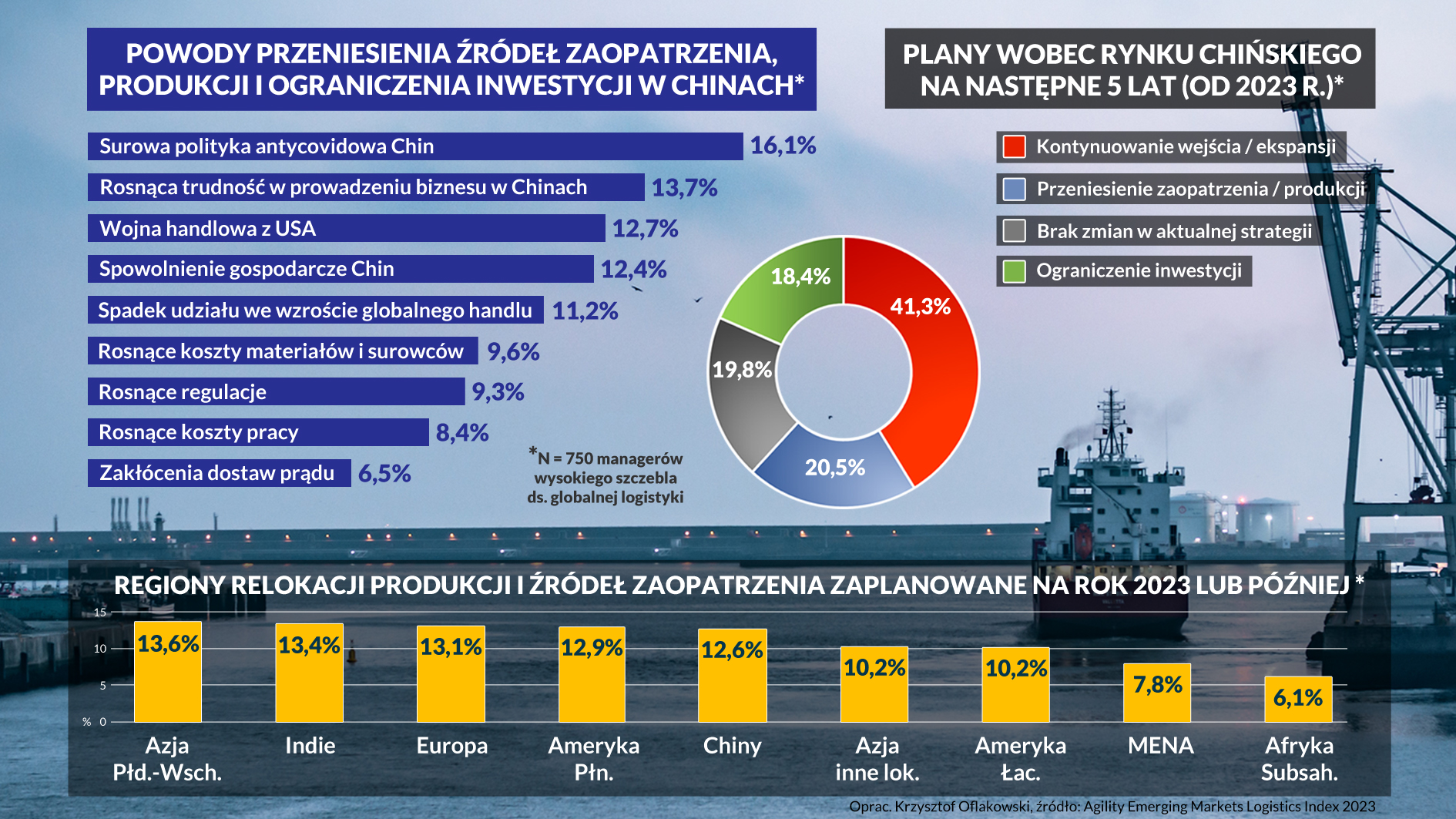
China has also ceased to be the first choice for companies when it comes to global relocation plans prepared for 2023. The most frequently indicated destination for relocation is currently Southeast Asia (13.6%), followed by India (13.4%) and Europe (13.1%). Further down the list of priorities is North America (12.9%), and only then China (12.6%) and Latin America and the rest of Asia (10.2% each). The situation looked completely different before 2023. Companies that relocated operations in previous years most often chose China (17.1%), followed by India (13.8%) and Europe (13.6%). The current leader, Southeast Asia (12.6%), was only in 4th place.
So far, India and Vietnam, among others, have clearly gained from China’s weakening position, becoming a strong enough magnet for brands such as Nike, HP, Apple, Google, or Samsung. According to managers with decision-making power in global logistics, Mexico will also gain a lot from deglobalization and the deteriorating relations between China and the US. Not only thanks to the proximity of the American market, but also lower average labor costs in the industrial sector, which according to IHS Markit amounted to 3.9 dollars per hour in 2022. In the same period, the hourly rate in China reached 5.58 dollars per hour, which is 43% more.
How will Poland benefit from potential deglobalization?
This question can be answered by last year’s study conducted by Maersk and Reuters Events among 368 supply chain professionals scattered around the world. According to their opinion, globally, Poland is in 4th place among the most attractive individual countries when it comes to relocating production or supply. This is not just about withdrawing operations from China, but production and supply reshuffles involving all countries of the globe. Reaching 13% of indications, we were only behind Vietnam (21.2%), India (20.7%), and Germany (13.7%). In doing so, we outperformed, among others, the US (12.4%), China, Mexico, and Turkey (9.1% each).
The authors of the study note, however, that the specificity of the countries that will be the target of individual companies is quite clearly defined. Highly developed and high-income economies will be chosen by companies from high-margin sectors, advanced technologies, and strategic industries, such as advanced electronics, aviation, automotive, medicine, or the chemical industry. Here, Germany, the US, the UK, France, or Italy will gain in particular, and this is partly why Intel announced the construction of a new mega semiconductor factory in Germany last year, the creation of a research and development and design center in France, and the establishment of a new chip testing and packaging plant in Italy.
Poland, being in the group of middle-income countries with low innovation potential, will compete in the second league with Mexico, Turkey, Romania, and Hungary. Here, advantages will be determined by lower labor and transport costs, proximity to sales markets, or membership in trade blocs, and Poland undoubtedly possesses such assets.
Besides a high ranking in the global list, Poland’s situation looks even better if companies of European origin are facing the choice of a new production or supply location. Here, our country wins unequivocally, indicated by 23.3% of the surveyed managers. Germany (19.4%) and, much further behind, Turkey (12.4%) are in the following places.
– It can be said with certainty that if the declarations of production deglobalization and shortening the global supply chain made today are fully realized, Poland will face the opportunity to make another big economic and civilizational leap within the next dozen or so years. The logistics sector will play a key role in this process, because its condition and capabilities will be one of the basic criteria for evaluating Poland by organizations planning to move their operations here. Here we definitely have something to boast about, because we possess some of the best arguments in this area, including Western business culture, a mature transport and warehouse market, proximity to the sales market, and educated staff. Locating European production in Poland also has deep economic justification, and due to its axial geographical location, also ecological. The transformation of the global economic order may therefore generate a number of measurable benefits in the form of increased production and export capacities, transfer of know-how, jobs, and ultimately faster GDP growth and the enrichment of society. On the other hand, the new reality means a number of challenges, and even threats, including the exhaustion of the potential of existing competitive advantages in favor of other economies. This, in turn, may hinder Poland’s advancement in the production structures of the global value chain, the so-called Global Value Chain. The key, therefore, will be to ensure conditions for the influx of companies from the most advanced technology sectors, create an appropriate legislative environment and investment incentives, guarantee appropriate digital infrastructure, and continuously improve the logistics base, whose task will be to serve an innovative economy and its immediate surroundings. This will be the responsibility of operators using an advanced technical and IT base, as well as very large organizational capabilities and international reach. We want to be an active participant in this process, hence our recent decision to consolidate – says Marcin Bąk, President of the Management Board of Spedimex, a Polish logistics operator serving retail chains, shopping malls, e-commerce, as well as LTL and FTL transport in Poland and Europe.
How is the Polish logistics sector perceived in the world?
The most comprehensive and globally reliable comparative ranking in this regard is the Logistics Performance Index (LPI) maintained by the World Bank. The tool, created as an interactive benchmark, is intended to help countries identify opportunities and threats in the area of national logistics, but the analyses are also used by other stakeholders wanting to gain knowledge about, among other things: the efficiency of customs clearance, infrastructure, ease of organizing deliveries, quality of logistics services, tracking and identification capabilities, and timeliness. While the current assessment is hindered by the timeliness of the data, which dates back to 2018, on the other hand, they give a comprehensive and undisturbed picture of the sector in the last full year before the outbreak of the pandemic.
The last review of logistics potential gave Poland 28th place out of 160 analyzed countries. We were placed just behind South Korea, China, and Taiwan. Among the countries of our region, Poland was outperformed by, among others, Germany (1st place), Sweden (2nd place), Belgium (3rd place), but also the Czech Republic (22nd place). The harshest assessment was given to Poland in the Infrastructure category, which focuses on areas such as ports, railways, roads, or information technology. We were given the best rating for the timeliness of deliveries.
However, these are not the only analyses that assess the condition of the Polish logistics sector against other countries. According to the periodically published Fraunhofer Institute report – Top 100 in transport and logistics services, focusing on the value of individual markets in Europe, Poland took 7th place in the 2021/2022 edition. We were outperformed by Germany, France, the UK, Italy, Spain, and the Netherlands. Switzerland, among others, was placed behind us.
There are also sectoral indicators, including the United Nations Conference on Trade and Development (UNCTAD) ranking – Liner Shipping Connectivity Index (LSCI), which shows how well countries are connected to global shipping networks. In Q4 2022, Poland was in 29th place in the world in this respect. Among the countries of our region, and thus our potential competitors in the race for flows and relocation of production, we were outperformed by: Spain (6th place), the Netherlands (7th place), the UK (8th place), and Belgium (9th place). Subsequently also Germany, Italy, France, Portugal, and Greece. At the end of 2022, the global podium of the ranking belonged to China, South Korea, and Singapore. The distant place can only be compensated by the fact that in Q4 2006 we were in an even more distant 94th position, and it took us 16 years to advance by 65 places.
Poland has not said its last word yet
When it comes to Poland’s attractiveness as a key player in the logistics market, there is still a lot to be done, but there are a number of important investments in the plans or under implementation that will improve our position on the map of Europe. One of them is undoubtedly the CPK (Central Communication Port), important not only in the context of freight capacity, including belly cargo, but also in the perspective of redesigning the existing railway infrastructure, which is to increase the availability of the system for freight transport. Already now, the transport work performed in rail freight transport occupies a high position compared to other countries in the world. According to data from the International Union of Railways (UIC), we are the 12th country in the world in this respect and, despite a clearly smaller territory, we are one notch ahead of, among others, Mexico.
Work has also been ongoing for years and conditions in road transport are improving. The road construction program adopted in December 2022, assuming the implementation of investments with a total length of over 6.1 thousand km by 2030, is to be the largest undertaking of this type in the history of Poland. It includes, among other things, national obligations regarding the construction of the Trans-European Transport Network (TEN-T), including the core network, creating priority connections from the point of view of the goals of European transport policy. The capacity and role of Polish ports are also constantly increasing. In 2025, Gdansk is to gain a new container terminal, as is Swinoujscie. The investment on the western coast will be able to handle approx. 1.5 million TEU annually (TEU – twenty-foot equivalent unit). In 2028, Gdynia will also gain a new Outer Port, which will increase its transshipment capacity to 2.5 million TEU annually.
For years, we have also been doing exceptionally well in the warehouse market, and according to the latest JLL data, Poland accounted for 20% of the new warehouse space delivered in Europe last year. At the end of Q3 2022, we had 27.8 million sq m of space, which places us in the strict European lead.
We also possess other valuable assets, including some of the lowest hourly labor costs in the transport and warehousing sector in the European Union. The latest Eurostat data for 2022 indicate that the average labor cost in this sector in Poland was 11.5 euros, while the average for the entire Community stopped at 26.1 euros, and in the eurozone at 29.2 euros. The favorable position in terms of labor costs does not only apply to logistics, but also to production (11.4 euros in Poland against the average of 30.5 euros in the EU), industry (12.2 euros against the average of 30.7 euros in the EU), and general average labor costs in the Polish economy, which in 2022 amounted to 12.5 euros, while in the Union 30.5 euros. Additionally, in the latest Competitive Industrial Performance Index (CPI) ranking conducted by the United Nations Industrial Development Organization (UNIDO), we occupied 23rd place in the world in terms of the competitiveness of industrial potential and outperformed countries such as Finland, Hungary, and Turkey.
We also generate a relatively high value added of the manufacturing sector. According to the World Bank, in 2021 we occupied 15th position among OECD countries, ahead of Australia, Austria, Sweden, and Belgium. We also perform well in credit rating ratings. At the beginning of March this year, Colin Ellis from the Moody’s rating agency, commenting on Poland’s A2 rating, pointed out that although this is not the best result in the world, it is a very solid result, and its outlook is stable. This, in turn, makes Poland look attractive to investors, the economy is described as resilient, diversified, and well-prepared to benefit from nearshoring trends. The update of the indicator carried out at the end of March 2023 maintained the previous level of Poland’s rating.