









Almost 170,000 units will be the number of newly registered fully electric passenger and commercial vehicles in Poland in just eight years, according to the latest edition of the “Polish EV Outlook” report, prepared by PSPA. This is more than 10 times higher than in 2022. The forecasts for the development of the BEV market for 2022 included in the previous edition of the PSPA report were close to the actual result by almost 100%.
The first edition of “Polish EV Outlook 2023” presents the current state and development forecasts for the Polish zero- and low-emission transport market across more than 300 pages. The study contains a collection of knowledge on electromobility, both at a national and local level, unavailable in any other source.
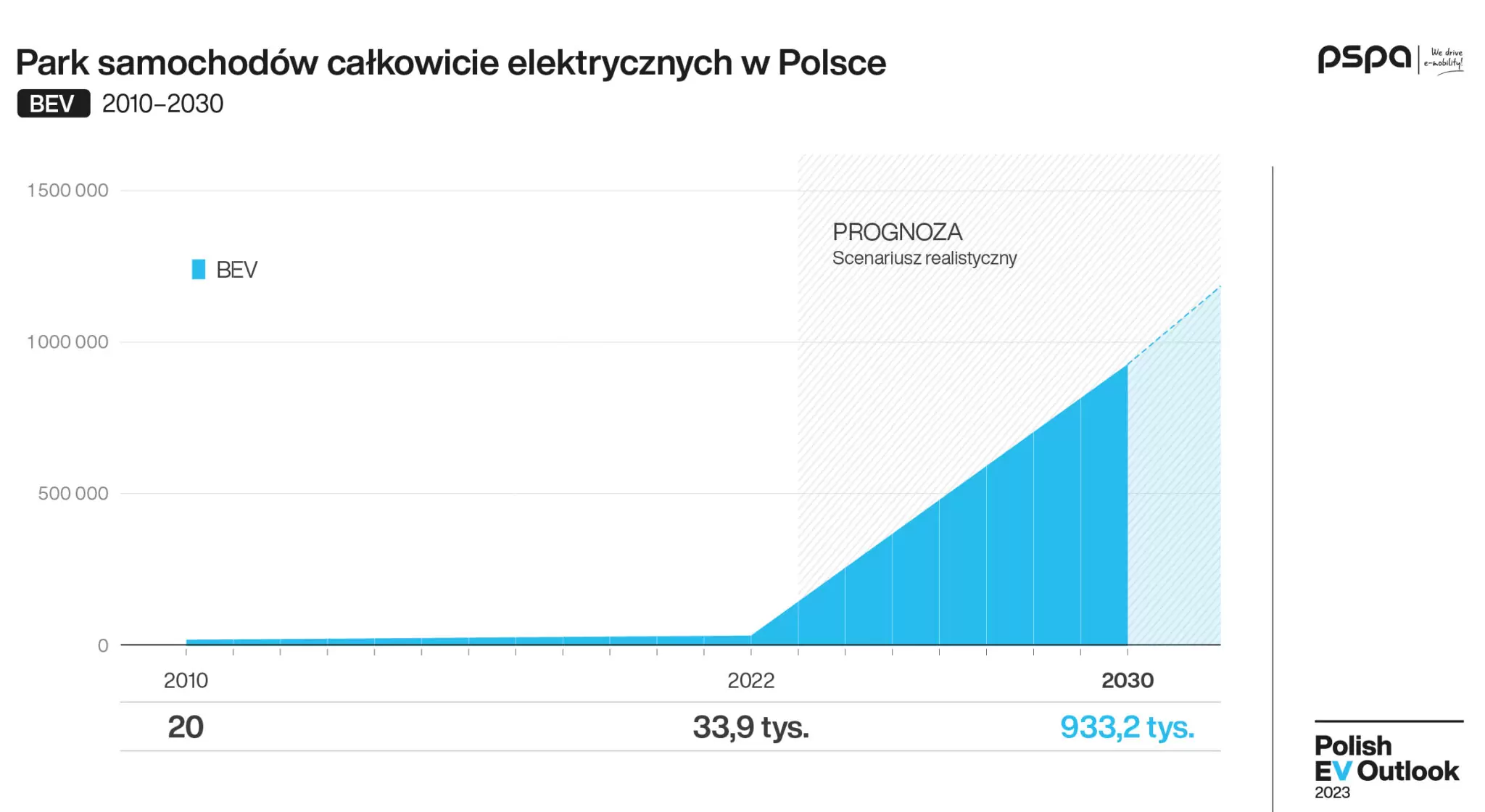
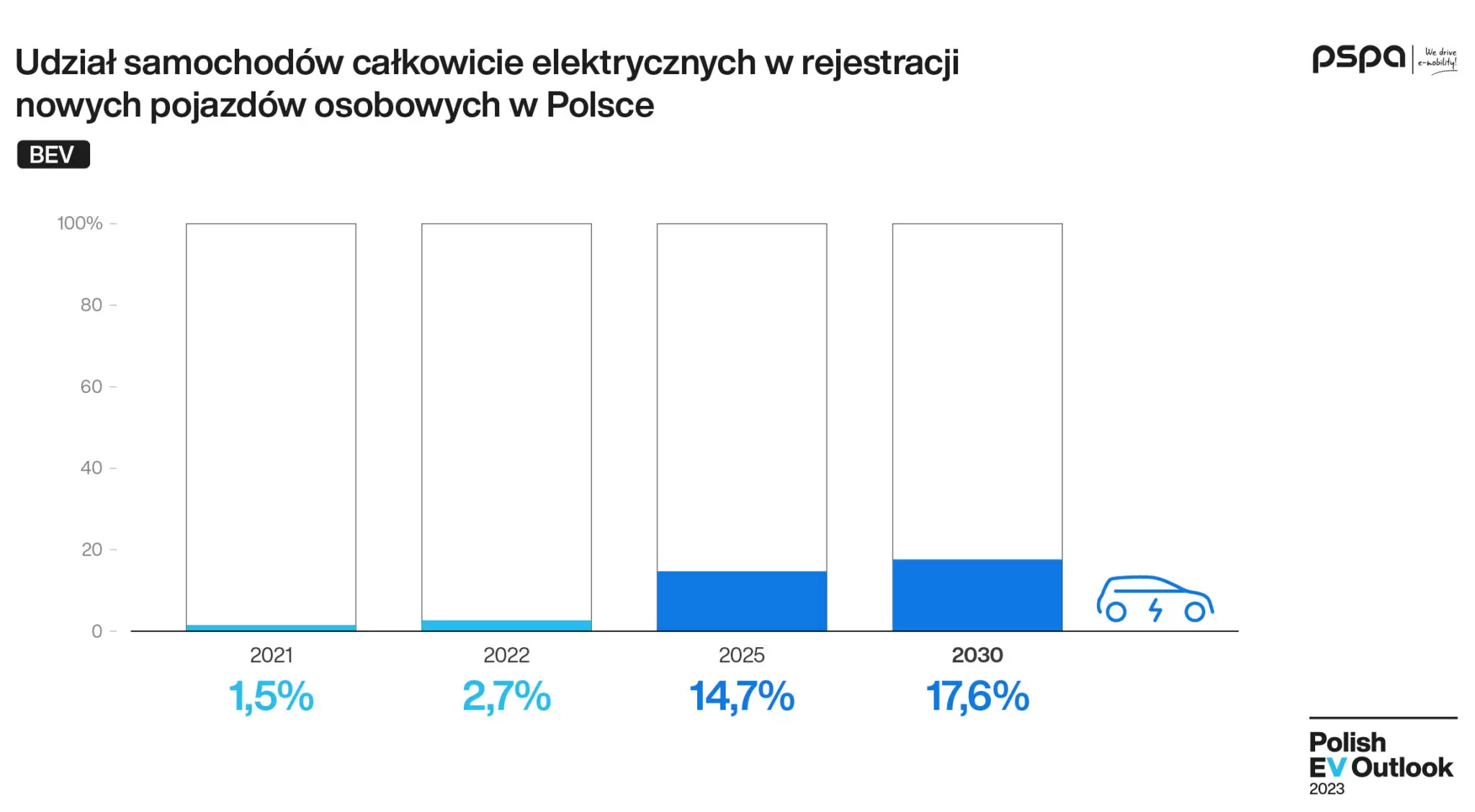
The PSPA report confirms that despite ongoing supply chain disruptions in the automotive sector, the Polish e-mobility market is not slowing down. According to data from IBRM Samar, a substantive partner of “PEVO 2023”, at the end of 2022, the cumulative number of registrations of fully electric passenger and commercial vehicles (BEV) in Poland was 33,866. This means that in just one year, the fleet of such vehicles has grown by over 80%, and since 2020 – almost fourfold. In 2022, 12,607 new BEVs were registered in Poland (which is 74% more than in 2021), as well as 2,783 vehicles of this type from imports (+49% y/y). “Polish EV Outlook 2023” shows that between 2014 and 2022, the share of fully electric cars in the sales of new passenger vehicles in Poland increased from 0.02% to 2.7%. However, this is still significantly lower than the European Union average, which, according to ACEA, was 12.1% at the end of 2022.
In which cities are there the most electric cars?
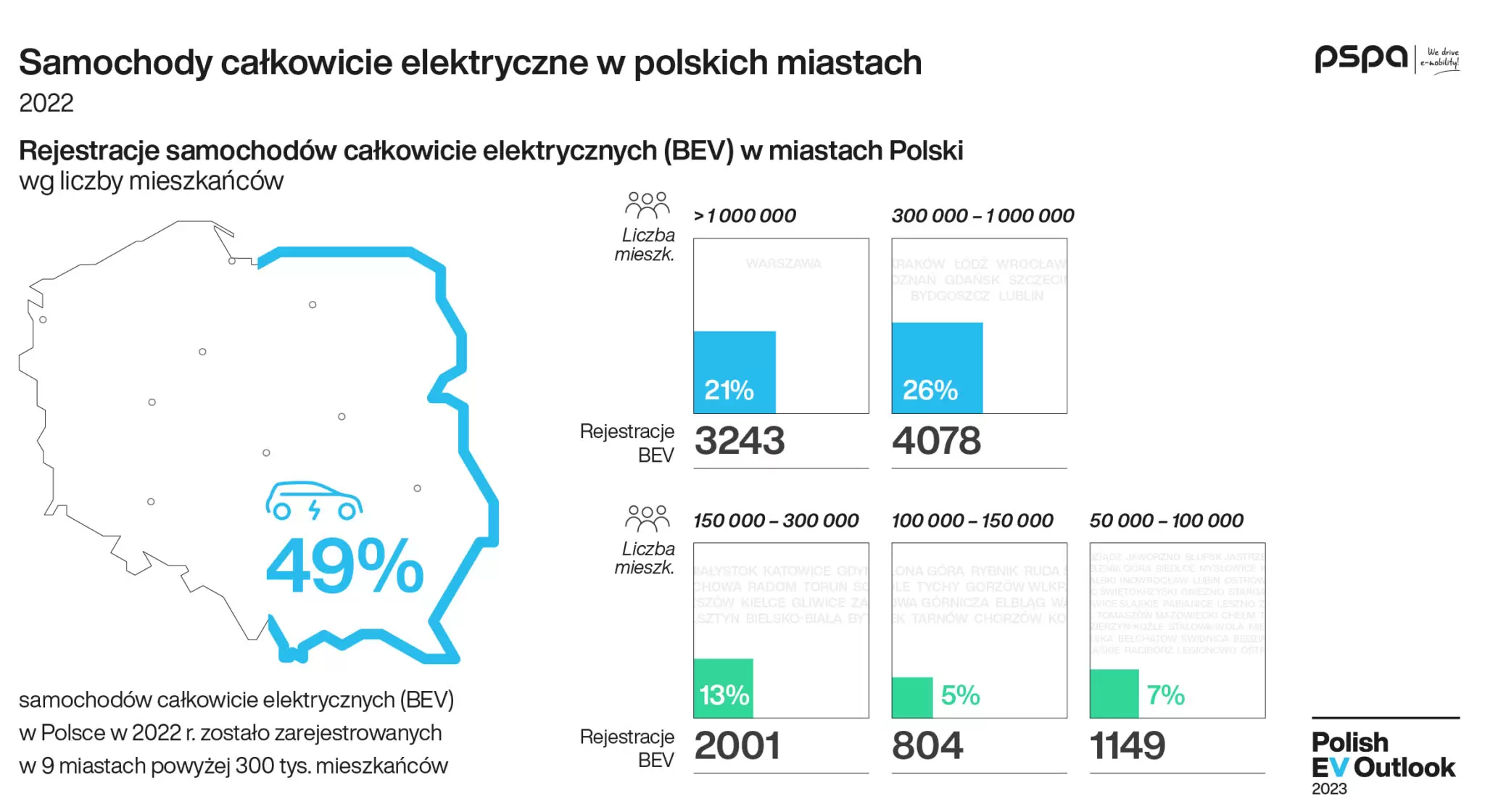
Electromobility in Poland is still concentrated primarily in the largest urban centers. The first edition of “Polish EV Outlook 2023” shows that the most fully electric cars – almost 22% of the entire Polish fleet – were registered in Warsaw. In 2022, the capital also accounted for over 21% of new BEV registrations in Poland. Approximately 26% of the Polish fully electric car fleet was registered in cities with populations between 300,000 and 1 million – Krakow, Lodz, Wroclaw, Poznan, Gdansk, Szczecin, Bydgoszcz, and Lublin. The fleet in smaller urban centers, with populations between 150,000 and 300,000, accounts for 12% of the total number of BEVs in Poland. Meanwhile, the share of cities with populations between 50,000 and 150,000 is approximately 5%.
– The highest number of BEVs per capita among Polish cities is in Warsaw – over 4. The next places were taken by Poznan, Katowice, Krakow, and Opole. The lowest result (below 0.5) was recorded in Bytom, Chorzow, Dabrowa Gornicza, Walbrzych, and Ruda Slaska. We also observe significant differences in the development of the fully electric car fleet at the level of voivodeships and counties. 31% of all BEVs in Poland were registered in the Masovian Voivodeship. The second place belongs to the Lesser Poland Voivodeship with a share of over 11%, and the third – to the Greater Poland Voivodeship. At the opposite pole are the Opole, Warmian-Masurian, and Swietokrzyskie voivodeships. Their combined share is only about 4.5% – says Jan Wisniewski, Director of the PSPA Research and Analysis Center.
Who buys electric cars in Poland?
Companies are increasingly making their mark on the Polish electromobility market. In 2022, entrepreneurs (excluding individuals running sole proprietorships) accounted for as much as 78% of registrations of new, fully electric passenger cars on the Polish market. The share of companies thus proved to be higher than in 2020-2021. The leaders in terms of the number of BEV registrations were lessors (almost 39% share) and car dealers.
– The high share of CFM (car fleet management) in the electromobility market should not be surprising, given that leasing and long-term rental are particularly attractive forms of financing from the perspective of electric car buyers (they reduce, among other things, the risk associated with the depreciation of the vehicle). 26 leasing companies have already signed agreements with BOŚ Bank under the “My Electrician” program, which positively affects the competitiveness of the offer for people intending to purchase a zero-emission vehicle with a subsidy – says Aleksander Rajch, Director of External Relations at PSPA.
Which electric cars do Poles choose?
“Polish EV Outlook 2023” also contains a collection of detailed information on the BEV offer available on the Polish market. Based on “PEVO 2023”, Poles can choose from 107 models of fully electric cars (82 passenger and 25 commercial). The given numbers become even higher when taking into account all battery and drive variants. The most extensive BEV offer in our country is proposed by the Stellantis group. The next places were taken by Volkswagen and Mercedes-Benz. The PSPA report shows that the most popular brands of fully electric cars in terms of the total number of registrations in Poland are Nissan, Tesla, and BMW.
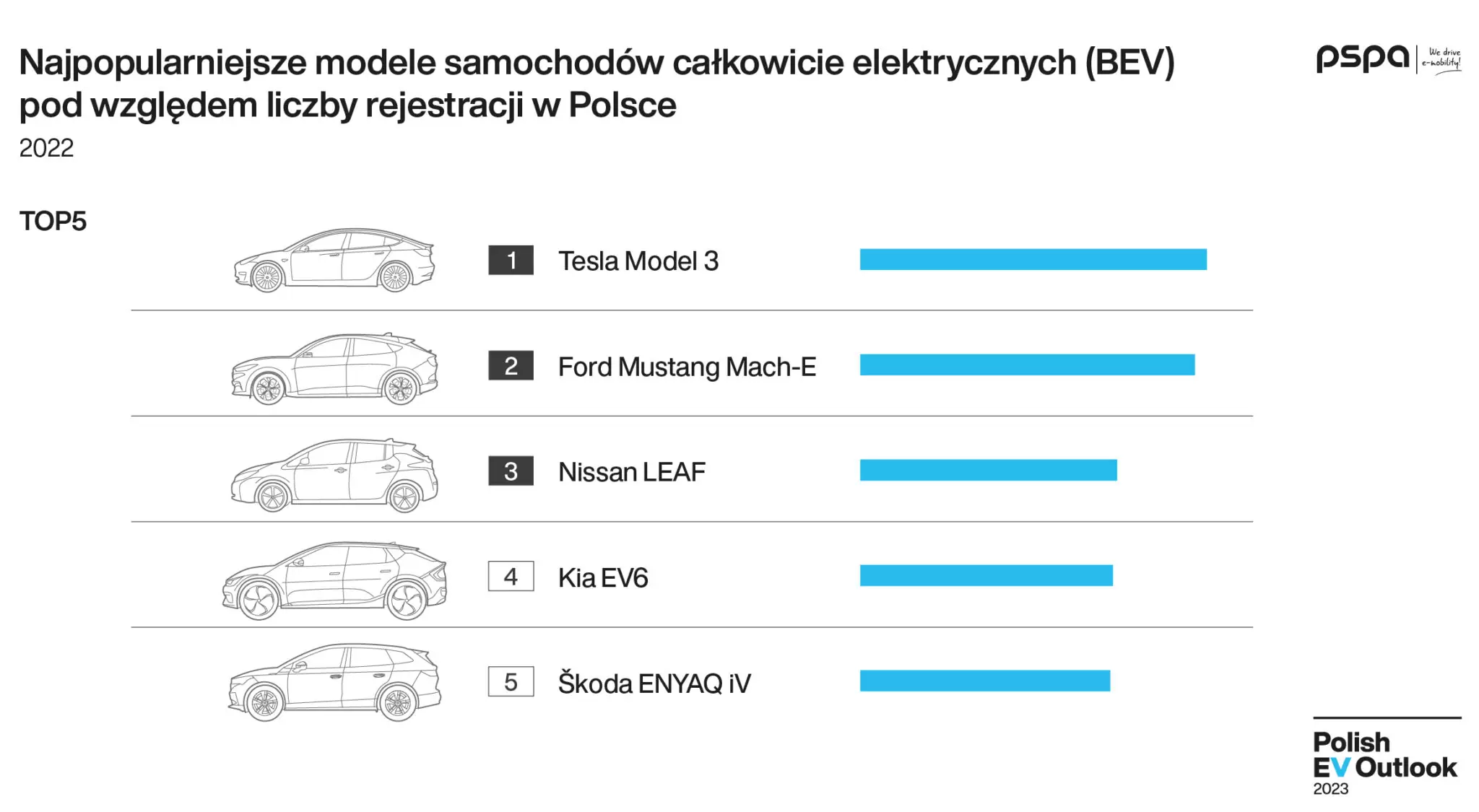
– Among the BEV models most eagerly purchased by Poles in 2022 were the Tesla Model 3, Ford Mustang Mach-E, and Nissan Leaf. In 2022, 18 new fully electric car models appeared in the Polish offer. Importantly, the average range of the debuting passenger models exceeded 500 km, and the average maximum charging power exceeded 150 kW. More than 30 further premieres of fully electric cars are planned for 2023 – says Albert Kania, Senior New Mobility Manager at PSPA.
When will we catch up with Europe in the electric car market?
For the purposes of “Polish EV Outlook 2023”, three different scenarios for the development of the electric car market were developed, in variants assuming the lack, continuation, or significant expansion of support programs for the electromobility sector in Poland. The forecasts are also based on a number of different factors, such as EU, national, and local legal regulations, leading trends in the automotive sector (also in the battery area), technological development, the implementation of clean transport zones, or progressive changes in consumer habits. Circumstances negatively affecting market development were also taken into account, including high inflation, supply chain disruptions in the automotive sector, or the ongoing war in Ukraine.
– In the forecast presented in the previous edition of “Polish EV Outlook”, we managed to predict the number of newly registered fully electric cars at the end of 2022 with almost 100% accuracy. In the realistic scenario, our estimate differed from the actual result by only 85 units. The margin of error was about 0.5%. We hope that the numbers included in the forecasts presented in “Polish EV Outlook 2023” will also be as close as possible to the final result in the electromobility segment that we will record in Poland in 2023. In the following years, the Polish e-mobility sector will definitely accelerate. We assume that by 2030, the total number of newly registered (from the domestic market and imports) fully electric cars (passenger and commercial) in Poland will increase to almost 170,000 units. We will reach a similar level of new BEV passenger car registrations as in Belgium, Spain, or Italy in 2022 as early as 2024, while we will approach last year’s result of the Netherlands in 2025 – says Maciej Mazur, Managing Director of PSPA.
The most comprehensive analysis of the electromobility sector in Poland
In addition to data on the passenger and commercial vehicle market, the content of “Polish EV Outlook 2023” also includes the first forecast in Poland for the development of the zero-emission heavy road transport market. Readers of the report can learn what factors are key to accelerating the pace of electrification of heavy-duty vehicle fleets in Poland and how many eHDVs will hit Polish roads by 2040. The first edition of “PEVO 2023” also contains a comprehensive analysis of the charging infrastructure network in Poland and forecasts for its expansion included in two variant scenarios. In the new edition of the cyclical PSPA report, data on the level of charging station utilization and the most important market trends, collected on the basis of in-depth interviews with leading operators of public charging networks, were published, among other things, which are not available in any other study. The report also describes in detail the recent changes in legal regulations shaping the Polish electromobility market.
More information about “Polish EV Outlook 2023”, as well as the possibility to order the report, is available on the website: Polishevoutlook.pl