








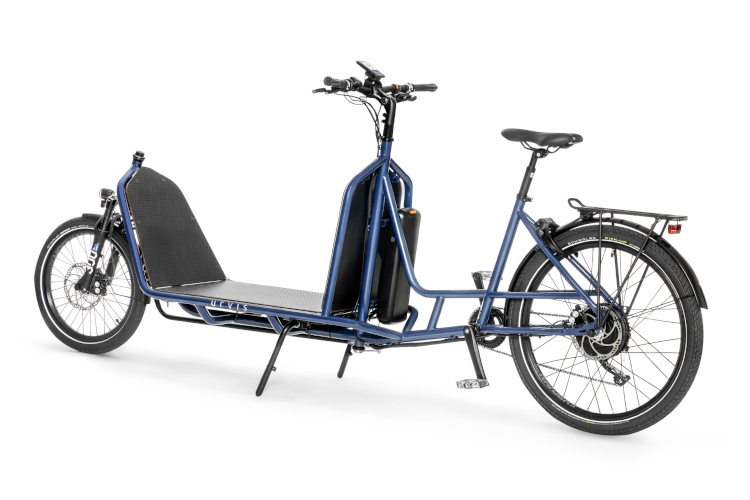
Cargo bike sales in Europe are hitting record highs. The City Changer Cargo Bike consortium forecasts that the market will grow by approximately 60% annually until 2030. In Poland, these types of bikes are also becoming increasingly visible, but they are still far from the levels seen in Germany, France, or England. Polish manufacturer Urvis Bike believes in catching up with Western markets and has prepared a new offer, under which its electric cargo bikes are available through several different acquisition models.
“Much has already been said about the effectiveness of cargo bikes in city centers. However, it is clear that for most delivery companies, this is still a novelty they are approaching with caution. Therefore, to convince more users and allow them to test this vehicle in specific conditions, we have introduced a new offer. The first element is a free trial program, where you can pilot one or several bikes to see if everything said about them is true. The second, and more important one, is an expanded acquisition model. Currently, our bikes can be obtained through direct purchase, installment plans, leasing, and a subscription model. Insurance and consulting on implementing bikes into a fleet are also available,” says Paweł Raja, CEO of Urvis Bike.
Cargo bikes from Urvis Bike are a Polish design based on a proprietary steel frame equipped with components from brands such as Shimano, Magura, and Bafang. The bikes are available in 4 different body variants for specific applications – with a flat platform, an open box, a closed box, or a canopy for transporting children. A network of company-owned service centers is also being developed (currently in Wrocław, Warsaw, and Poznań), where the bikes are serviced, and in the case of longer repairs, a replacement bike can even be provided. Depending on the model and purpose, the bikes cost approximately 23,000–24,000 PLN (which is below the prices of direct foreign competition), and in the case of choosing a lease, the monthly installment can be around 450 PLN net.
1.28 PLN per 100 km
“It won’t happen overnight, but car traffic in cities is being gradually restricted, and clean transport zones are being created. Furthermore, the cost of acquiring and subsequently owning a delivery van versus a cargo bike is incomparable. Of course, it is impossible to handle all deliveries with bikes, but where possible, it is worth considering seriously. We recently measured the energy consumption of the bikes under various loads and the associated costs. With a cyclist weighing 95 kg, an 80 kg load, and maximum assistance level, the cost of traveling 100 km is 1.28 PLN. Through our new offer, we want to show, in a non-invasive way, how much can be gained by diversifying a delivery fleet with cargo bikes,” says Adam Smorawiński, investor and co-founder of Urvis Bike.
Back in 2021, the University of Westminster in London conducted a study proving that cargo bikes in city centers are 1.6 times faster than delivery vans while achieving higher average speeds. More and more companies are realizing this; for example, DHL already carries out about 60% of its deliveries in 80 European cities using cargo bikes. There are many more advantages, such as no parking fines, zero exhaust emissions, and reduced time lost in traffic jams or searching for parking spaces.
However, it is worth remembering that cargo bikes have their specialization, where they fully realize their potential and provide a full package of benefits, but they are not the answer to all delivery challenges. This specialization is the last 5–7 km of the supply chain and urban areas. Therefore, they work best as a supplement to a fleet dedicated to last-mile deliveries.