








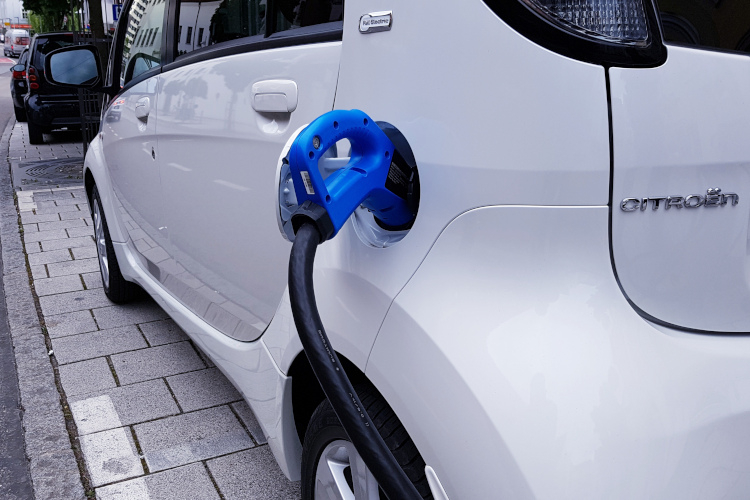
The vast majority of Polish metropolises have introduced paid parking zones, the price lists of which are increasing year by year. The current record holder is Krakow, where leaving a vehicle for an hour costs as much as 9 PLN. We decided to check how much you can save on parking by using electric cars, which are exempt from fees under current regulations. It turns out that you can save even several thousand a year.
Practically every city in Poland now has an unpaid paid parking zone (SPPN). The main reason for the creation of such areas is a deficit of parking spaces, and SPPNs increase the turnover of parked cars. The introduction of zones is also intended to encourage vehicle owners to use public transport. There is also a third aspect – fiscal. Thanks to the zones, authorities are repairing their budgets. In 2017 alone, the capital’s Municipal Road Authority obtained 94.9 million PLN this way, which is 4.5 percent more than the year before. Krakow obtained revenue from the SPPN at the level of 64 million PLN in 2020, and Gdansk and Szczecin nearly 15 million PLN.
– Unpaid Paid Parking Zones help regulate the parking situation for Warsaw residents. Those residents who live within the zone area have greater freedom of parking, while all users who arrive in the zone area will find it easier to find a parking space. The goal is to increase the circulation of vehicles parked in a given area – says Michał Olszewski, Deputy Mayor of Warsaw.
Those parking in the zone who are not residents with a permit must prepare for significant expenses, which may increase in the near future. From July of this year, the upper rates for the first hour of parking will range from 5.40 PLN in the paid parking zone and 16.20 PLN in the case of the downtown paid parking zone. Why so much? The level of rates is linked to the level of the minimum wage. Regulations in this regard are carried out by the city or municipal council in accordance with Art. 13b, paragraph 4, point 1, letters a and b of the Act of March 21, 1985, on public roads. From July 1, the gross base salary is to be 3600 PLN. Last year it was 3010. Hence the difference. The Public Roads Act indicates that the fee for the first hour of parking a motor vehicle cannot be higher than 0.15 percent of the minimum wage – in the case of a paid parking zone and 0.45 percent of the minimum wage – in the case of a downtown paid parking zone. The law also regulates fees for the second and third hour of parking. In this case, the fees are progressive – a maximum increase of up to 20 percent in relation to the rate for the previous hour. In turn, the price list for the fourth and subsequent hours of parking cannot be higher than the rate for the first hour.
– The zone is not there to make money, but to ensure the rotation of parking spaces. We believe that where there is no problem finding them, fees should be lowered, and where there is a shortage of free spaces – raised – argued Michał Starobrat, head of the Nowoczesny Kraków club, during the February City Council meeting, as quoted by Polskapress.
Price list adjustments are already taking place
New rates were recently presented by Krakow. The first hour of parking for city residents who have a Krakow Card and use the mobile application in subzone A will not change – it will be 6 PLN, and in subzone B – 5 PLN, in subzone C – 4 PLN. The second hour costs 7, 6, and 4 PLN respectively. The third hour of parking is 8, 7, and 4 PLN, and the fourth and subsequent ones are 6, 5, and 4 PLN. Those who do not use the application will pay as much as a tourist, i.e., 9 PLN for the first hour in zone A, 8 PLN in subzone B, and 7 PLN in C, and in subsequent hours it will be even more expensive – up to 11 PLN for the third hour.
Sopot is also preparing changes to its price lists. During the February session of the City Council, a resolution regarding the paid parking zone in the resort was processed. – The resolution included, among other things, a change in parking fees in the city. Raging inflation, rising prices related to the maintenance of urban road infrastructure, and the increase in the minimum wage forced the need to make one-time fees realistic. According to the resolution, the fee was changed for parking an hour in the zone from 4.50 to 5.20 (second hour from 5.40 to 6.20, third hour from 6.40 to 7.40). Unfortunately, according to current law, Sopot cannot charge parking fees on weekends and holidays, when car rotation is most desired – explains Anna Dyksińska, spokesperson for the Sopot Road and Greenery Management.
More SPPN
It is a fact that parking fees in 2023 will be higher in many cities. Additionally, some metropolises are also planning further expansion of the SPPN. This is what Krakow will do. – Subzones have changed (and consequently, the parking rate will change) such as: subsector C10 will change to B10 (Krowodrza – Wrocławska – to the railway tracks), subsector B6 will change to A6 (Zwierzyniec – from the Avenues to the Rudawa River), and subsector C5 will change to B5 (Dębniki) – informs Sebastian Kowal from the public relations team of the Public Transport Authority in Krakow. – Gdansk also plans to expand the paid parking zone this year, but this is conditional on the successful resolution of the tender for the purchase of new parking meters. This can happen at the earliest in the fourth quarter of the year – says Magdalena Kiljan, spokesperson for the Gdansk Road and Greenery Management. – This year in Poznan, we plan to expand the paid parking zone area to include the Sołacz area – also announces Agata Kaniewska, spokesperson for the Municipal Road Authority.
Sopot also has such plans. The resolution of the Sopot City Council from February this year expanded the paid parking zone to include more streets. As the spokesperson – Anna Dyksińska – explains, the changes were preceded by consultations with residents, who themselves indicated the streets that the zone covers. According to the residents’ wishes, the zone was expanded to include the following streets: Karlikowska and Okrzei (zone B), Dębowa, Lipowa, Marii Skłodowskiej-Curie (zone B), Kościuszki St. and Władysława IV – from 3 Maja to Kościuszki (zone B), 23 Marca (between Armii Krajowej St. and Aleja Niepodległości) and 1 Maja (between Armii Krajowej, Aleja Niepodległości) and Grottgera Street. At the same time, issues regarding zones in the city were organized. Thus, from 10 zones and subzones, 3 year-round subzones and 2 seasonal ones were designated. – This procedure will result in greater clarity of areas in Sopot where parking fees must be paid and will increase the convenience for residents in choosing a parking space in the vicinity of their place of residence – adds Anna Dyksińska, spokesperson for the Sopot Road and Greenery Management.
Also, the capital’s councilors during the February session were to decide on expanding the SPPN to include Saska Kępa and Kamionek. – Ultimately, the resolution was not voted on, so it will likely be considered at one of the next sessions. However, I do not know the effective date – it could be this year, but it could also be, for example, January 2024. We are also after studies regarding the southern part of Mokotów, in the process of preparing projects that will be the basis for social consultations. But here, the expansion will certainly not happen this year – says Jakub Dybalski, spokesperson for the Department of Strategy and Social Communication.
– Katowice is also in the process of changing its parking policy. The starting point was conducting research in 2018. All actions were based on conclusions developed by experts. The proposals were subjected to broad consultations with residents, institutions, and entrepreneurs – explains Sandra Hajduk, spokesperson for the Katowice City Hall. As part of the changes, the paid parking area is to be increased.
– Additionally, it will be divided into two zones – the Downtown Paid Parking Zone and the Paid Parking Zone. The Downtown Paid Parking Zone will mostly overlap with the current paid zone area. It constitutes the strict city center, which should be intended mainly for residents, pedestrian and bicycle travel, public transport, or shared travel. We plan that the expansion of the paid parking area and the creation of the downtown zone will take place this year – adds Sandra Hajduk.
What about weekends?
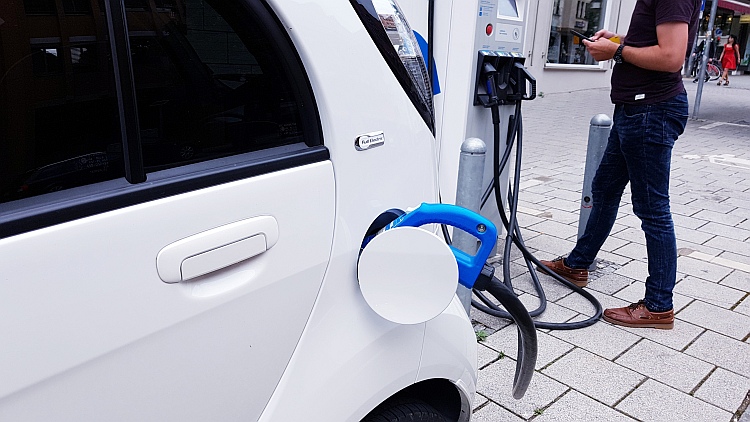
Area changes and price list changes – fortunately for drivers – do not go hand in hand with extending operating time to additional weekend days or hours. – The paid parking zone will be in effect – as before – from Monday to Saturday from 10:00 AM to 8:00 PM – assures Sebastian Kowal from the Public Transport Authority in Krakow. There will also be no changes in the scope of zone operating hours in, among others, Gdansk, Olsztyn, or Poznan. Also in Sopot, the zone will be in effect unchanged from 9:00 AM to 10:00 PM, from Monday to Friday. – Unfortunately, regulations do not allow for the introduction of fees, and thus force car rotation on weekends. In the case of Sopot, a city with a tourist character, which is also a health resort, extending the validity of the zone on weekends is a key problem. Unfortunately, still ignored by those in power – explains Anna Dyksińska, spokesperson for the Sopot Road and Greenery Management.
Analyses regarding extending the zone’s operating time were carried out by Warsaw. – Last year, we conducted analyses in the City Center and Powiśle regarding the possible creation of a downtown zone with fees on weekends (at the level of fees on working days). The analyses showed that such a change would be justified, and we recommended such a solution to the city hall – notes Jakub Dybalski from the capital’s Department of Strategy and Social Communication.
How much does parking cost?
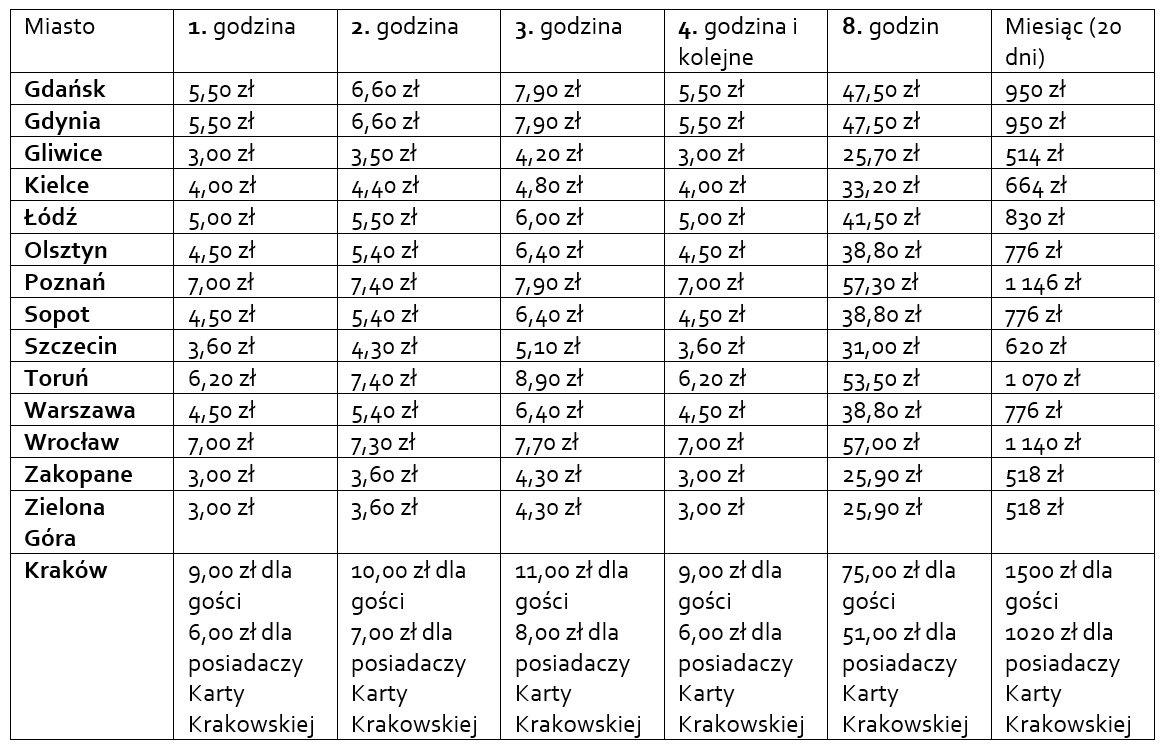
In the case of vehicle owners who will occasionally use the SPPN, the increase in fees should not significantly strain the budget. However, for people who work in city centers and are forced to use municipal parking lots, the costs are much higher. In the case of the aforementioned Krakow, an 8-hour stay for a resident of the capital of Lesser Poland will mean 51 PLN in subzone A (1020 PLN per month; 12,240 PLN per year). For people from outside the city, it is an expense of 75 PLN for 8 hours (1500 PLN per month; 18,000 PLN per year). Drivers can also use a daily subscription – 55 PLN, 7-day – 300 PLN, or monthly – 500 PLN (for subzone A). A monthly subscription for zones A+B+C is an expense of 750 PLN – we read on the ZDM Krakow website.
Eight-hour parking in the capital costs less than 39 PLN (first hour – 4.50 PLN, second hour – 5.40 PLN, third hour – 6.40 PLN, fourth and subsequent hours – 4.50 PLN each). This means that you have to spend 776 PLN per month on parking in Warsaw, and 9,312 PLN per year. The cost of monthly parking in the downtown paid parking zone in Wroclaw (in area A), taking into account an 8-hour stay, would be 1140 PLN (7.00 PLN for the first hour of parking; 7.30 PLN for the second hour of parking; 7.70 PLN for the third hour of parking; 7.00 PLN for the fourth and every subsequent hour of parking), and 13,680 PLN per year. The same parking in Gdansk is an expense of 950 PLN per month and 11,400 PLN per year (5.50 PLN – for the first hour of parking; 6.60 PLN – for the second hour; 7.90 PLN – for the third; 5.50 PLN – for the fourth and subsequent hours) and in Katowice (in the “City Center” and “Ceglana-Wita Stwosza” subzones) – 516 PLN per month and 6,192 PLN per year (first hour: 3 PLN; second hour: 3.6 PLN; third hour: 4.2 PLN; every subsequent hour: 3 PLN).
Who will not pay?
According to regulations, vehicles of, among others, uniformed services, emergency services, armed forces, road authorities, school buses transporting children to school, and electric vehicles, as referred to in Art. 2 point 12 of the Act on Electromobility and Alternative Fuels, are exempt from fees for parking motor vehicles on public roads, i.e., in the paid parking zone and in the downtown paid parking zone.
With the entry into force of the Act of January 11, 2018, on Electromobility and Alternative Fuels, the provisions of the Public Roads Act (i.e., Journal of Laws 2017, item 2222, as amended) were changed. According to Art. 13, paragraph 3, point 1, letter e of the amended act, electric vehicles were exempted from fees for parking motor vehicles on public roads in the paid parking zone.
– According to the regulations, these must be vehicles that meet the requirements of the definition contained in the Act on Electromobility and Alternative Fuels, i.e., using exclusively electrical energy accumulated by connection to an external power source for propulsion – explains Mikołaj Krupiński, spokesperson for the Motor Transport Institute.
In other words, owners of electric cars park for free in paid parking zones that have been designated on public roads. – It should be emphasized at the same time that no additional marking of the car, e.g., with green license plates or EE stickers on the windshield, is required – adds Krupiński. Nevertheless, one must take into account the fact that if an electric vehicle does not have markings, e.g., green license plates, the services controlling the zone have the right to issue a summons to present the registration certificate, where there is an annotation about the type of drive.
A user of an electric car who parks it for free, e.g., for three years in one of the Polish cities, can save a considerable sum this way. Whether it is Katowice, Gdansk, Warsaw, Sopot, or Szczecin, it can be even from approx. 80 to over 200 thousand PLN! Savings on the parking meter is one thing. To this, one should add the possibility of using municipal bus lanes, which shortens travel time. This last privilege, resulting from Art. 148a of the Road Traffic Law Act, is, however, to be in effect only until January 1, 2026.
Source: elektromobilni.pl