








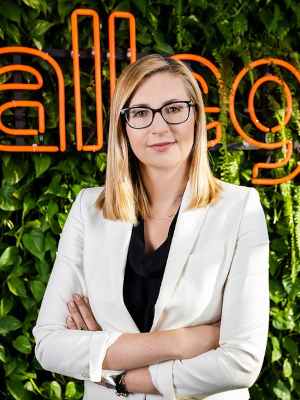
The past year has seen many events that have impacted us, as well as our economic situation. How can we summarize 2022, and what trends, changes, and challenges will 2023 bring for the e-commerce market? Commentary provided by Aleksandra Sroka-Krzyżak, Strategy Director / Chief of Staff at Allegro.
 Events and trends of the 2022 e-commerce year
The past year has seen many events that have impacted us, as well as our economic situation. Personally, I can point to three events that have had a very significant impact on e-commerce.
The first and most important is Russia’s invasion of Ukraine, which caused, among other things, price increases and influenced customer purchasing behaviors and preferences. We have observed that shoppers are spending more time searching for the right products at the lowest prices and for free delivery. They are also increasingly turning to flexible payment methods. Poles, as well as those in the refugee crisis who arrived in Poland over the past year, are strongly feeling uncertainty about the economic future. As the largest e-commerce player in this part of Europe, we want to support our customers by providing them with the largest selection of products and the best prices on the market. Furthermore, we are actively involved in charitable initiatives – thanks to the actions of the Allegro Group and the support of our customers, we have donated 11.7 million PLN to support victims of the war in Ukraine.
The second significant change occurred in the so-called quick commerce segment. At the beginning of the year, we saw growth trends – especially in the area of food delivery – but the second half of the year revealed problems characteristic of this business model. Above all, it is an industry where it is very difficult to achieve profitability. During the pandemic, the number of companies providing such services grew rapidly. However, the market and rising inflation verified their profitability, often forcing consolidation or exit from the market. In an era of very expensive capital costs, investors and investment funds are also much less willing to finance businesses that cannot prove they will ever be able to generate profits.
Another important event of 2022 was the popularization of the buy now, pay later payment model. Not long ago, this was a niche product, which is now becoming a large-scale business. At Allegro, we see huge and still growing customer interest, as well as very high satisfaction results with the Allegro Pay service (our NPS above 95 is probably a record in this industry!). This model works particularly well now, during a time of rising prices, because it helps in managing the household budget. I think the buy now, pay later model will continue to develop and become an increasingly important factor in choosing where to shop.
The impact of the pandemic and inflation on the industry in 2022.
The pandemic had a huge impact on e-commerce because, in a short time and very rapidly, a huge portion of traffic moved to shopping platforms and e-stores. But the forecasts that spoke of the collapse of shopping malls and brick-and-mortar stores did not come true. We observe that customers – especially those who used online shopping for the first time during the pandemic – are now returning to their habits and opting for offline shopping.
But it is worth emphasizing that the pandemic contributed to another change that seems to be more permanent. Sellers realized that offline sales alone are not enough. We see this at Allegro, where many new companies have appeared – even those that until now had a very traditional approach to their sales channels. Those who bet on online are already seeing that omnichannel sales bring additional profits. At the same time, a shopping platform is the simplest and fastest way to develop a new sales channel without significant investment outlays.
Trends, changes, and challenges in 2023
We see more and more clearly that in times of rising prices, customers are approaching shopping more cautiously. They focus even more on quality, choose the option of spreading payments over time, and also check whether – if necessary – they can return the goods without any problems. Therefore, platforms and online stores that take care of these aspects, increasing customer convenience and ensuring good customer service experiences, will win.
Another trend we are already observing – although it only has the potential to become a significant growth factor – is ecology and sustainable development. Young people, in particular, pay attention to whether the actions a company engages in bring real change. In the case of e-commerce, plastic-free and recycled packaging will gain importance, as will delivery methods that have a lower impact on the environment. An example could be parcel lockers, which replace up to 90 courier deliveries to different addresses with delivery to one convenient location for many customers. Large companies will also be watched more closely in terms of being a “good neighbor,” i.e., how they behave in the local space and what charitable and sustainable development initiatives they are involved in.
The third trend is technology used more practically – focused on bringing measurable benefits. We see that the days of easy access to capital are over, which is why projects that did not have a clear goal or direct translation into business – such as blockchain or impractical examples of metaverse usage – are losing popularity. Smart use of technology is that which gives the customer additional value. Customers have become more impatient, mobile, and consequently, they expect fast and convenient solutions from technology. Therefore, I predict that in the near future, the development of artificial intelligence or augmented reality will move towards meeting very specific customer needs and expectations.
In the case of challenges typically related to our industry – it is certainly worth mentioning the Omnibus Directive. While Allegro introduced the recommended changes earlier and customers already saw the real value of discounts during this year’s shopping festivals such as Smart! Week and Black Week, many companies are still just beginning this process. But again, we return to the topic of paying closer and more critical attention to whether companies are acting fairly or just conducting effective marketing.