








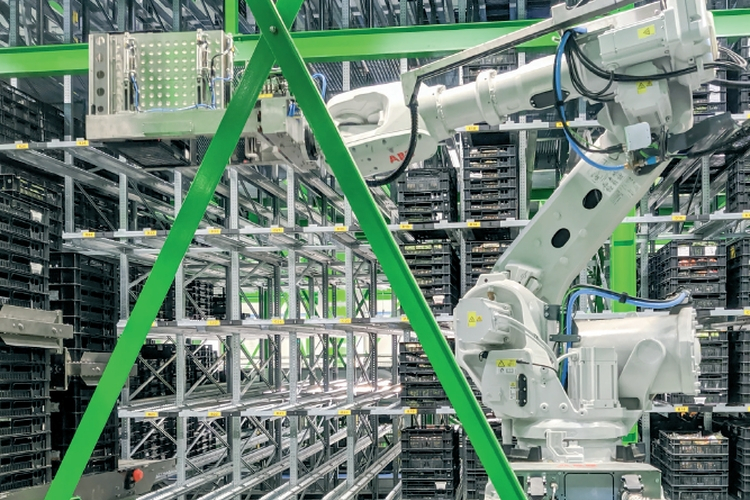
At the Heemskerk processing plant, ABB robots have automated order picking. This has reduced the time fresh food spends in the supply chain, while simultaneously extending shelf life and minimizing waste.
The Problem
The Dutch company Heemskerk delivers 3.5 to 4 million fresh products weekly to retailers and fast-food chains worldwide. Due to the growing demand for minimally processed plant-based food, the company has expanded its operations, offering over 400 products such as fresh salads, ready-to-cook meals, and pre-cut fruits and vegetables. As it grew, Heemskerk faced supply chain challenges, as the company had to fulfill “just-in-time” deliveries of fresh food products to supermarkets across the country. Since food items like fresh salads and ready-to-cook meals have a very short shelf life, typically three to four days, the ability to reduce the time spent in the supply chain is crucial for Heemskerk and supermarket customers, who can store them for longer and reduce potential losses. The existing manual order picking and dispatch operations at the Heemskerk facility were no longer sufficient for the company. The lack of skilled labor to handle the process on a large scale also increased production costs. The company faced the decision to implement a flexible and scalable automation solution that could pick and stack orders.
The Solution
Responding to Heemskerk’s needs, ABB provided robots to automate order picking operations. The robotic order picking installation at the Heemskerk plant in Rijnsburg, Netherlands, prepares orders according to the needs of each supermarket or food retailer so that products can be reloaded directly onto supermarket shelves rather than stored in distribution centers.
– The robotics system used helps us by supporting our very fast production and order picking process. As a result, 75% of processed products reach retail stores within 24 hours – says Peter van Duijvenbode, COO of Heemskerk Fresh & Easy.
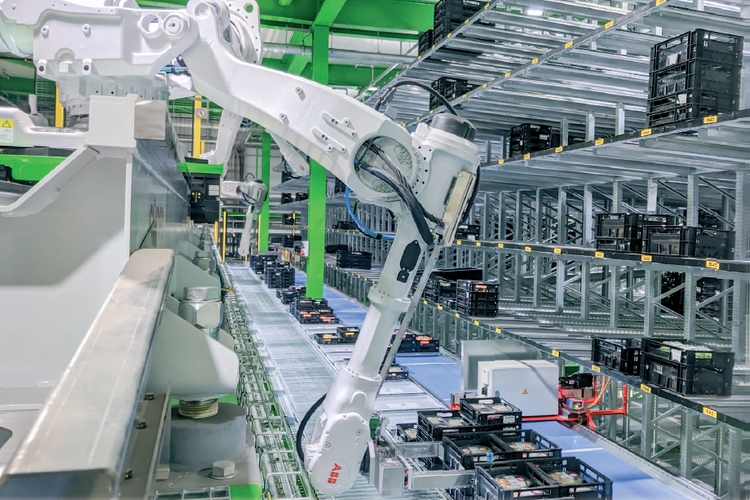
The first element of the implemented installation is a four-axis ABB IRB 660 robot, which removes order crates for a given supermarket and places them on a conveyor belt. The crates then move to the order picking zone, where six six-axis IRB 6700 robots pick up the crates and place them in slots designated for a specific supermarket. Two other IRB 6700 robots, located on the other side of the picking zone, consolidate the picked crates, creating stable, mixed, high stacks. These crates are finally picked up by another four-axis IRB 660 robot, which places them on trolleys to be transported directly to the supermarket. This form of order picking makes the solution more robust, as it can seamlessly process an infinite number of orders – a concept very useful for the daily changing orders in the fresh food industry.
Benefits
One of the most important advantages for Heemskerk and supermarket customers is that the solution reduces the time fresh products spend in the supply chain, which extends their shelf life, minimizes losses, and creates a more sustainable solution for the fresh food industry.
Another major advantage for Heemskerk is the flexibility offered by the ABB system. Thanks to fast yet precise movements, the robots are able to quickly adapt to the changing requirements of supermarket and grocery store customers, whose demand for quantity and variety of products changes almost every day, as well as seasonally. Unlike traditional logistics automation, which typically handles single units in a time-consuming order picking process, the ABB robotic solution enables Heemskerk to fulfill over 60 large deliveries every day.
– Currently, ABB robots are able to process between 300 and 400 crates per order. Previously, about 30-40 people were needed to perform the same task – says Chris Vleeschouwers, Sales and Marketing Manager at ABB’s Consumer Segments and Service Robotics.
While the system processes over 800,000 crates per week, it can handle two or even three times that amount without the need for changes. On one hand, this flexibility allows Heemskerk to quickly increase volume based on demand without additional investment, and on the other hand, the solution eliminates the underutilization of the automation system on days when demand is low.
The modular and standardized design of the ABB robotic solution makes it very easy to add new robotic zones to meet additional production capacity. Heemskerk plans to add more robots to the current system to support its future growth. The entire solution can be installed in relatively low buildings or even divided into several modules that do not necessarily have to be placed next to each other. This makes the automated logistics solution ideal for use in brownfield sites. Furthermore, the system consists of fewer components, which means lower maintenance and spare parts costs.