









Melting forecasts for the global economy and trade are still kind to the e-commerce sector and the logistics companies that serve it. However, a slowdown in both industries is inevitable, although the current shopping peak will slightly cushion the coming declines. The following quarters will be more demanding for both e-shops and logisticians. Already, high transport and material prices are forcing companies to cut costs and abandon free returns. Yet, the online customer is not letting up; they want it faster, more convenient, and cheaper, and preferably for free.
The destabilization of the global economy caused by the war in Ukraine, the energy crisis, inflation, and the tightening of monetary policy, as well as the still-felt effects of the pandemic, are expected to lead to a slowdown in global GDP growth, declines in industry and investment, and a reduction in consumer demand this year and next. In October of this year, the International Monetary Fund updated its growth forecast for the global economy downward to 3.2% in 2022 and 2.7% in 2023. Compared to the estimates from April of this year, this is a decrease of 0.4% and 0.9%, respectively. According to the IMF, Poland is expected to grow slightly better this year than previously predicted in April (3.8% versus the earlier 3.7%), but a hard landing is forecast for 2023. The growth rate of Poland’s GDP will fall from the previously announced 2.9% to 0.5%, and we are not expected to regain a dynamic of 3.1% until 2027.
The slowdown and worsening sentiment in the economy herald a wave of declines and uncertainty in transport, which can be seen, among other things, in credit risk assessments for this sector. The latest Country & Sector Risk Barometer index published quarterly by Coface has defined the risk in global transport as high, and in all of Europe as very high. The indicator, calculated based on changes in revenue, profitability, net debt, cash flows, and claims observed by Coface, does not bode well for retail sales either, for which the risk in Central and Eastern Europe has been downgraded to a high level.
The mounting turbulence in trade and the decline in consumption are also visible in a study published in September by GfK. It shows that 82% of Poles announce a reduction in purchases of larger goods and services, and 70% of consumers are suspending the acquisition of unnecessary products. Also, 78% of respondents declare limiting expenses and looking for savings in grocery shopping. The GfK analysis further indicates that price has become a significant element of the purchasing decision, and half of Poles are looking for promotions, while 42% are looking for goods at lower prices.
Slightly better statistics come from consumers shopping online, which in turn is good news for logistics operators serving this market. A September study published by Gemius, PBI, and IAB Polska shows that Poles surveyed in the middle of the year did not limit online shopping due to high inflation, and 58% of respondents claimed that they buy online as much as before. In turn, 14% bought more online. E-consumers made similar declarations for the following months. As many as 53% of them announced that they did not intend to reduce their online shopping behavior, while 13% indicated that they would buy online more than before. They are motivated to shop online by 24/7 availability (75%), not having to drive to a store (74%), and prices lower than in traditional stores (67%). Price is also a key factor for those internet users who have not shopped online so far. It is the price competitiveness of offers that would convince them to e-commerce (33%). Next would be lower delivery costs and discounts (32% each).
A slowing but still positive trend in Polish and global online trade
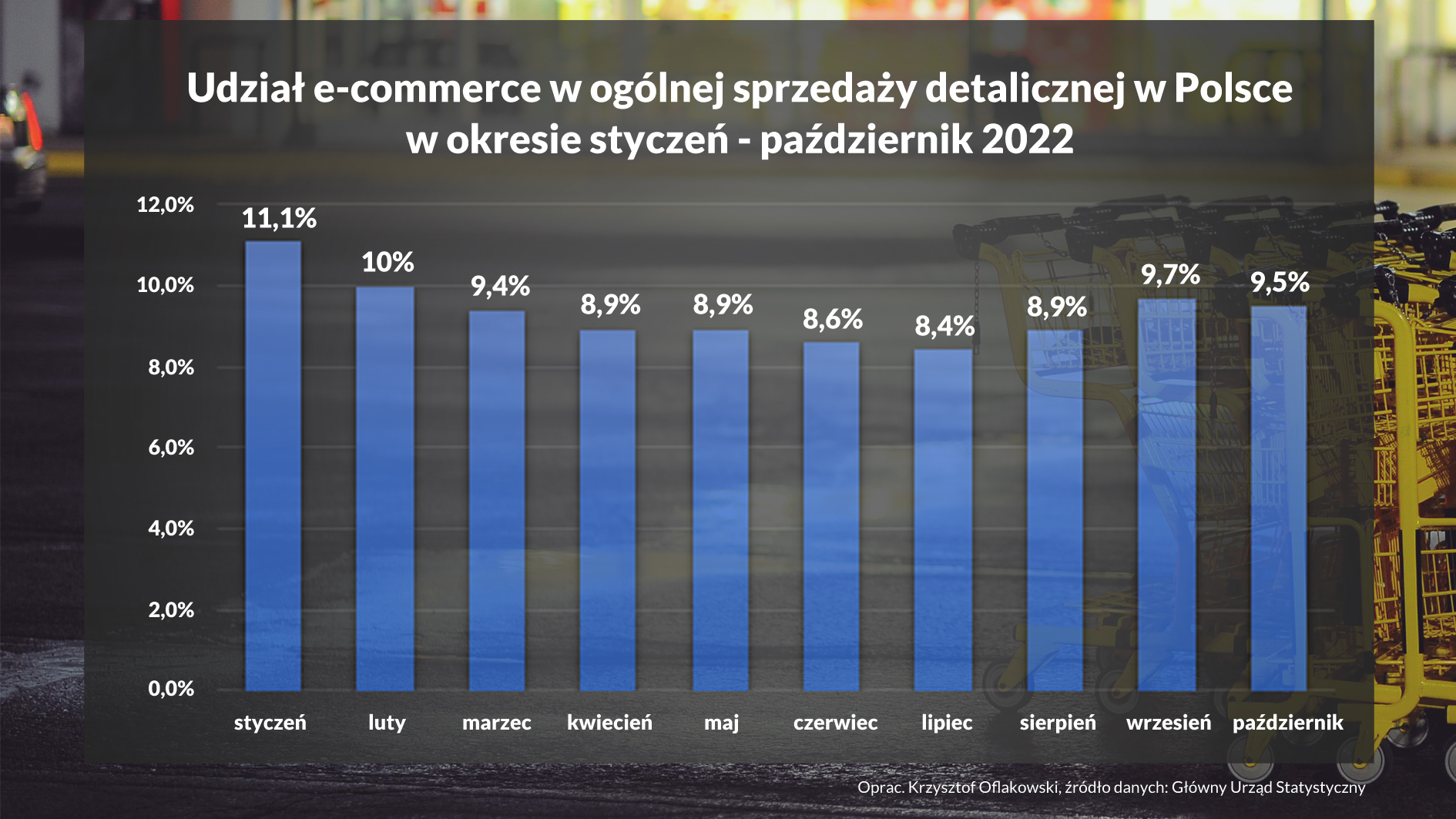
The relatively good position of Polish e-commerce is indicated by, among others, GUS data. It shows that already in August, the share of online trade in total retail sales returned to the levels of April and May of this year (8.9%) and was 0.5% higher than in July. In September, this share increased again, reaching a level of 9.7% with a slight weakening in October (9.5%). In both cases, this is a better result than in March (9.4%) and all months of the second quarter. In January, when the highest value this year was recorded, the e-commerce share was 11.1%.
– Handling online orders can be a relatively safe haven during a slowdown, especially in the coming months. We are entering the season of annual shopping peaks, and the fourth quarter is usually also a good period for the logistics sector. Recent years with the galloping development of e-commerce have meant that more than three-quarters of Polish internet users shop online. We also have a high rate of people using the internet, which has already reached over 90%, and more and more people are staying there permanently. This year, we also expect great interest in virtual shopping, although due to inflation, reaching almost 18%, the shopping volume may be lower. Paradoxically, however, higher prices in traditional stores may redirect consumer attention towards e-commerce. The financial factor will therefore work very strongly in favor of e-shops, and everything indicates that with persistently high prices, this phenomenon will also extend to next year. Although the entire transport sector, like the European and global economy, will feel the coming slowdown, handling online shopping may cope slightly better than, for example, the catering or hotel industry – says Marcin Bąk, President of the Management Board of Spedimex, a Polish operator serving retail chains, shopping malls, online trade, and less-than-truckload and FTL transport in Poland and Europe.
Despite unfavorable circumstances, PwC also draws attention to slower, but still positive, development prospects for domestic e-commerce. The latest forecast predicts a 13.7% growth in the sector’s value in 2023 and 11.9% a year later. The market value will also grow in subsequent years, reaching PLN 187 billion in 2027 compared to PLN 109 billion this year. At the end of the forecast period, the number of e-consumers, who will be served by 282,000 online sellers, will also increase to 20.6 million from 17.1 million in 2021. That is 102,000 more than a year ago. Global e-commerce also has a positive growth forecast for the coming years. According to Insider Intelligence and eMarketer analyses, global online retail sales could reach nearly $7.4 trillion in 2025 compared to just under $5 trillion in 2021.
Logistics companies serving e-commerce will also earn well
This year’s calculation published by Transport Intelligence (Ti) assumed that between 2021 and 2026, the global market for logistics services for e-commerce would grow at an average annual rate of 11.8%. Last year, the sector grew by 19.9% to 441.47 billion euros, and among the 10 countries with the largest nominal growth was Poland with a 41% increase.
Cross-border services will also enjoy great interest, for which an average annual growth of 10.65% is forecast until 2026. E-commerce will also significantly contribute to further, albeit weaker, growth in the global express and small parcel market. Ti estimates indicate that the value of such services will grow by 9% (yoy) this year and exceed the value of more than 503.5 billion euros. In 2021, double-digit growth was observed in 6 out of 7 major regions of the world, and the entire market grew by 12.2%. This year’s single-digit levels are expected to be visible in both domestic shipments (9.1% yoy) and international ones (8.3% yoy). The driving force of the industry will primarily be e-commerce in the B2C model, which currently accounts for about 60.3% of the market. In 2026, this share is expected to be 65.9%. As in the entire global logistics, a slowdown is also expected here, resulting from the weakening condition of the global economy. Therefore, the average annual growth in the market for such shipments is estimated at 7% until 2026, and international services (8.1%) are expected to develop slightly faster than domestic ones (6.7%).
Poland also has good growth prospects in this segment
According to the September Last Mile Express report, the Polish CEP market reached a value of PLN 13.7 billion last year and a shipment volume of over 1 billion units. In 2023, this is expected to be over 1.33 billion parcels, which will translate into an average annual growth of 14.4%. The market value will also grow to PLN 19.9 billion, which in this regard will grow at an average rate of 19.9% per year.
Handling free returns has become too expensive
Weaker, but still growing indicators do not mean that companies serving e-commerce will pass through the crisis unscathed. Not only will trade slow down, but the tense situation in the global economy is compounded by rising operating costs and pressure from consumers regarding the time and forms of order fulfillment and returns. Pressure is exerted not only on logistics operators but also on sellers, who, dependent on the shopping habits of their customers, are increasingly stretching the profitability limit in terms of logistics support for online purchases. This has already led to a situation where the largest global players are abandoning the option of free returns, even though such a policy was until recently a key factor determining the level of competitiveness online.
This issue has become too burdensome for, among others, the clothing giant H&M, which is testing paid returns in the UK and Norway. The brand points out that this is to help cut expenses, which have increased, among other things, after price hikes for materials and transport. Products ordered online can still be returned for free in brick-and-mortar stores, and another clothing giant, Zara, has decided on a similar step. A fee of over 2 dollars is deducted from the amount returned to the customer, and the described solution had its pilot, among others, in the UK, Ireland, Belgium, and the Netherlands. Paid returns are also being opted for by British Boohoo, Next, as well as the Japanese Uniqlo and a number of other companies in the clothing industry. All decisions in this regard have a common denominator – logistics costs, projected weaker sales dynamics, and a high percentage of returns.
The largest player on the Polish e-commerce market – Allegro – has also decided on price hikes. Since November 21, the minimum purchase amount guaranteeing free delivery in the Smart subscription, which also provides free return options, has increased. For deliveries to parcel lockers and collection points, the value of the shopping basket increased by 12.5% to PLN 45. To not pay for courier delivery, you have to make purchases for a minimum of PLN 65. That is a jump of as much as 62.5%. The Smart package itself also grew by 20%, with an annual subscription for new subscribers now costing PLN 59.90.

The burden of deliveries and returns is growing, but not everyone decides to make changes
Return statistics differ significantly depending on the category of ordered products. According to last year’s Nielsen and Sendcloud study, the most frequently returned goods in Europe are clothing and accessories, where the average for 8 surveyed countries with developed e-commerce markets is as high as 58%. Slightly fewer sports products (56%) and those from the home and garden category (55%) are returned. Electronics (53%) and the health and beauty segment (51%) are further down the list. The least returned are toys, books, and games (43%).
– So far, we have not observed such a significant percentage of returns in the health and beauty category on the Polish market. Our experience shows that they do not even exceed a single-digit level, which is a very good result compared to other segments of online trade. This testifies not only to a high level of consumer maturity but also to a high-quality assortment that meets customer expectations. Due to the low percentage of returned products, we are not planning any changes in this regard in the near future. However, we see how crucial logistics support for orders is for building a position in the e-commerce channel and customer relations. Shopping experiences and after-sales service, and thus also returns, have become an important factor of competitiveness. Customer expectations in this regard are systematically growing because more and more people are moving their shopping activity to the internet, and the consumer in this channel is just as demanding as in a traditional store. At the same time, the number of e-sellers who fight for the customer with service quality, and not just product price, is growing. However, the market is still evolving, and in recent years, a certain trend can be noticed, namely, as the basket value increases, the number of returned products decreases. More and more customers also make the finalization of an order dependent on the company’s delivery and return policy, especially when it comes to the lead time and cost of these services – says Katarzyna Sawińska, Senior Logistics and Transport Manager at Sephora.
This is confirmed by research conducted among e-consumers in Europe. According to Nielsen and Sendcloud, as many as 74% of customers will give up shopping in a specific online store if it turns out that returning goods is paid. Also, the analysis of e-commerce deliveries conducted this year by Ipsos points to the key role of logistics. As many as 85% of surveyed respondents declare that delivery time is important or very important to them, and the same percentage always verifies it before purchasing. For 36% of shoppers, the cost of the service also plays a decisive role, while 85% will not return to a seller if the delivery process fell below their expectations. Especially this last indicator well shows how strongly the relationship between e-shops and the logistics companies serving them has evolved. Ipsos additionally emphasizes the fact that for the majority of buyers (57%), the possibility of choosing between same-day or next-day delivery is also important.
Interesting data on the direction in which European e-consumer expectations may soon head is also provided by a study conducted by Pitney Bowes in the USA. It turns out that as many as 41% of all customers shopping online consider Sunday deliveries important, and the need for such deliveries increases to 56% in the group of people born in the 80s and 90s, i.e., among the millennial generation. Also, 49% of Gen Z shoppers (the next generation) consider Sunday deliveries important. There are more supporters of such an option among consumers living in cities, where 53% of respondents indicate its importance.
– Expectation patterns regarding logistics services coming from developed e-commerce markets have repeatedly confirmed that they will soon also apply in Poland. However, one must ask whether the Polish consumer will be willing to cover the additional cost of such services, or whether they will rather expect it to remain on the seller’s side. Launching a Sunday delivery option means an increase in logistics expenditures, involves hiring additional drivers and warehouse workers, and higher costs of maintaining infrastructure and bills. Handling online trade is becoming increasingly demanding, especially now, when the energy and fuel market is less predictable, and the logistics sector is still struggling with problems from previous years, including a chronic shortage of drivers. At the same time, customer expectations are growing, which often diverge from the real capabilities of companies, even the largest ones. Abandoning free returns is a perfect representation of this and confirms that companies are moving towards cost rationalization of delivery operations, especially in those categories of online trade where the burden is greatest. On our market, where the customer is extremely price-sensitive, the key to maintaining competitiveness will be a consensus between the expectations and capabilities of all parties involved in the purchasing process, including the logistics component – adds Marcin Bąk.
The Polish e-consumer is difficult to satisfy online, much easier for Scandinavians
The issue of expectations related to deliveries was also addressed in this year’s report by Gemius, PBI, and IAB Polska. As many as 88% of Poles declared in the study that a form of delivery that motivates or rather motivates them to shop online is free home delivery with the possibility of free carrying in. Next, same-day delivery (83%) and weekend delivery (75%) were indicated. In turn, according to 95% of respondents, the service lead time that would induce them to shop online more often is an 8-hour limit. Slightly fewer, because 87% of shoppers would be satisfied with a deadline within 12 hours, and 39% would be convinced by a time shorter than 24 hours. For only 32% of people, a delivery time of up to 36 hours is a factor motivating more frequent e-shopping.
The above expectations contrast well with those presented in last year’s HUI Research and PostNord report. A study conducted in 12 European countries indicates that only 19% of e-consumers from Poland are willing to pay an extra 3 euros to speed up the delivery of an online order. Only the Netherlands (16%) achieved a weaker result than us. A surcharge is more acceptable for the British and Norwegians (34% each) as well as Italians and Germans (30%). Not only do Poles not want to pay extra for faster deliveries, but they also have some of the highest expectations when it comes to their time. As many as 25% of our compatriots expect deliveries in 1-2 days, which is the second-highest result after the Dutch (30%). In turn, tolerance for services exceeding 6 days is expressed by only 7% of Polish e-consumers. This is the lowest indicator in Europe. On the other end of the scale are the Finns and Norwegians, where almost 29% of internet users can wait for a week. For comparison, only 4% of Finns and 5% of Norwegians expect deliveries within two days.