








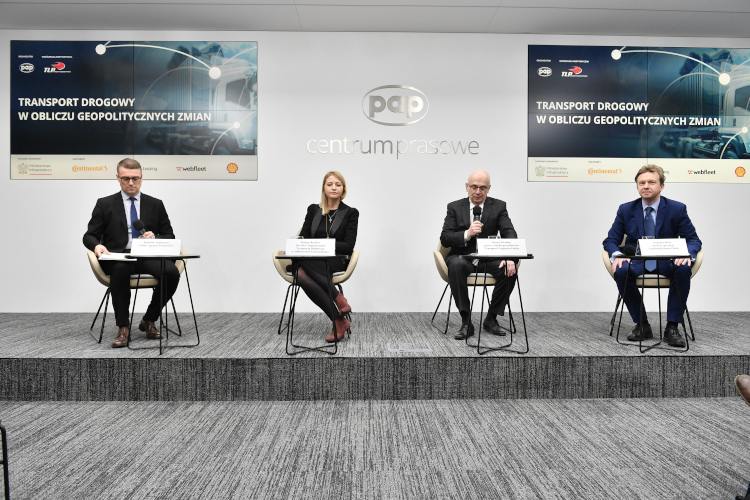
Thanks to its flexibility and ability to adapt to new geopolitical and market conditions, Polish transport remains in good condition, although the negative impact of supply chain disruptions and rising energy prices, related among other things to the war in Ukraine, is noticeable – pointed out the participants of the debate “Road transport in the face of geopolitical changes”, which took place as part of the PAP conference titled “Road transport today and future challenges”.
According to Maciej Wroński, president of the Transport and Logistics Poland employers’ association, neither the pandemic nor the ongoing war in Ukraine has significantly worsened the condition of Polish transport, although some of its sectors have certainly suffered more than others, e.g., so-called occasional transport during the pandemic.
– As for the war across the eastern border, in my subjective opinion, the war itself did not have a negative impact on road transport as a whole, because transport to Belarus, Ukraine, or Russia accounts for only a few percent of the transport performed by Polish carriers – said Maciej Wroński – However, those who traveled to the east certainly felt its effects – he added.
The biggest negative indirect effect of Russia’s aggression against Ukraine for transport – in the opinion of President Wroński – is the rise in energy commodity prices, and thus diesel and LNG. – The war in Ukraine may cast a shadow over the state of the European economy in the coming years – assessed President Wroński and added – despite everything, I am an optimist.
– It is very good that Polish transport companies are able to adapt to changing conditions – whether during the pandemic or in response to Russia’s attack on Ukraine. They are able to use their resources in other places or look for new opportunities that arise in situations of rapid change, becoming the first in a given field. Those who are ready for this win – pointed out Stanisław Rosół, Sales Director at Continental Tires Poland.
He added that the scale of truck tire sales can also testify to the condition of the transport industry.
– It is at a similar level to last year, which shows that the challenges faced by transport companies do not adversely affect their demand for spare parts, including tires – assessed the Sales Director of Continental Poland.
A good assessment of the transport industry was also given by Dr. Renata Rychter, Director of the Road Transport Department at the Ministry of Infrastructure, stating that in the current situation of sudden changes, sanctions, and counter-sanctions, it is doing “quite well”.
– Road transport is very flexible to changes, it reacts relatively quickly to changing delivery routes – stated Director Rychter – There is no threat of breaking the supply chain of goods, although the delivery time is certainly getting longer. The demand for transport services is still very high, however, factors such as rising fuel costs or a shortage of drivers cause the prices of these services to constantly rise, and more so than the inflation rate – she added.
A problem for the industry is staff shortages when it comes to drivers. It is estimated that there is a shortage of about 200,000.
– We are supplementing the transport system of Western European countries with our staff, but we are also starting to feel shortages. In 2017, we estimated them at about 120-130 thousand drivers. Since then, we have supplemented the staff by hiring about 130,000 drivers from outside the EU and unfortunately, we have not closed the gap; it is currently at the same level as 5 years ago – pointed out Marcin Wroński.
– We do not have official data on the number of drivers, but we have noticed an outflow of drivers from Ukraine. Firstly, it was related to returning to the country, e.g., due to mobilization. The second factor is the search by Ukrainian citizens living in Poland for other, less burdensome professions than working as a driver in international transport – explained Renata Rychter – Furthermore, the environment of Polish drivers is aging, very many are over 60 years old – she added.
As she informed, more and more citizens from other countries, such as the Philippines, India, and Bangladesh, are working for our domestic carriers, who are competitive enough to attract human potential from even very distant countries. Thanks to this, there are no downtimes and Polish transport companies can maintain their strong position in the European market.
– A lot depends on the decisions of our authorities on how to deal with potential candidates for work in Poland. For a citizen of the Philippines or Bangladesh to be able to work in our country, it requires a certain administrative procedure, obtaining an employment permit. We can either facilitate this or hinder it. My experience from conversations with Lithuanian transport companies is that in Poland, when it comes to accepting foreign drivers, it is much simpler than in Lithuania – said Stanisław Rosół. – This is our chance. By creating more flexible regulations, we can make Polish transport companies benefit from this – he noted.
The participants of the debate also pointed out solutions regarding problems with supply chains. – The pandemic and the war in Ukraine have shown that it is important to shorten supply chains so that they become less sensitive to geopolitical factors. And this is already starting to happen slowly, e.g., the warehouse economy is developing dynamically – said the director of the Transport and Logistics Poland employers’ association. – Investments must follow this, for example, to move the production of what is manufactured in China to the country, and therefore we must have a predictable tax system – he concluded.
Source: PAP MediaRoom