








The results of a new study conducted by the non-governmental organization Transport & Environment (T&E) show that e-fuels are expensive, in short supply, and less environmentally friendly, and above all, they will slow down the transition to zero-emission road transport.
Trucks running on e-fuel cost more
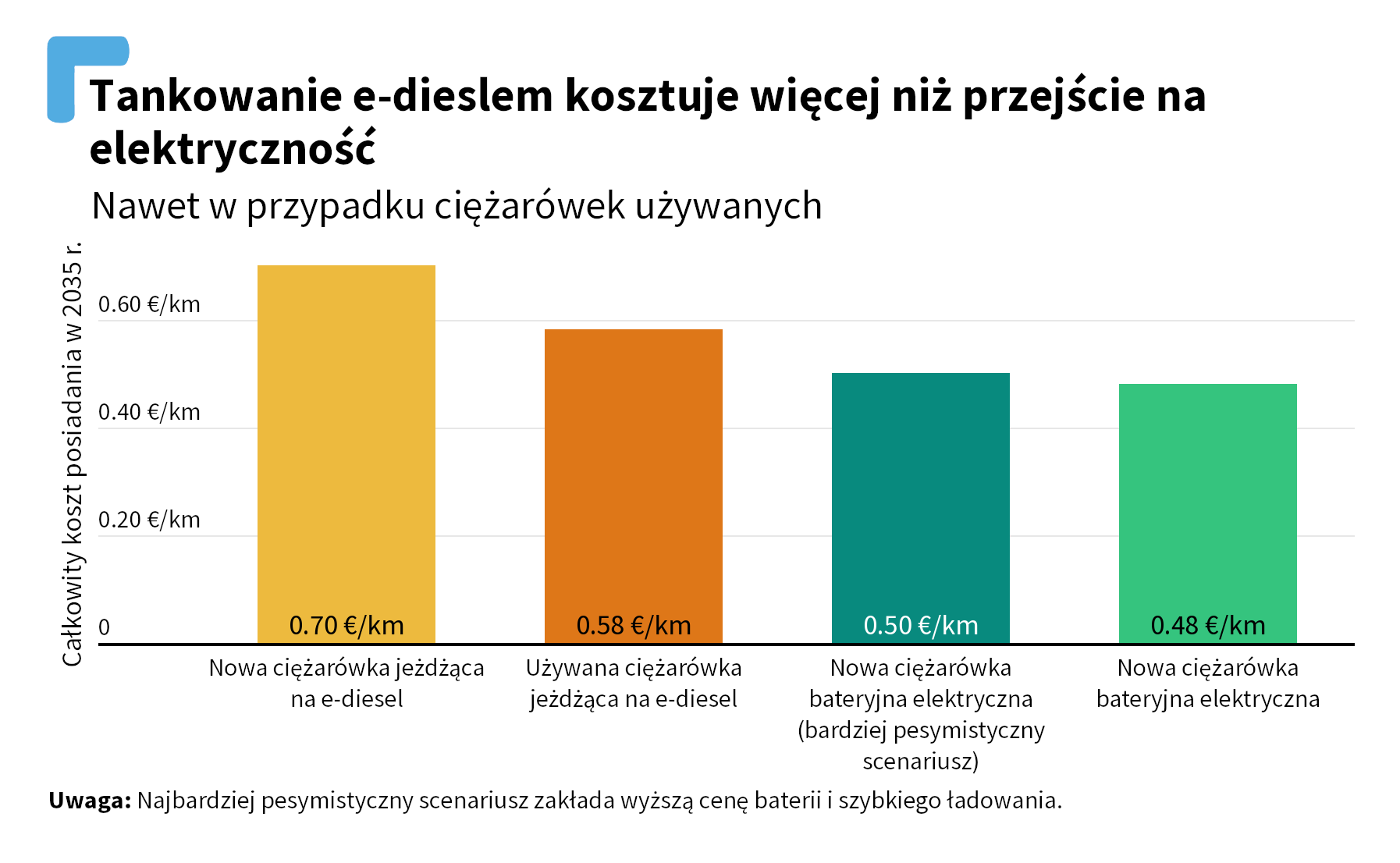
By 2035, the purchase and operation of a new long-haul diesel truck running on pure e-diesel would cost 47% more than the purchase and operation of a battery electric truck (BET)1. This is because the lower energy and maintenance costs of an electric truck quickly offset its higher purchase price. At the same time, vehicles powered by e-fuels would be significantly more expensive precisely because of the high cost of these fuels.
The T&E study compared various price scenarios for e-fuels, but even in the most optimistic one, they remain 15% more expensive than battery electric trucks. The aforementioned scenario analyzes the use of e-fuel in a used truck and compares the operation of an electric truck with high battery and charging costs.
– Cost is a significant factor for companies offering road transport, and that is exactly why battery-electric trucks are the direction they should follow. E-fuels are a desperate attempt by the fuel industry to throw themselves a lifeline at the expense of carriers who will be operating on increasingly low margins. Why force them to buy expensive e-fuels when they have a cleaner and cheaper solution at their fingertips? Based on sound reasons, the European Union recently announced that it would not use e-fuels in cars – now it is time for a similar move regarding trucks – comments Rafał Bajczuk from the Polish T&E office.
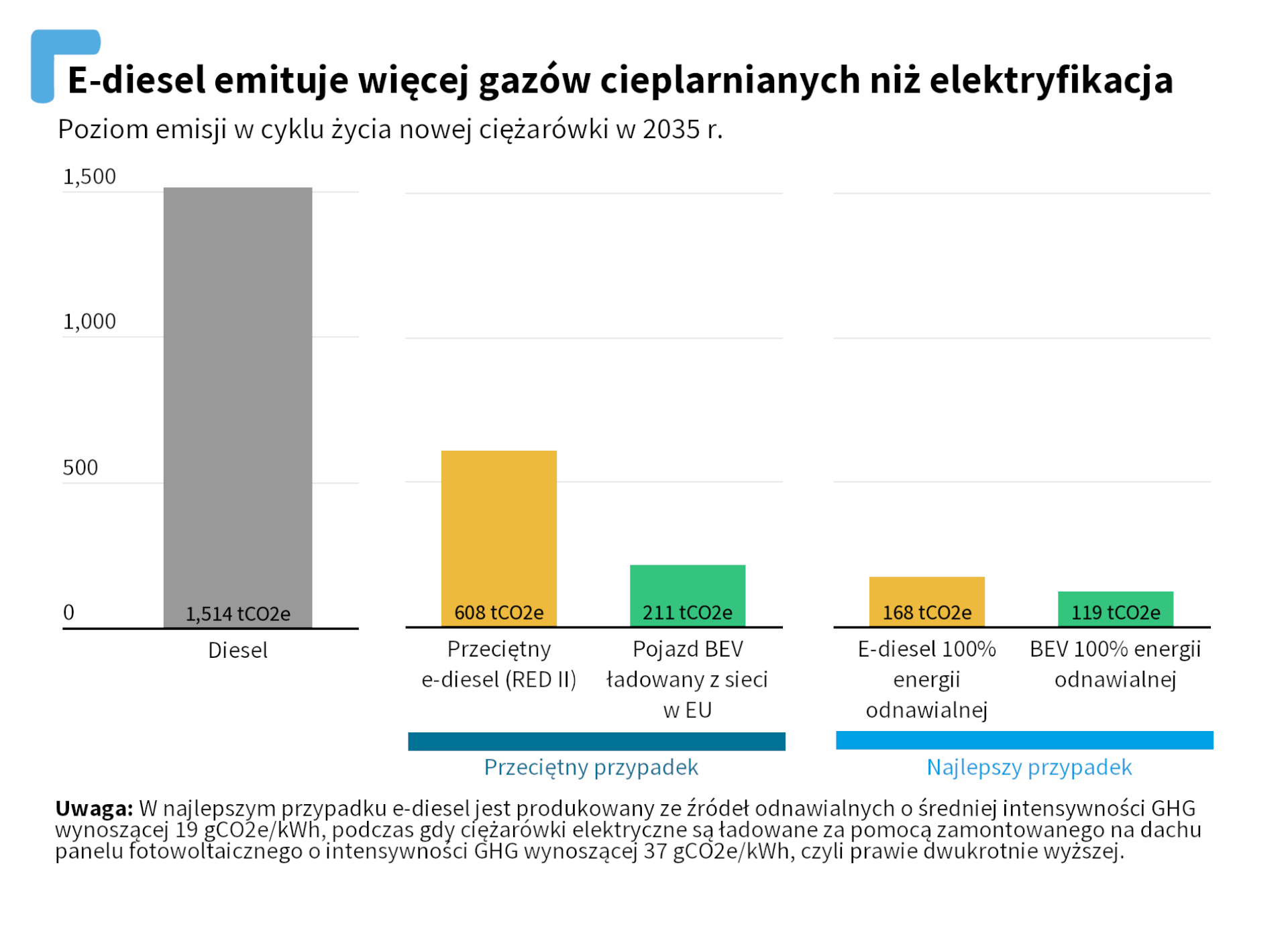
Studies show2 that a typical e-diesel-powered truck would emit nearly three times as much CO2 over its lifetime as a battery vehicle using an average amount of electricity. Even in the most optimistic scenario, assuming the use of only renewable energy for e-fuel production and charging battery vehicles, an e-diesel truck would still emit 41% more. Despite higher emissions in the battery production process, e-fuel trucks emit significantly more greenhouse gases over their lifecycle than battery-electric trucks. This is because most emissions occur during driving, and trucks are high-mileage vehicles.
In 2035, there will be enough e-fuel to power only 6% of trucks
Modeling conducted by Concawe, a research group associated with the oil industry, showed that European production of e-fuels for road transport will reach 6 Mtoe in 2035. In 2035, this will meet only 6% of the fuel demand for trucks. Current forecasts regarding the import of transport e-fuels speak only of synthetic aviation fuel and ammonia, which would not be applicable to road transport. There are no public forecasts regarding import volumes of e-diesel or e-gasoline from abroad to Europe, which means that the supply of e-fuels for trucks and cars would be very limited3.
According to T&E, if the aforementioned 6 Mtoe of e-fuels were to be used for trucks, the remaining supply for aviation and shipping would not be enough to decarbonize these two sectors, where other technologies, such as electric and hydrogen ships and planes, are not feasible or scalable.
– After the attempt with passenger cars, the fossil fuel industry hopes to revive the topic of e-fuels in trucks. Their claim that this technology is a scalable solution on the path to decarbonization is untrue in the case of passenger cars, and new evidence shows that it is also untrue in the truck sector. This will threaten the transition to electric trucks and lock in diesel technology, extending this process for much longer than our planet can bear – concludes Rafał Bajczuk.
The European Commission plans to revise CO2 emission standards for trucks at the end of 2022. Before presenting a new proposal, T&E calls on the EC to:
- Exclude any role for fuels in regulating the sale of new vehicles;
- End the sale of all new internal combustion engine trucks by 2035.
The study is available at:
https://www.transportenvironment.org/wp-content/uploads/2022/11/202211_trucks_BET_vs_e-fuels-1.pdf
1) Battery-electric trucks are less susceptible to energy price fluctuations than conventional trucks due to higher efficiency. On the other hand, high electricity prices have a much greater impact on e-fuels due to the large amount of energy needed for their production.
2) The typical case assumes that the reduction of greenhouse gas emissions from e-diesel is no more than 70% necessary to ensure compliance with the Renewable Energy Directive (RED II).
3) In a recently published report, the Hydrogen Council predicts that by 2050, the only fuels derived from hydrogen imported into Europe will be synthetic aviation fuel and ammonia. https://hydrogencouncil.com/wp-content/uploads/2022/10/Global-Hydrogen-Flows.pdf
Source: European Federation for Transport and Environment AISBL