








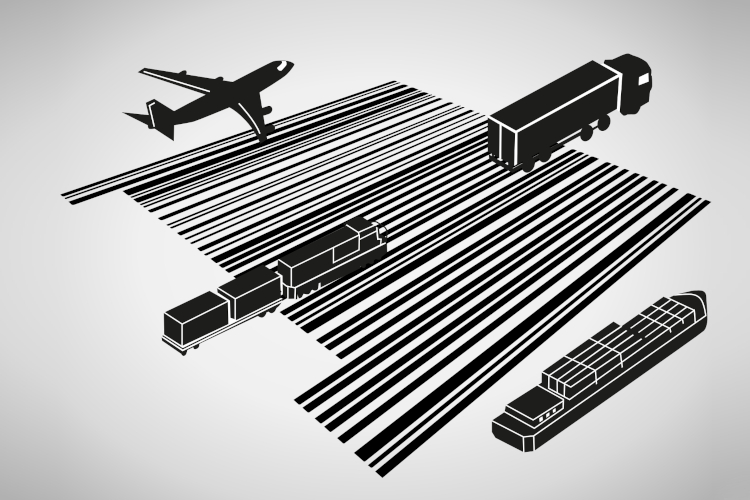
Modern data carriers require greater capacity than traditional barcodes. This is all to enable the implementation of many different scenarios for using product information. Two-dimensional (2D) codes are proving effective in this role. However, their popularization will require broad cooperation in the retail world.
The first EAN codes were introduced for general use at points of sale (POS) half a century ago. This revolutionary solution became the foundation of the global GS1 standard and allowed for the automation of one of the world’s most essential business processes: retail. The role of the small symbol placed on product packaging proved so significant that the BBC recognized the barcode as one of the 50 factors that contributed most to the creation of the modern economy. However, modern trade requires a transition to a new dimension of data exchange.
Retail says: “more data!”
Although the EAN code remains the dominant data carrier for manufacturers and retailers, they are beginning to feel its limitations. Only the Global Trade Item Number (GTIN) associated with the product can be saved in an EAN code. This is not enough to meet today’s market expectations, which count on speed, data transparency, and a variety of available functionalities.
The impulse to switch to more advanced barcodes comes from the industry itself. Retail needs more data encoded on packaging because consumers expect more information. Modern codes also improve supply chain operations and build brand trust by providing more accurate, complete, and updated product data while streamlining the processes at the POS itself.
A new format means more information for everyone
To give the consumer more options and unlock the potential of applications, the retail sector is currently undergoing one of the most profound transformations since the introduction of the first barcode. 2D barcodes, such as QR or GS1 DataMatrix, are entering the market. This method of labeling can contain much more data than the currently used linear EAN barcode. Thanks to 2D codes, you can check, for example, the expiration date, production batch/serial number, or visit the manufacturer’s website with information about ingredients
and potential allergens. 2D codes provide access to product photos and even video presentations or reviews.
The greater amount of available product information positively affects not only the end customer’s experience. It also helps retailers, brand owners, and other market participants. This is why GS1, together with companies operating in the retail industry, is striving for a gradual transition from the older, one-dimensional version of barcodes to new, more advanced 2D codes on retail packaging.
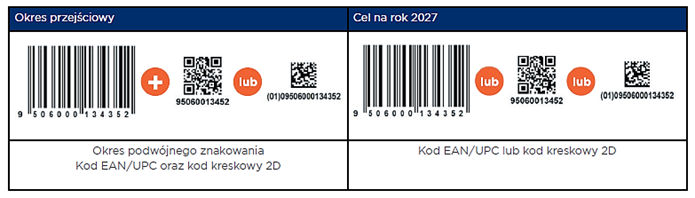
Transition period: two ways of recording data until 2027
GS1, together with retail industry representatives, is currently working on solutions that will support the transition to the new code format and create globally consistent guidelines for various application scenarios. GS1 does not intend to impose a common set of data required to be saved in a 2D code. Each sector will be able to choose what data it wants to include in the new marking and how it will introduce it into general use.
It is assumed that by 2027, scanners in POS systems will be able to read both old (one-dimensional) and new (2D) barcodes. There is no fear that “old” barcodes (EAN) will disappear after 2027; they will be used together with 2D codes as long as there is a need.
New markings require close partnership
The success in implementing new areas of 2D code applications at POS points will depend on several factors. The first issue is the pace and scale of implementing updated or even completely new POS environments that allow for reading and processing many different barcodes.
Secondly, the popularization of 2D codes will also depend on the exchange of different types of data between partners. Implementation pioneers and participants in pilot programs will have to cooperate with their partners so that they, in turn, can both read the data carrier and correctly interpret the information stored in it.
For example, if a POS system is to reject recalled goods based on a batch number, the store will need an up-to-date list of recalled GTINs and batch numbers from suppliers. In turn, to avoid selling counterfeit goods, the retailer will also need access to a list of original GTINs and serial numbers from suppliers.
We will all benefit from the huge potential of data
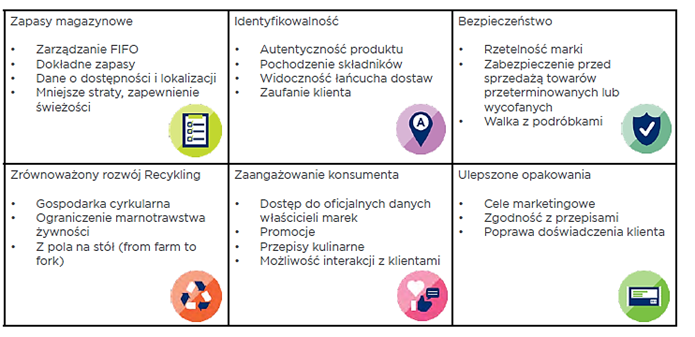
Technological changes related to the introduction of 2D codes bring challenges, but also open up a range of new benefits. First, two-dimensional codes provide more product information and data relevant to the supply chain. Thanks to this, manufacturers and retailers can optimize key business processes. Second, thanks to 2D codes, consumers are increasingly learning to interact with data carriers on products, gaining a completely new quality of shopping experience. The potential of 2D codes is very large, and all involved parties can benefit in many areas:
For GS1, the introduction of 2D codes is a global challenge. To facilitate a smooth transition to the new markings, the organization has established an international working group that brings together representatives of manufacturers, retailers, and solution providers. They are to exchange experiences and develop common guidelines for organizations that want to introduce 2D codes.
More at https://gs1pl.org/handel-i-produkcja/kody-2d-w-branzy-handel-i-produkcja-retail/