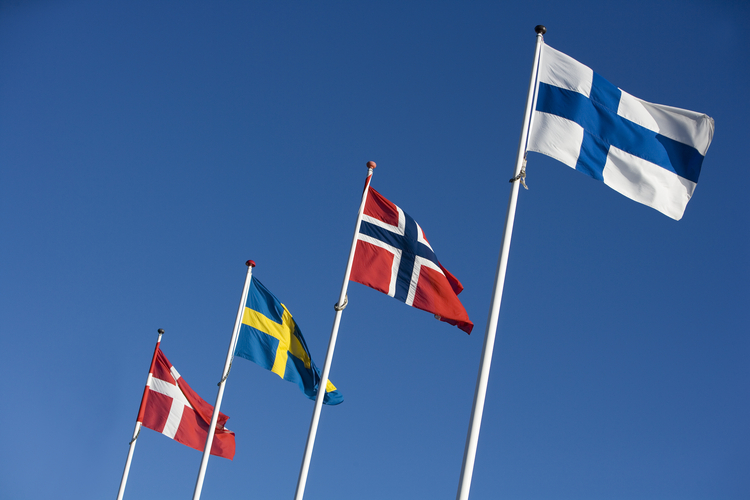
The Nordic countries, defined as Denmark, Finland, Norway, and Sweden, share a common heritage dating back at least to the Viking Age, the conclusion of several unions in the past, and close cooperation today. Occupying an area of over 1.2 million square kilometers, they form one of Europe’s largest regions, although about 26 million people live there, which is only 5% of the continent’s population. These countries, with the exception of Denmark, are among the most sparsely populated in the world. Consequently, the region has a long history of distance selling and mail-order trade.
The Nordic countries began building internet infrastructure early on, even in areas with low population density. Therefore, when internet access became available to almost everyone and e-commerce gradually developed, the conditions and willingness to shop online already existed.
Scandinavian consumers have therefore been relatively mature in their behavior for a long time when it comes to e-commerce. Impressive progress has been made here in this regard. For example, the percentage of Nordic residents who shopped online once a quarter in 2015 was 23%. In 2021, a similar value (24%) already applied to the percentage of people who shopped online three times a month.
Nordic online consumers have a lot in common when it comes to shopping habits and preferences. However, online stores that want to start operations in the Nordic region should avoid treating these four countries as a single market. In some respects, there are significant differences between them.
Therefore, it is best to look at each market individually:
Sweden
With 10 million inhabitants, Sweden is the largest country in the region and also the largest market. The Swedish e-commerce market is one of the most developed in Europe. Before the COVID-19 pandemic, e-commerce accounted for 11% of the entire retail market. By the end of 2020, this figure was 15%. A characteristic feature of Swedish consumers is a high willingness to test new technological solutions. The pandemic certainly accelerated the process of e-commerce gaining larger market shares. Most online retailers in Sweden believe it had a positive impact on sales results. Only nine percent of them believe that the pandemic had a decidedly negative effect.
Product categories that Swedes want to buy online
Back in 2013, the most frequently purchased product categories online included books — just ahead of clothing and footwear and consumer electronics. Nine years later, in 2021, clothing products and household appliances maintained their positions as number two and three. Pharmaceutical products took first place. The pandemic, of course, led to certain changes in the choice of products purchased online. In 2018, interest in buying groceries online was quite limited. 10% of consumers declared buying food this way. In 2020, the worst period of the pandemic, 35% of consumers bought food online, and in 2021 this value was 32%. This clearly proves that shopping habits, acquired to a greater or lesser extent out of necessity, tend to persist once consumers discover their benefits. Other categories that are becoming more popular in Sweden year by year are skincare products and interior design elements. When Swedish online consumers buy products from other countries, they most willingly choose China, the UK, and Germany.
Marketplaces
At the end of 2020, Amazon launched the Swedish version of its website. Initially, it was widely criticized due to inaccurate translations and a relatively small assortment. Despite the criticism, four out of ten Swedes declared interest in the Amazon site, and a few months after its launch, 12% had already made purchases there. However, by far the most popular international online marketplace in Sweden is the German fashion giant Zalando. In 2021, 41% of consumers shopped there. Amazon currently occupies second place with a result of 27%, followed by Wish with 22%.
Most frequently chosen delivery methods
Among the methods of delivering products purchased online, Swedes most willingly choose home delivery without a signature (31%), followed by delivery to a mailbox (23%) and self-pickup from a point (also 23%). As for delivery time requirements, consumers from the Nordic countries have long been among the most patient, but recently a tendency to demand faster deliveries is starting to appear here.
 Denmark
With almost 6 million inhabitants, Denmark is the second country in the Nordic region in terms of population, but by far the smallest in terms of area. Transport distances are relatively short, which means that compared to the results of its neighbors, domestic e-commerce in Denmark is characterized by quite fast delivery times. The e-commerce market has been well-developed for a long time, and according to many studies, Danes spend the most money per person of all online consumers in the region. Almost 90% of Danes aged 18 to 79 say they have shopped online. According to DESI, the Digital Economy and Society Index published by the European Commission, Denmark ranks second (after the UK) in terms of the percentage of the population shopping online. Danish consumers are not the only group convinced of digital technologies. 54% of companies in Denmark say they are highly digitized — this is the highest level in the EU, where the average is 28%.
Product categories that Danes want to buy online
The three most popular product categories purchased online in Denmark are clothing and footwear (bought by more than half of consumers), followed by consumer electronics and skincare products. As in Sweden, the COVID-19 pandemic also became an impulse for increased interest in the food/gastronomy category in Denmark. In 2018, 11% of Danish consumers declared that they buy food online, and in 2021 this value was already 24%. The pandemic also affected online sales of pharmaceutical products. In 2018, this category was not even in the top ten most frequently chosen goods, and in 2021, 27% of consumers were already buying these products online. When shopping abroad, Danes prefer China, the UK, and Germany.
Marketplaces
The German clothing store Zalando is a popular market player in Denmark as well, and last year the company launched Zircle on the Danish market — an online second-hand service. Another new player is the online platform The Founded, founded by the Danish fashion company Bestseller Group. The platform offers products from several clothing brands, including Jack & Jones, Vero Moda, and Only. However, the top three positions in the ranking are still occupied by Zalando with a 42% share, followed by Wish with 22% and Amazon with 20%.
Most frequently chosen delivery methods
When it comes to delivery methods preferred by Danish consumers, the pandemic also played a major role here. In 2018, the most frequently chosen option was self-pickup of purchased goods from a service point. During and after the pandemic, by far the most popular method was home delivery with a signature (34%), followed by home delivery without a signature (21%), and only in third place was pickup at a point (18%).
 Finland
, with just over 5.5 million inhabitants, is the third country in the Nordic region in terms of population. As in Sweden, outside metropolitan areas, population density is low here. This is most likely why Finns accept longer delivery times more often than any other online consumers in Europe (unlike consumers from densely populated Denmark). Finnish e-commerce has historically lagged slightly behind other countries, despite the high level of digitalization in the country. Older consumers in Finland were more skeptical about e-commerce than comparable age groups in Sweden, Denmark, and Norway. However, during the COVID-19 pandemic, the share of online sales in total retail sales in Finland increased, and new consumer groups appeared on the market. The percentage of people declaring that they shop online at least once a month increased from 49% in 2020 to 59% in 2021, and furthermore, 30% of consumers stated that they spent more money than usual during the pandemic.
Product categories that Finns want to buy online
As in the case of Denmark, the top three products most frequently purchased online include clothing and footwear (55%), followed by consumer electronics (40%) and skincare products (33%). Over the last few years, the popularity of groceries, pharmaceutical products, and interior design elements has also increased. In 2016, these product categories were not even in the top eight. Finnish consumers are quite willing to source products from outside the country. This can probably be linked to the fact that in the past there were relatively few strong domestic brands. When shopping abroad, Finns choose products from China, Germany, and the UK.
Marketplaces
Compared to their Nordic neighbors, Finnish consumers are the least inclined to purchase products on marketplaces. As many as 39% of Finns state that they did not make a purchase on any platform in 2021. As mentioned earlier, they like to buy products from Germany, so the platform Zalando gained total dominance among trading portals, where 36% of consumers made purchases, followed by eBay (18%) and Amazon (15%).
Most frequently chosen delivery methods
In most markets surveyed for the Direct Link/PostNord report “E-commerce in Europe 2021”, the most frequently chosen delivery method was home delivery. This is different in the case of Finland. Consumers from this country are the only ones in the study who prefer personal pickup from a parcel locker (34%), followed by delivery to a mailbox (27%) and personal pickup from a service point (17%). Furthermore, compared to most online consumers from other European countries, Finns do not consider fast delivery to be particularly important. They care more about the ability to choose the delivery location.
 Norway
With 5.3 million inhabitants, Norway is the smallest country in the Nordic region in terms of population. It is also the only country in this region that is not a member of the EU. This factor places certain specific requirements on foreign online retailers who want to conduct business here — more on this can be read below in a separate text*. Consumers in Norway, like in the rest of the region, are digitally advanced, and the internet usage rate is among the highest in Europe. The pandemic was the cause of a significant jump in results for many Norwegian e-commerce companies. In its annual report for 2020, the sports chain XXL recorded a 43% increase. As a result of the introduction of strict restrictions during the pandemic, many companies were forced to reconsider their sales strategy. When the hardware store chain Clas Ohlson had to close its stores, it offered customers the option of picking up goods ordered online on-site (so-called curbside pick-up), which became very popular. Due to restrictions, home delivery of food also gained recognition.
Product categories that Norwegians want to buy online
Norwegian online consumers prefer more or less the same products as consumers in neighboring countries. The top products have been practically the same for the last eight years. The difference is that now Norwegians buy more of them and do so more often. In 2016, 28% of consumers bought clothing and footwear, and 16% skincare products. In 2021, these values reached 56% (clothing and footwear) and 31% (skincare products). When shopping online in foreign stores, consumers prefer China, the USA, and the UK.
Marketplaces
Norwegian consumers show great interest in shopping abroad. The German fashion giant Zalando is at the top of the list of favorite stores in Norway as well. Consumers here buy more on the American market than their Scandinavian neighbors, which may be related to the fact that Norway is not an EU member. There are also quite a few domestic companies in Norway with large market shares, such as Komplett.no, a store selling electronics, or the grocery chain Kolonial.no.
Most frequently chosen delivery methods
In 2016, the most frequently chosen delivery method by Norwegian online consumers was personal pickup from a service point. 52% of buyers preferred this option. In second place in terms of popularity was delivery to a mailbox by a carrier (25%), and in third place was daytime home delivery (8%). In 2021, the results were more or less the same, but at different levels: personal pickup from a service point — 44%, delivery to a mailbox — 18%, and home delivery — 15%.
* Shipping e-commerce items to Norway — the necessity of meeting the requirements of the VOEC (VAT On E-Commerce) program
On July 1, 2021, the EU introduced new VAT rules that apply to all member states. The new special procedure is the Import One-Stop Shop (IOSS). According to the VAT rules in force until July 21, it was not necessary to pay import VAT for commercial goods worth up to 22 EUR. After this date, all commercial goods imported into the EU from a third country or third territory are subject to VAT, regardless of their value.
Norway, which is not an EU member, has its own system called VOEC (VAT On Electronic Commerce). Its goal is to simplify the customs procedure by eliminating the need to file customs declarations. The main element of the program is the assumption that foreign sellers whose total turnover in Norway exceeds 50,000 NOK over a 12-month period will be required to pay Norwegian VAT when selling low-value goods, valued at less than 3,000 NOK, to consumers in Norway. In the case of shipping goods worth more than this limit, it is not possible to use the VOEC system — all items exceeding this value will be subject to customs clearance in Norway.
Thus, entities that are foreign suppliers operating via the Internet, selling goods to Norwegian consumers and qualified as above, must register in VOEC.
To find out how Direct Link can help with cross-border deliveries and e-commerce order fulfillment, contact Direct Link here:
Direct Link — a global e-commerce company
As Direct Link, we support our e-commerce and postal sector clients every day in handling distribution, logistics, and fulfillment of shipments to every place in the world. At the same time, we are the exclusive representative of PostNord, a key logistics operator in Scandinavia.
We operate from offices that are strategically located around the world. Currently, we coordinate our activities from Germany, the Netherlands, Poland, Turkey, the UK, Sweden, Brazil, the United States, China (Hong Kong, Shanghai, and Shenzhen), and Singapore.
PostNord in numbers
- 40.7 billion SEK in net sales,
- 28,000 employees,
- 226 million parcels,
- 1.2 billion letters and other postal items,
- 9,500 distribution points in Scandinavia,
- 7.5 million PostNord app downloads,
At Direct Link Poland – we are experts in the Scandinavian logistics market
Our branch in Poland is based in Żerniki near Poznań, where we focus on handling shipments and orders for our e-commerce clients. Beyond being a supplier, we strive to build partnership relationships with our clients every day – which is in the DNA of Scandinavian business principles. By listening to client expectations, we are able to propose cost- and time-optimal delivery solutions that will address the requirements of the industry they come from.
Warehousing
This is the place and process where we begin optimizing your supply chain. We are able to offer individually tailored services in the scope of pallet and single SKU warehousing.
Packing – Pick&Pack by Direct Link
We generate a picking list using a system that is integrated with your e-commerce platform, and then we pick the products and pack them in an agreed-upon manner. We conduct internal and external quality controls to minimize the number of complaints and returns. Our solutions address the specific needs of a sector or product, as they are ultimately intended to ensure and properly strengthen your customers’ experience upon receiving the shipment.
Deliveries
Together with you, we choose the best delivery options and the most convenient return solutions for you and your customers. Borders are not an obstacle — as we carry out deliveries to every place in the world. By carrying out fulfillment and distribution for you, we take the entire logistics area off your hands so that you can focus on developing sales and increasing your customers’ satisfaction.
Managing Director of Direct Link Poland: Bartosz Hnatyszyn