









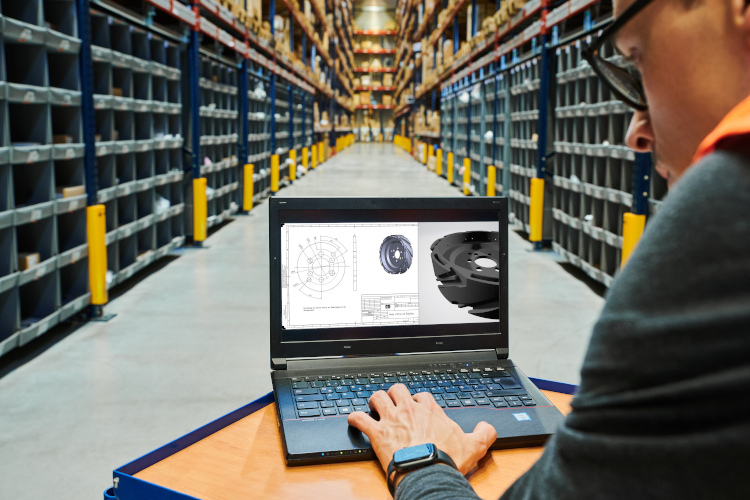
DB Schenker, the first global logistics service provider, offers 3D printing capabilities and a virtual warehouse. Thanks to this, spare parts deliveries become faster, cheaper, and more sustainable. DB Schenker showcased these innovations during the DB Schenker Product Show, paving the way for sustainable spare parts logistics.
“We are the first global logistics operator to offer spare parts delivery via 3D printing. Products from our virtual warehouse are available in a very short time and are created exactly where they are needed,” said DB Schenker CEO Jochen Thewes during the company’s first Product Show conference. “The virtual warehouse reduces delivery costs, shortens delivery times, and protects the environment. This perfectly illustrates what the logistics of the future can do for customers. Our main goal is to avoid unnecessary warehousing and to make supply chains even more stable and flexible.”
In the face of new global logistics challenges, digital innovations such as spare parts delivery using 3D printing provide real added value for customers across various industries. “We want to shorten distances while maintaining the highest possible product availability in the shortest time and at an attractive price. To achieve this, we are putting a great deal of effort into developing digital innovations,” explained Thewes.
As part of pilot projects, DB Schenker has already successfully tested a virtual warehouse for customers in the mechanical engineering, automotive, and rail transport sectors. Parts such as handles, linings, and housings were manufactured “on demand” near the customer. Without pre-production and warehousing, “On-Demand Production” reduces capital commitment costs. The new DB Schenker virtual warehouse service is now being offered to a wide range of customers worldwide.
DB Schenker works closely with Deutsche Bahn, a company with extensive experience in 3D printing, having produced 80,000 parts using various materials and technologies. “According to our findings, up to ten percent of a company’s inventory can be manufactured on-site,” said Thewes. Spare parts that are needed relatively rarely and those that must be stored in large quantities due to high minimum order thresholds are particularly suitable for 3D printing. Virtual storage of components is carried out by securely uploading 3D plans to the cloud.
In addition to the new “On-Demand Production” approach, DB Schenker presented various innovations in Frankfurt, including a “Digital Control Tower” for land transport, which allows for the daily real-time tracking of 9,000 consolidated shipments across Europe. DB Schenker’s “Intercontinental Supply Chain Solutions” in air and ocean freight use artificial intelligence, real-time data, and interactive information platforms to make customer supply chains even more flexible and sustainable. In the area of warehousing, DB Schenker relies on sensor technology to protect employee health during the pandemic, and inspections using data glasses help avoid travel and transport costs.