









The claim that exempting e-fuels from the EU ban on internal combustion engines in new vehicles would help reduce the emissions of the existing car fleet is not supported by facts.
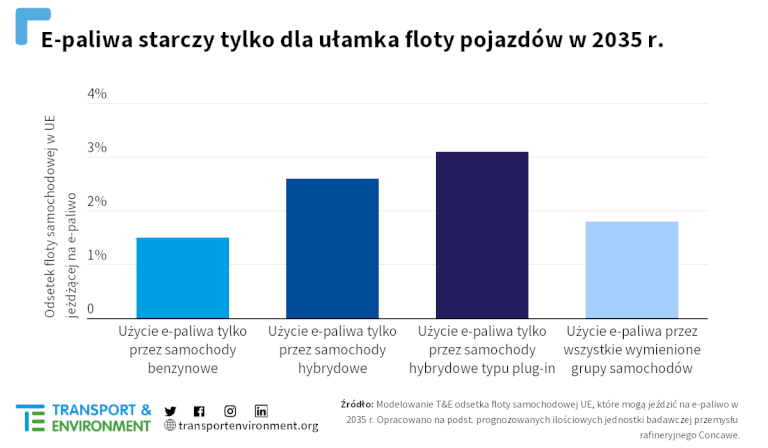
The oil industry is hoping that e-fuels will help exempt internal combustion engine cars from the EU’s proposed 2035 sales ban. The oil lobby argues that allowing the sale of new internal combustion engine vehicles powered by synthetic fuels will help scale up the technology and accelerate the climate neutrality of the current car fleet. However, a new analysis based on the oil lobby’s own data shows that by 2035, there will only be enough synthetic fuel for 2% of the cars on European roads.
By the time of the EU’s planned phase-out of internal combustion engine cars, the production of e-fuels, which have a chemical composition similar to gasoline and diesel, will still be in its infancy. According to a quantitative analysis conducted by T&E based on industry forecasts, only 5 million out of an estimated EU car fleet of 287 million vehicles will be able to fully use synthetic fuel in 2035. According to T&E, in the context of cars, e-fuels are a Trojan horse for oil companies and engine manufacturers intended to delay the transition to zero-emission technologies. The organization has called on EU lawmakers to resist pressure from the automotive industry aimed at maintaining a loophole in the regulations regarding the phase-out of e-fuels.
– E-fuels are presented as a carbon-neutral way to extend the life of internal combustion engine technology. But the industry’s own data shows that there will only be enough of these fuels for a small fraction of cars. That is why lawmakers should close the door on e-fuels, which are a Trojan horse for the fossil fuel industry. – comments Rafał Bajczuk, an analyst at the Electric Vehicle Promotion Foundation (FPPE):
The industry forecast is based on e-fuels produced in the EU, but it also includes CO2 captured from industrial emitters, so it is unclear what portion of the electricity would be certified as 100% renewable. The number of cars potentially powered by synthetic fuels would be even lower if only CO2-neutral e-fuels were used, i.e., those produced entirely from additional renewable energy and CO2 captured directly from the air.
T&E adds that the industry’s plans to import climate-neutral e-fuels on a massive scale are unrealistic because the necessary production facilities and global certification standards for synthetic fuels do not exist. Furthermore, accepting e-fuels from other countries would delay efforts in less developed economies to decarbonize their own transport and energy sectors.
– In such a situation, e-fuels for cars in Europe would consume renewable energy needed by other economies. It is also naive to assume that developing countries, some of which lack the capacity to meet their own basic needs, would share their own renewables to produce e-fuels for European cars just to satisfy the interests of engine manufacturers. Therefore, synthetic fuels produced in Europe should be prioritized for aircraft and ships, most of which have no way to use electric batteries for decarbonization. – comments Rafał Bajczuk, an analyst at the Electric Vehicle Promotion Foundation (FPPE).
E-fuels are also a much less environmentally friendly solution than electric cars. The latest life-cycle analysis of such vehicles confirms that by 2030, an electric car will emit 53% less CO2 over its entire service life than a car running on e-fuels.
Burning e-fuels in cars will also not mitigate toxic emissions from one of the largest sources of air pollution. Laboratory tests conducted last year showed that a car burning e-fuels emitted the same amount of toxic nitrogen oxides (NOx) as burning fossil fuels. Another issue remains the high cost of producing synthetic fuels, which will persist for some time, as well as the cost of operating a car running on e-fuels, which will cost the driver an average of 10,000 euros more over five years than operating an electric car. In road transport, e-fuels are highly inefficient compared to direct electrification. It is estimated that replacing just 10% of cars with e-fuels and another 10% with hydrogen propulsion would increase electricity demand by 36%.
EU lawmakers are finalizing regulations on the proposed phase-out of internal combustion engines in 2035. The next round of negotiations will take place on October 27, 2022.