








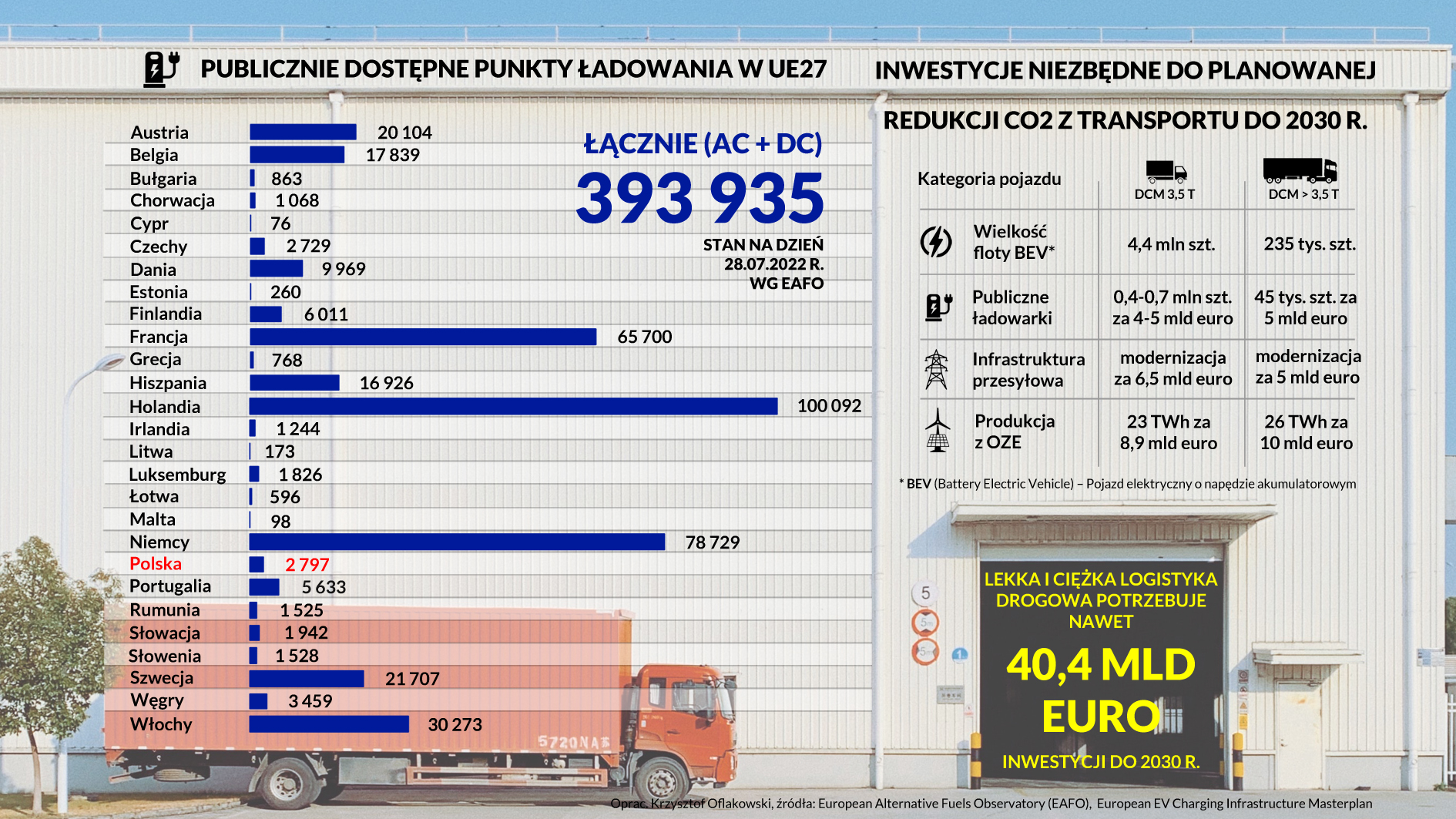
By 2030, the EU’s road transport decarbonization strategy will require 280 billion euros in investments for charging points, power grids, and renewable energy production capacity. By 2050, these expenditures should rise to 1 trillion euros. By the end of the decade alone, infrastructure for light and heavy logistics will need up to 40.4 billion euros, excluding the cost of fleet replacement, which will fall on transport companies. These companies continue to buy combustion-engine vehicles and delay electrification because incentives are lacking, electric vehicles are expensive, and the energy market is unpredictable. Furthermore, there are no chargers, and price competitiveness for heavy-duty vehicles is not expected for another 12 years.
As part of the “Fit for 55” package, two important legislative packages that will determine the future of freight transport on European roads are still being processed. These concern zero-emission light vehicles from 2035 and the creation of an emissions trading system for road transport (ETS2), among others. In the first case, the positions of the main EU bodies are consistent, and it is expected that the regulations will enter into force in the proposed form. This means that from 2035, it will not be possible to buy a new van or light truck powered by diesel or gasoline.
Regarding ETS2, a consensus has not yet been reached. In particular, the launch date of the new system is unknown. According to the Council’s latest proposals, the auctioning of allowances would begin in 2027, while the first surrenders—in practice, the settlement of emissions—would take place in 2028. The EC and EP proposals assume 2026 and 2025, respectively. It has also not been determined whether ETS2 will apply to private vehicles, but it is known that all commercial carriers will bear the costs, including, or perhaps primarily, the freight transport sector. This will happen because the obligation to purchase allowances will cover distributors who supply fuel for combustion in road transport. The cost of CO2 emissions will be hidden in the fuel.
In the context of the logistics industry, the proposed changes fit into the landscape of existing regulations concerning new trucks and other heavy-duty vehicles. Their emissions in 2030 are to be 30% lower compared to 2019. However, the EU’s plans for decarbonizing road transport are much more ambitious. The Strategy for Sustainable and Smart Mobility assumes that by 2030, there will be at least 30 million zero-emission passenger cars and 80,000 zero-emission trucks in use. Two decades later, almost all passenger cars, vans, buses, and new heavy-duty vehicles will be zero-emission, i.e., they will emit 0 gCO2/km. These are astronomical assumptions, because in 2020, a total of 281,975,402 of the mentioned types of vehicles were moving on EU roads, all of which were combustion-powered.
The overwhelming majority of the freight fleet still runs on diesel, with no chance for a quick change
The EU scenario, although very optimistic, may prove extremely difficult or even impossible to implement, especially in the context of heavy-duty vehicles. July data from the European Automobile Manufacturers’ Association (ACEA) shows that in 2021, zero-emission trucks (medium and heavy) in the EU accounted for only 0.5% of new registrations, while 95.8% of vehicles were still powered by diesel. The picture of the entire market also leaves no doubt about the share of heavy electric vehicles. In 2020, there were 6,230,100 medium and heavy trucks in use, of which 96.3% were powered by diesel, 0.7% by gasoline, and only 0.24% were battery-powered vehicles. On a Community scale, this is about 14,952 units. Vehicles powered by natural gas and LPG performed significantly better. Their market share was 0.6%.
The EU light fleet also burns diesel, but it is older
ACEA data on light vehicles indicate that in 2020, out of 28,715,247 vans on EU roads, only 0.4% had electric propulsion, i.e., about 114,860 units. This is fewer vehicles than small delivery vans powered by LPG (0.8%) and natural gas (0.6%). The overwhelming advantage again lies with traditional fuels, as 91.2% of light commercial vehicles are powered by diesel, while 6.2% by gasoline. Hybrids and plug-in hybrids also had a low market share (0.01% and 0.06%, respectively). The rate of electric van registrations in 2021 looked slightly better, but they still accounted for only 3% of new vehicles. For comparison, diesel registrations reached 90.2%.
Although the planned regulations are intended to promote electrification, its implementation will be a major challenge, especially for Polish companies. They have the largest fleet of trucks in the Union (approx. 1.2 million), with an average age not exceeding 13.2 years. This is a better result than the EU average of 13.9 years. We also have 2.8 million light vehicles, which places us in 5th place among the 27 countries of the Community. The average age in this segment is 13.6 years, which is a worse result than the EU average of 11.9 years.
– The rate of new registrations clearly shows that electric vehicles do not yet enjoy the expected popularity in EU logistics, because it is much more difficult to decide on fleet replacement when one has a relatively young vehicle park. The current situation in Europe also does not favor electrification, because it is difficult to estimate the cost of using an electric vehicle. The energy market has become less predictable, so companies do not want to take additional risks. Paradoxically, information recently arrived from highly electrified Netherlands that using an electric car has become more expensive than a combustion one. The reason was precisely the spikes in energy prices. If such a situation occurred in freight transport, it would lead to price increases in other sectors of the economy and probably to a further increase in the prices of consumer goods. For green transport to develop freely, stability and favorable market conditions are needed. The economic factor and the ability to rationally forecast costs must play a significant role. Electric cars are still very expensive, even 50% more expensive than their combustion counterparts, and there is a lack of incentives for companies with large fleets. In this context, it is worth recalling that the recent edition of the eVAN program, which aimed to subsidize the purchase of an electric delivery van, did not include transport and forwarding companies, and this resulted directly from EU de minimis aid regulations. As a result, fewer than 100 applications were submitted, and not even 10% of the budget was used. If companies are to finance electrification on their own, it should at least not be based on the logic of punitive taxation of enterprises that will not be able to invest enough at the imposed pace. A serious obstacle to electrification is also the density of charging infrastructure, especially that available to the public. Until it is sufficiently developed throughout the Community, it is difficult to expect mass investments in electromobility – says Michał Wochna, Chief Operating Officer and Vice President of the Management Board at Spedimex, a Polish operator serving retail chains, shopping malls, e-commerce, and LTL and FTL transport in Poland and Europe.
The EU charging network is leaky and is developing 9 times too slowly
The EU Recovery and Resilience Facility assumes the construction of half of the thousand hydrogen refueling stations by 2025 and one million of the three million public electric vehicle charging points that will be needed in 2030. The ultimate goal is to provide a dense, widespread network for all users of EU roads, including operators of heavy-duty vehicles.
The plans are ambitious, but as in the case of the fleet structure, the issue of infrastructure does not look best at the moment. Not only because in 2020 there were as many as 10 countries in the Union (including Poland) where there was not even a single charging point per average 100 km of roads, but also because the vast majority of chargers are concentrated in the western part of the continent. This makes the entire network inefficient and discourages companies from Central and Eastern Europe from electrification.
According to the European Alternative Fuels Observatory (EAFO), as of July 28, 2022, there were 352,750 publicly accessible charging points operating on alternating current (AC) and 41,185 on direct current (DC) in the Community area. This is a total of 393,935 public chargers of various power, calculated according to the AFIR (Alternative Fuels Infrastructure Regulation) classification. As many as 100,092 points from this pool are installed in the Netherlands, 78,729 in Germany, and 65,700 in France. For comparison, in the middle of this year’s holidays, there were only 2,797 chargers in Poland. However, there are large countries where this percentage is significantly lower. In Romania, there are 1,525 charging points, in Bulgaria 863, and in Greece 768. Smaller countries, such as Lithuania, Latvia, and Estonia, have 173, 596, and 260 public chargers, respectively, and Malta and Cyprus only 98 and 76.
This is definitely an insufficient amount, which is confirmed by a report published by ACEA, WindEurope, SolarPower Europe, and Eurelectric. In the document from March this year, the authors calculate that to achieve the EU reduction targets in road transport, by 2030, it will be necessary to have not 3 or even 4 million public charging points, but 6.8 million, and that is only for passenger cars. Light commercial vehicles will need up to 0.7 million such points, and trucks at least 45,000. This means that by 2030, 14,000 public chargers should be installed per week, and not about 2,000 as is currently the case, which is only 11.5% of the required installation rate. This does not exhaust all the needs of road transport, because alongside public chargers, non-public installations will also be necessary.
Consequently, light commercial vehicles will need a total of 3.4 million chargers. As many as 2.7 million will not be publicly accessible, of which 1.9 million (56%) should be located in transport hubs.
Trucks, in turn, will require 279,000 chargers by 2030, of which 84% (235,000) should be located in transport hubs. The rest of the locations must be situated along motorways (36,000) and overnight parking areas (9,000). To meet the needs of commercial vehicles, and especially trucks, 24,000 fast public chargers will be needed in the TEN-T core network alone, which will translate into an average of 51 points for every 100 km of roads. For comparison, the EU Alternative Fuels Infrastructure Regulation assumes that by the end of 2030, the TEN-T core network will have a charging zone in each direction every 100 or 60 km (depending on the offered power output of 1,400 kW or 3,500 kW), and heavy-duty vehicles will find at least 1 or at least 2 charging points there, respectively.
EU assumptions for road transport require gigantic funding
According to analyses conducted by ACEA, achieving the climate goals set for 2030 will require capital expenditures of 280 billion euros, not only for private (approx. 30%) and public chargers (approx. 30%), but also for modernizing the energy grid (approx. 15%) and building renewable energy production capacity (approx. 25%). Expenditures dedicated to light commercial vehicles will consume 50 billion euros, and the budget directed at the needs of trucks and buses should reach 45 billion euros. Investments in public infrastructure, transmission networks, and green energy for logistics alone will consume up to 40.4 billion euros.
Moreover, a condition for the realization of EU assumptions by 2030 is the presence on the roads of 42.8 million electric passenger cars and 4.4 million light delivery vans. The number of trucks should, in turn, be 235,000. As a reminder, in 2020, about 115,000 electric vans and about 15,000 electric trucks of various sizes were driving on EU roads. Their share would therefore have to increase by about 3,730% and about 1,466%.
– Taking into account the current level of saturation in commercial electromobility, it is hard to imagine that the light electric fleet in the Union will increase 37-fold in just 7 years. It is even harder to believe that the number of electric trucks will increase almost 15-fold during this time, especially since they are characterized by a longer service life. Doubts also concern whether the automotive industry would be able to guarantee supply at the required level, even in the case of light vehicles. Besides, heavy battery vehicles are incomparably more expensive than small cars, and a serious debate about green transport, alongside purely environmental issues, must take into account the economic factor, real possibilities, and tasks that rest on the transport sector. Without price competitiveness, also at the usage stage, and at least comparable vehicle efficiency, electrification will be delayed, especially in less affluent economies. This does not mean, of course, that it should be hindered; on the contrary, it is an inevitable direction of change. However, one must remember the real capabilities of all countries of the Community, the possibilities of the transport sector, and the advancement of accompanying infrastructure. These factors should determine the time horizon of changes – adds Michał Wochna.
Large electric vehicles price-competitive only in 12 years
A report by the International Transport Forum (ITF) from the beginning of September this year indicates that large, zero-emission delivery vans will become price-competitive against traditional trucks only around 2035. In terms of TCO (total cost of ownership), it is not entirely clear what the competitiveness of such vehicles will be against combustion vehicles and other solutions, including pantograph-powered trucks. There are too many factors to reliably assess potential operating costs at such an early stage of adoption, among other things due to future energy and traditional fuel prices, trends in vehicle design, battery costs, and their efficiency. There are also a number of barriers that may delay the adoption of a zero-emission heavy fleet, including insufficient financial resources of transport companies and underdeveloped infrastructure. Even a behavioral factor, such as reluctance to switch to a new technology, which is followed by the need to change operational patterns, can be an obstacle.
The ITF publication sheds some light on the EU hydrogen direction
While the competitiveness of electric vehicles will sooner or later equal that of combustion vehicles, the matter is slightly different with hydrogen. The ITF estimates that trucks using this fuel will be economically less competitive than combustion and battery solutions. Competitiveness will be limited to a small number of cases, and that is with the initial assumption of low hydrogen prices, below 2.5 euros/kg. It is worth noting that ITF analysts do not rule out the usefulness of this technology elsewhere in the world, but everything indicates that it will play a niche role in the future structure of the heavy freight fleet in Europe. Its market share will not be greater than 10% by 2050, which in turn raises questions about the sufficient use of large-scale refueling infrastructure for this fuel.
EU plans outlined in AFIR assume that by the end of 2030, publicly accessible hydrogen refueling stations, equipped with a dispenser at a pressure of at least 700 bar, will be located along the TEN-T core network at least every 200 km. Currently, as in the case of electric vehicle charging stations, the saturation of the hydrogen refueling network is at least insufficient, and the available points are located almost exclusively in Western Europe. According to ACEA, in 2021, only 136 public refueling points for this fuel were installed in the Union, of which 108 had the desired pressure of 700 bar. As many as 80 of these stations were in Germany, 14 in France, and a few each in, among others, the Netherlands, Denmark, or Austria. ACEA data does not show that there was even one publicly accessible hydrogen refueling point in Poland last year.