









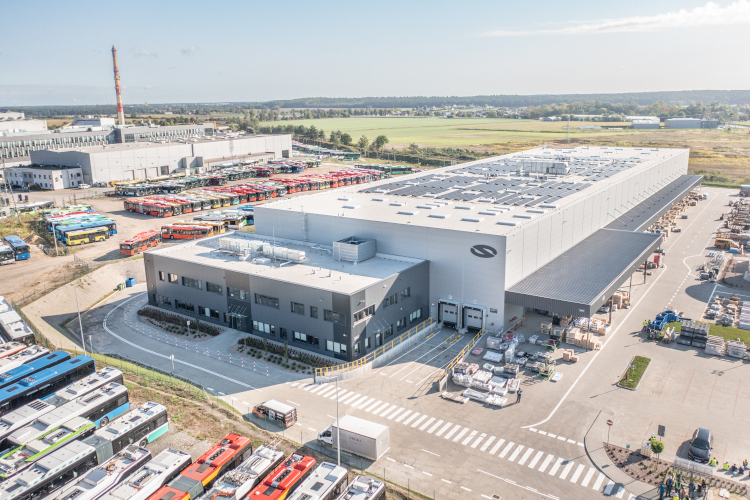
Official opening of two investments by Solaris Bus & Coach sp. z o.o.: a new Warehouse Hall and an innovative battery vehicle charging station, the Charging Park.
For many years, Solaris has been providing low- and zero-emission transport solutions to cities across Europe. Wishing to remain at the forefront of manufacturers having a real impact on the green transition in public transport, the company is constantly investing in further development. Among many other initiatives implemented in recent months, two deserve special attention: 10,000 m2 of new warehouse space, equipped with state-of-the-art logistics systems and solutions, and the Charging Park, a unique battery vehicle charging station.
On Thursday, September 29, 2022, during the official opening, to which representatives of local governments, business partners, and media representatives were invited, the company’s two latest investments were presented. Both the new Warehouse Hall and the Charging Park were built directly on the premises of the factory in Bolechowo near Poznań, the company’s headquarters.
“As one of the largest employers in the region, we are particularly committed to continuous improvement and optimization of solutions in our factory. Our goal is to effectively strengthen the company’s potential and accurately respond to dynamically changing market needs. That is why we are constantly investing in the technological development of our products and the improvement of the production process, as well as in new technologies that contribute to improving the quality of workplaces and increasing the competitiveness of our enterprise,” said Dr. Eng. Dariusz Michalak, Vice President of Solaris Bus & Coach responsible for R&D, Quality Assurance, and Procurement.
Warehouse Hall: a key role in the supply chain
The new Warehouse Hall covers an area of 10,000 m2. It was built in the immediate vicinity of the Solaris factory and is connected to it in terms of road infrastructure and utilities. The new warehouse facility plays a key role in the supply chain of parts and components for the production of Solaris buses and trolleybuses. The hall is equipped with a modern multi-level warehouse mezzanine with an automatic conveyor line. Nearly 25% of the total warehouse area has been allocated for office and social rooms. Advanced smoke detection systems have been implemented throughout the facility, and the equipment used in the new warehouse has been fitted with special covers that dampen noise generated by daily operations.
The new warehouse facility has a reinforced roof on which 572 photovoltaic cells with a total capacity of 260 kWp have been installed. In addition, 80 kWp charging stations have been installed at the investment site.
There are also plans to equip other facilities, such as the acceptance hall and the new service facility, with photovoltaic systems, as well as to install photovoltaic cells on parking shelters.
Charging Park: a central place for charging battery buses
The Charging Park is an innovative, multi-station charging facility for battery vehicles: electric buses, hydrogen buses, and trolleybuses. Investing in its own Charging Park, i.e., one central place for charging electric buses, is a natural step related to the dynamic development of Solaris’s zero-emission offer. The park was created to enable customers to see innovative solutions used in the energy replenishment processes for Solaris buses. The Charging Park also has a second extremely important function: it will allow for the testing of new technologies and functionalities in the charging and discharging processes of manufactured battery vehicles. The investment consists of eight bus charging stations, pantograph mechanisms, plug-in charging islands, a section of the trolleybus network, an info-kiosk equipped with an LCD screen, and a technical room.
This is the first bidirectional park in Poland, meaning it supports Vehicle to Grid (V2G) functionality, the bidirectional flow of energy between the vehicle and the power grid. This technology allows for flexible charging and discharging of vehicles. V2G enables the discharging of vehicles for testing purposes and using them as mobile energy storage units, which allows for more economical cost management.
State-of-the-art energy replenishment systems from three suppliers—Medcom, Ekoenergetyka, and ABB—have been installed on the 5,000 m2 area of the park.
The first charging system used in the Charging Park consists of two independent 150 kW plug-in chargers, each of which has V2G functionality. This innovative solution was implemented and delivered with full bidirectional functionality (charging and discharging bus batteries) to the Polish market for the first time and is one of the first on the European market. The second system is an innovative charger with eight charging points with a power ranging from 150 kW to 600 kW, which allows for the simultaneous charging of three vehicles. Currently, the charger is equipped with collectors enabling cooperation with all types of pantographs used by Solaris (inverted pantograph, lifting pantograph, and roof-mounted pantograph). Additionally, the charger has three plug-in solutions. One of them is a liquid-cooled HPC plug-in connector allowing for charging with a power of up to 300 kW. The other two plug-in points allow for charging up to 150 kW. The third charging system implemented in the park is based on a four-output charger with a total power of 360 kW, which allows for the simultaneous charging of two buses with a power of up to 150 kW or, in the near future, one with a power of up to 360 kW (pantographs only). This charger supports two plug-in outputs, a lifting pantograph, and an inverted pantograph.
Like the Warehouse Hall, the Charging Park is equipped with an extensive photovoltaic installation, which will allow for an increase in the share of renewable energy in the daily energy demand of the entire factory.