








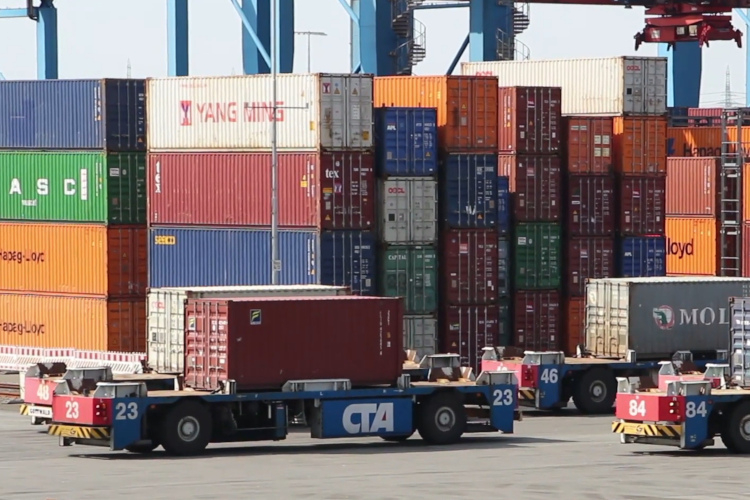
In the face of economic challenges, LCL (less-than-container load) transport is gaining increasing popularity. Production bottlenecks, unstable global supply chains, and container shortages have further increased the demand for small and predictable shipments in sea freight. Michael Kriegel, Department Head DACHSER Chem Logistics, explains which services enable a reliable flow of goods by sea. He also talks about why a good network connection is crucial, especially for goods with high safety requirements.
Sea containers facilitate a continuous flow of goods.
Companies are already analyzing their global supply chains and are increasingly shifting their shipments to sea LCL (less-than-container load). A major advantage of this form of transport for customers is that they can ship smaller loads without having to pay for a full container. This allows them to maintain a constant flow of goods, even in the event of production bottlenecks, and to react more flexibly to seasonal fluctuations. LCL containers are often prioritized over so-called full containers in the loading process, which provides an additional advantage and allows for better planning of transport times. DACHSER is introducing “consolidation boxes” to the market – customers only pay for the space they actually occupy in the containers. Furthermore, the company plans transits a week in advance, rather than only when production volumes are known. This means that containers, which are still in short supply, can be booked earlier, and customers retain flexibility when making bookings.
Many companies, especially in the automotive, life science, and healthcare industries, have been using sea LCL for years. However, this service is also suitable for the chemical industry, which places particularly high demands on safety and process transparency during transport – and therefore requires a logistics service provider with the appropriate experience. One such provider is DACHSER. In 2009, the company established a partnership with the German Chemical Industry Association (Verband der Chemischen Industrie e.V., VCI). This successful alliance was subsequently expanded in 2015 to include air and sea freight. Association members now benefit from globally standardized core services in the LCL network – transport, warehousing, and IT solutions. All this specialized expertise has been consolidated into the DACHSER Chem Logistics team.
– For shipments from customers in the chemical industry, which sometimes contain hazardous goods, safety is always the decisive factor. We must protect life, health, and the environment – says Claus Freydag, Managing Director DACHSER Air & Sea Logistics in Germany. – DACHSER can also boast global experience in hazardous goods in the LCL container segment and covers all IMO classes compliant with LCL within its own network and the partner network.
The company’s central hazardous goods management system and more than 250 regional safety advisors monitor compliance with special regulations for the transport of hazardous goods. In addition, many DACHSER employees are trained annually on the specific requirements of logistics in the chemical industry.
– In the case of sea freight, the team consolidates various LCL loads and loads them into a full container. In this way, the utilization of container capacity is optimized, which in turn optimizes transport costs. Maximum utilization also improves the sustainability of transport while lowering the risk for individual companies in times when supply chains are fragile. “Ports around the world have been congested for months, causing significant delays and making it rare, if not impossible, for shipping companies to adhere to schedules. Instead of sending a full container on its way, which could be held up if time windows are missed, more and more customers are opting for sea LCL. This reduces their risk by spreading it across several shipments and vessels and ensures more timely deliveries – explains Freydag.
The key importance of intelligent solutions and a strong network
The demand for LCL services will continue to grow, even ignoring the impact of the pandemic. Therefore, DACHSER, as a leader in the German and European LCL market, has also expanded its sea LCL network with 70 weekly direct connections to and from Germany.
– By focusing on major global routes, we are also systematically increasing our capacity for transporting hazardous goods. This, of course, means serving major markets in both the Eastern and Western Hemispheres, such as China, India, and the USA – says Freydag.
In 2021, DACHSER shipped approximately 19,700 cubic meters of hazardous goods as LCL to customers in the chemical industry. Hazardous goods thus already account for 15 percent of DACHSER ASL Germany’s LCL business. In addition to regular port services, DACHSER also provides various direct import services to the hinterland or other European cities. For example, once a week, LCL containers depart directly from ports such as Hong Kong, Shanghai, and Ningbo to ports such as Hamburg and Bremen – but also with direct loading to Frankfurt, Kaufbeuren, Cologne, Munich, Nuremberg, Stuttgart, as well as Copenhagen and Gothenburg. Direct loading minimizes the risk of cargo damage and provides additional security by eliminating deconsolidation at the transit terminal.
– Furthermore, this increases profitability and provides additional benefits in terms of lead times by removing bottlenecks at the port. “The global DACHSER network connects all LCL transport by land and sea. We combine our own sea LCL services to and from Germany with the comprehensive range of services offered by DACHSER European Logistics, thus enabling end-to-end service throughout Europe – says Freydag.
For storage and unloading, DACHSER increasingly uses its own branch infrastructure, in addition to standard container freight stations (CFS) at ports. In a situation where port capacity is limited, companies benefit from additional shipping quality and shorter transit times.
– This concept, in line with the “everything from a single source” idea, combines the European road transport network with the global sea freight network – which not every company can offer. Thanks to a comprehensive LCL solution that goes beyond sea transport alone, we can maintain high quality across all mentioned carriers and offer a transparent shipment tracking option – adds Freydag.
Over the last two years, minimizing risk in the global flow of goods has become a key success factor. To fully utilize the benefits of LCL shipments, it is crucial that pickup and onward transit are also handled in an integrated manner, which ensures the safety of hazardous goods transport throughout the entire transport route.