








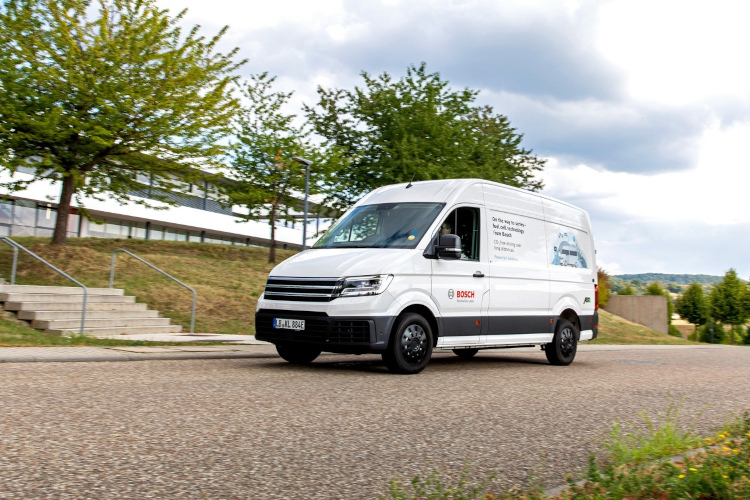
Tests of two demonstration vehicles provide the data necessary for the further development of hydrogen propulsion. The initial results regarding range and refueling time are impressive. Bosch is using its own hydrogen fuel cell components for the tests.
The advantage of light commercial vehicles, or vans, is the rapid transport of goods to their destination, as well as the possibility of using zero-emission local propulsion. However, the longer the journey and the heavier the vehicle, the less efficient battery-electric propulsion becomes. The solution lies in other zero-emission technologies, such as hydrogen fuel cells, which can be successfully used in the transport industry. Robert Bosch has equipped vans with this technology and has begun road testing.
“The use of hydrogen fuel cells enables a long vehicle range while maintaining short refueling times. This makes long journeys more economical,” says Dr. Markus Heyn, member of the Bosch board of management and chairman of the Mobility Solutions business sector. “Through testing hydrogen-powered vans, we are expanding our knowledge and demonstrating that hydrogen fuel cells can also be a suitable propulsion solution for light commercial vehicles.” The project partner is ABT eLine, which designed and converted the vehicles together with the Bosch Engineering division. The test vehicles, along with Bosch fuel cells, can be seen and tested on the track during the IAA Transportation trade fair in Hanover.
Technology based on Bosch components
The production of hydrogen fuel cells was almost entirely based on Bosch brand components. The vehicles use a complete fuel cell kit, which consists of a stack, an anode supply module containing a hydrogen injector and a recirculation blower, an electronic control unit, an electric air compressor, and hydrogen storage system components, as well as numerous sensors.
Already at this stage, the project is providing important data: even with a load, the vehicles can travel up to 540 kilometers, and a full refill takes six minutes. Hydrogen fuel cells could therefore be a good complement to battery-electric propulsion in the future for fleet operators whose vans cover long distances during the day and return to the service point and warehouse in the evening.
The technical basis for both vehicles are commercially available vans that run exclusively on electric power. To conduct the tests, the batteries and their peripherals were replaced by hydrogen fuel cells, five tanks storing a total of over 10 kilograms of hydrogen, and a smaller lithium-ion battery.
Partner ABT eLine adapted the cooling system, vehicle control system, and electrical system, while Bosch designed the hydrogen fuel cell system, integrated it into the vehicle along with the hydrogen storage system, and developed the appropriate control system. After conducting the required technical tests, the vehicles were officially approved for road use.
Next steps for the development of fuel cells and hydrogen
The first Bosch components for hydrogen fuel cells have already entered series production. “To further develop this area, we need as much data as possible from real-world road operations,” explains Gackstatter. Thanks to cloud connectivity, both test vehicles provide the necessary information to developers’ computers in real time, thus supplementing measurement values from test benches. Thanks to the knowledge gathered, Bosch can offer customers tested and proven components and comprehensive support in system design sooner.
However, further steps are necessary for a breakthrough in the fuel technology market. “Industry and political representatives must work together to remove the obstacles that limit the potential of hydrogen technologies,” notes Gackstatter. Issues such as the development of storage infrastructure and increasing the production of green hydrogen can only be solved through close cooperation.