









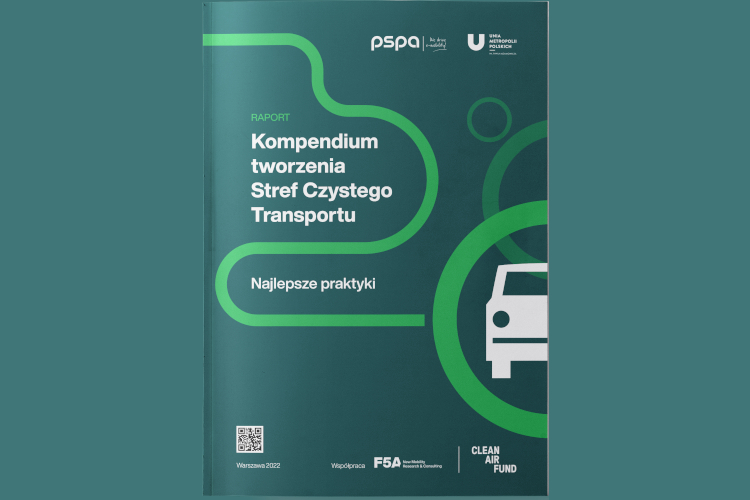
What are the rules for establishing Clean Transport Zones? How does their evaluation process work? What recommendations does the business sector operating in low-emission zones present, based on experiences in various countries, regions, and cities? What distinguishes a model Clean Transport Zone, for example, in Antwerp? Answers to these very current questions can be found in the “Compendium for Creating Clean Transport Zones. Best Practices,” just published by PSPA and the Union of Polish Metropolises.
Over 300 clean transport zones (CTZ) are already operating across Europe. Thanks to the amendment of the Electromobility Act, low-emission areas will soon be created in Poland as well. To facilitate their implementation for local governments, PSPA, together with the Union of Polish Metropolises, has prepared a report that is a collection of best practices for establishing CTZs. The report premiered during the New Mobility Congress 2022 – the largest event in this part of Europe entirely dedicated to zero-emission transport.
The transport sector is the source of nearly 1/3 of global greenhouse gas emissions. Emissions from transport come mainly from the combustion of fossil fuels in passenger cars, delivery vehicles, trucks, ships, trains, and airplanes. More than 90% of the fuels used in this sector are petroleum-based, primarily gasoline and diesel. Road transport is responsible for the largest share of transport emissions (in 2019, it was the source of 72% of all emitted GHGs). There are over 20 million cars on Polish roads, and 1.5 million are registered every year. The extensive fleet means that in addition to producing a significant amount of carbon dioxide, road transport generates up to 80% of air pollution in Polish cities. Consequently, it contributes to the formation of smog and the deterioration of the air we breathe. In over 70% of Polish cities, air quality standards are regularly exceeded. Every day, this causes enormous health and financial losses and lowers the quality of life for their residents. In a number of cities across Europe, an effective solution has already been implemented, the goal of which is to limit the traffic of the most emission-intensive vehicles, leading to an improvement in air quality. This is the implementation of Low Emission Zones, which in Poland have been named Clean Transport Zones (CTZ).
Opinion of Maciej Mazur, Managing Director of the Polish Alternative Fuels Association:
– Clean Transport Zones (CTZ) are an increasingly popular solution in Europe addressing one of the most serious challenges of the 21st century – the high level of pollution emissions from road transport. Thanks to CTZs, the air we breathe can be much cleaner, and cities quieter, less congested, and friendlier for all stakeholders: from residents and tourists to entrepreneurs doing business there. Although over 300 low-emission areas have already been implemented across Europe, and some of them (e.g., in Gothenburg) have been operating for nearly 30 years, no clean transport zone is currently functioning in Poland. The situation may soon change thanks to the amendment of the Act on Electromobility and Alternative Fuels of December 24, 2022, which opened the way for local governments to establish CTZs. Thanks to the new regulations, Polish municipalities now have much greater freedom both in terms of setting entry restrictions for low-emission areas and their scope. Selected local government units have already officially announced the introduction of zones. However, the effective establishment of CTZs and the maximization of the positive socio-environmental effects of their operation can be a challenge. It is a very complex process, requiring comprehensive planning of implementation, organizational, and communication activities. To meet the needs of Polish local government units, PSPA has prepared a report defining the necessary actions that should be taken in the process of establishing CTZs and presenting examples of best practices used in this regard in other countries.
Opinion of Tomasz Fijołek, Managing Director of the Paweł Adamowicz Union of Polish Metropolises:
– Without a doubt, Clean Transport Zones (CTZ) are one of the most important postulates found in city policies around the world and are being consistently implemented. If we look at the example of the Belgian city of Antwerp, which is cited in our report, we know that methodically and with a concrete plan, we can pursue a similar direction in our local governments. During a study visit to this beautiful city, Polish local government officials and experts had the opportunity to see for themselves how the zones function and what significant benefits they bring. They were able to see what challenges lie ahead and what difficulties they might face. Drawing on the experiences of other European local governments is invaluable, because the fact that there is no CTZ in Poland today does not mean that no one is working on it. Some cities (including Krakow and Warsaw) have already announced the introduction of CTZs. This is certainly a long-term process, but profitable for everyone, also, and perhaps above all, for our climate and health. Did you know that the creation of the Umweltzone in Berlin caused the rejuvenation of the car fleet and reduced particulate matter emissions from vehicles by 50% in a few years? And according to the report presented to you, 58% of Poles support the creation of Clean Transport Zones in their city or the one they visit most often. The survey was conducted in cities belonging to the Union of Polish Metropolises: Warsaw, Łódź, Krakow, and Wrocław, i.e., partly in those units that have already declared the creation of such zones. The report that we have the pleasure of presenting to you together with PSPA is a lot of valuable tips for our local governments. We hope it will be helpful and at least slightly explain how Clean Transport Zones can be created in our cities.
Link to the report: https://metropolie.pl/fileadmin/news/2022/09/PSPA_Strefy_Czystego_Transportu_Kompendium.pdf