








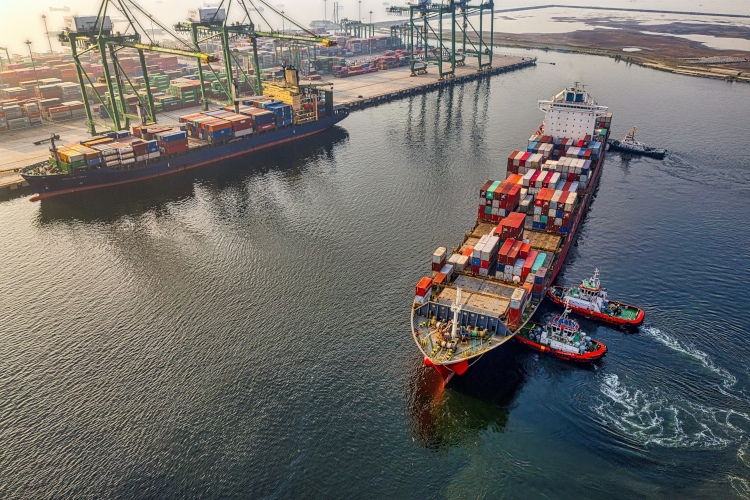
Turmoil in the global shipping market, caused by many factors such as the pandemic, has severely disrupted supply chains. This is already being felt not only by importers and exporters, but also by consumers. What is the current situation in the market and what is the biggest challenge? – comments Hillebrand Gori, an operator specializing in logistics for the beverage industry, including sea freight.
Over 25 million TEU
In June, the global container fleet reached a milestone in available free container space – 25 million TEU (+3% y/y), and by the end of the year, growth is projected to be 3.5%. The order book for new cargo space is 7 million TEU, with delivery in 2023 and 2024, which is equivalent to 27 percent of the current fleet. It is worth emphasizing that this is an unprecedented rate since 2011, when the availability of new cargo space was only 15 million TEU. The nominal fleet is expected to grow by 8% in 2023 and 9% in 2024, excluding delays or scrapping.
Global demand for containers is slowing down
After a record increase in the number of containers in 2021, global demand for containers began to fall at the beginning of the year and has now reached a negative rate year-on-year. Taking into account the impact of the war in Ukraine and China’s “zero COVID” policy on the global economy, demand for containers decreased by 4% in April. The decline in global demand since the beginning of the year remains at -1.5%. The region that feels its effects the most is Africa.
Spot rates are falling, but are still at a high level
As Drewry’s World Container Freight Index shows, in July, sea freight rates fell by 17% compared to January. But that is still 300% more than in January 2020 and 5% more than in June 2021. Considering the possibility of new disruptions, among other things, no major changes in ocean rates should be expected.
Transit time is increasing
One of the biggest challenges facing the global shipping industry today is transit time. The pandemic has changed international trade. The global container crisis has disrupted the flow of goods, which shippers have felt in the lack of container availability. It is these factors that have influenced not only the increase in rates but also the extension of transit time. In May, the volume of shipments from Europe to the US East Coast increased by 42 percent y/y. In June, shipowners canceled 27 sailings due to congestion and unscheduled services, while one carrier launched new services: between Northern Europe and Mexico and between the Middle East and the USA. On-time delivery remains at a low level. According to Sea-Intelligence, in May of this year, 28.9 percent of ships arrived at ports on time on the South America – Europe route, and the average delay time was about 6 days.
Consumers are also feeling the lack of containers
Global supply chains are negatively affected by the shortage of containers. This is due to, among other things, congestion in ports caused by a lack of labor, which is a result of the Covid pandemic. It must be remembered that it still poses a threat and, according to forecasts, will continue until 2023. Also key is the change in consumer purchasing behavior, and with it, irregularity and variable demand. So what does the lack of available free containers mean for consumers? First of all, reduced deliveries, empty shelves and the lack of certain products, as well as an increase in their prices. Currently, there is no indication that the situation may improve in the near future.
What’s next? – challenges and forecasts
Despite a slight decrease in volumes, upcoming cargo flows and cargo backlogs remain a challenge for ports and intermodal operators. Congestion, which had been improving at ports on the US West Coast, has worsened in Europe and on the US East Coast. This leads to inefficient use of free cargo space. One must still count on the risk of the return of subsequent waves of Covid and the introduction of new restrictions.
In the long term, freight rates are expected to remain at a high level due to, among other things: the maintenance of charter rates, high fuel costs, and congestion in container handling at ports, which translates into the availability of empty containers. The increase in labor costs and problems with the availability of workers in ports will also be of key importance.
Logistics for beverage – prepared for challenges
For the beverage and alcohol industry, maintaining supply chain continuity is crucial. That is why it is so important to monitor changes and introduced restrictions and to plan deliveries accordingly. How can the negative effects of the lack of containers be reduced? Hillebrand Gori experts recommend increasing inventory and including the possibility of extending order fulfillment times in delivery plans, while having shorter container availability times. Securing transport capacity under long-term contracts should be a priority. It is also necessary to take into account higher fees related to delays and so-called “bottlenecks” in land transport. In the case of very urgent deliveries, it is worth considering air transport as an alternative. Choosing an experienced logistics company that will ensure timely and safe delivery of goods, while maintaining their quality and freshness, is also of key importance for the beverage industry. It is worth emphasizing that Hillebrand, as part of DHL Global Forwarding, Freight and thanks to the merger with Gori, has gained new opportunities for development and utilization of the potential of a strong, global logistics network. This allows the operator to prepare dedicated transport solutions that ensure supply chain continuity in such uncertain times.
*The latest “State of the Industry” report, prepared by Hillebrand Gori experts, is available at the link.
Source: Hillebrand Gori