








The courier operator is implementing the Climate Protect program and aims to achieve climate neutrality by 2045. The strategy of the entire GLS Group focuses on the gradual reduction of CO2, among other things, through an eco-friendly fleet, the use of renewable energy sources, and the daily actions of all GLS employees and partners worldwide.
Reducing CO2 emissions, optimizing waste management, and the responsible use of resources are at the heart of the Climate Protect program, which GLS is implementing globally, including in Poland. The company aims to achieve climate neutrality by 2045, which means it will gradually reduce CO2 emissions year by year. This is the next stage of its efforts. The operator already offsets all current emissions and intends to significantly reduce them per parcel by 2025. The GLS Group participates in four global programs aimed at, for example, protecting endangered parts of the Amazon in Peru and Brazil, or supporting the construction of wind and solar power plants in India.
– Climate Protect is a GLS program leading to climate neutrality. In 2008, we launched the ThinkGreen initiative, which focused on promoting ecological attitudes and solutions within the company. We are continuing these efforts, but the entire GLS Group is going further. As an international company, we know that we can have a real impact on improving the climate, which is why zero emissions, which we want to achieve in the next two decades, is a strong declaration by the entire Group – says Tomek Zwiercan, Managing Director of GLS Poland.
Poland’s path to zero emissions
GLS Poland already uses 85 percent renewable energy sources, such as biomass, hydropower, and solar energy. The company is successively installing photovoltaic systems on its own facilities, allowing the operator to generate the energy it needs itself.
– The commitments we made when embarking on the path to climate neutrality are being consistently implemented by us, both on a macro and micro scale. It is not only the actions taken by the company that are important, but also those taken by individuals. Together, they bring a truly impressive effect. That is why we encourage employees to engage in various ecological activities, such as saving energy by turning off devices and lights when they leave rooms or finish work. We only print documents that are truly necessary. In turn, GLS couriers use tips on economical driving and undergo practical training in this area – says Justyna Glaza, Environmental Manager at GLS Poland.
All these activities focus primarily on reducing emissions per transported parcel. As a logistics operator, GLS Poland is aware that the biggest revolution must take place in transport. That is why the company is consistently replacing its fleet with more eco-friendly vehicles, which consists of several very specific elements. First – in 2019, the GLS Poland fleet expanded to include Iveco Stralis NP 460 trucks powered by LNG, which are less emission-intensive compared to similar diesel-powered trucks. There are currently 28 such vehicles operating on the longest European routes. Second – in several Polish cities, 58 e-vans are operating in GLS colors. The operator is consistently expanding this part of the fleet and increasing the number of electric vehicle chargers at its depots. Company cars are also being systematically replaced with hybrid versions.
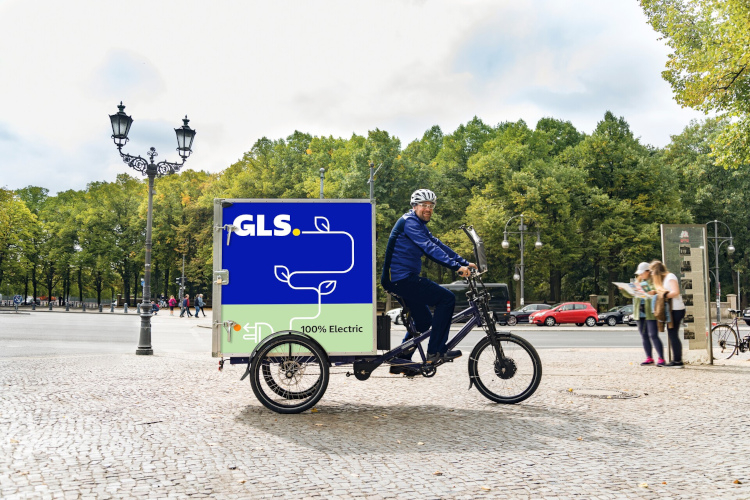
Thirdly – GLS Poland is investing in light transport. The company was the first operator in the country to launch a courier bicycle. The pilot program began in Krakow, and currently, 13 courier bicycles in GLS Poland colors are already operating in 9 Polish cities. Bicycles will systematically appear in other locations.
– Bicycles work well in zones with traffic restrictions, i.e., in the centers of large cities. It is a fast and zero-emission means of transport, thanks to which we gain measurable benefits for the climate. For example, in Krakow, using just one bicycle for regular parcel handling allowed for saving approx. 12 tons of CO2 emissions per year – says Justyna Glaza.
Since 2020, the operator has also been using advanced technology for managing courier routes based on geocoding. Geocoordinates, which are assigned to a given address, allow for the optimal planning of the entire delivery process thanks to the precise mapping of courier routes.
Additionally, in its journey toward climate neutrality, GLS is also eager to engage in initiatives promoting ecological attitudes, and it is also an initiator of campaigns aimed at protecting the climate, including by planting flower meadows and protecting bees.