








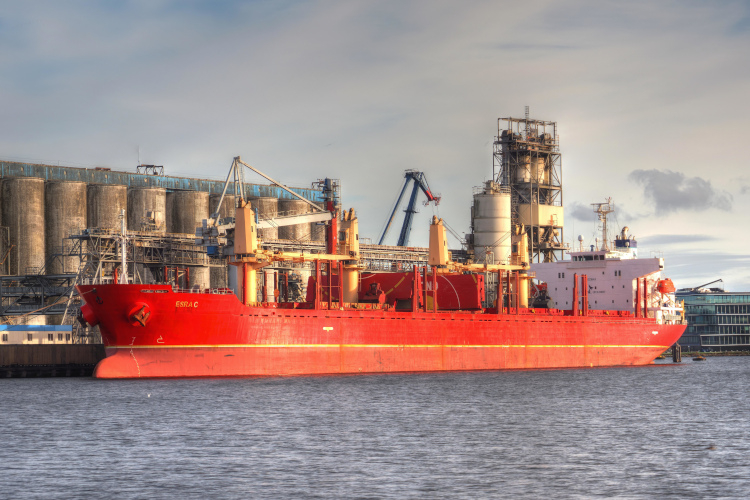
As a result of the Russian invasion of Ukraine, the country, which until now was the breadbasket of Europe and a significant supplier of grain to world markets, has been cut off from maritime routes for the export of goods and raw materials. Ukraine’s main ports – Odesa and Mariupol – have been blocked by the Russian fleet. The situation therefore forces Ukraine to seek alternative transport routes that can ensure the continuity of trade and supply chains with Europe, as well as with Asian and African markets, and also with the North American markets, which are new to Ukraine.
Problems with grain exports from Ukraine by sea
Poland, as Ukraine’s largest European neighbor, with a developed network of road and rail connections and significant seaports, can play an important role in the export of bulk goods from Ukraine. On the border with Poland, there are 6 road border crossings and 4 rail border crossings through which the export of cargo from Ukraine can largely take place. In the case of bulk goods—and we are talking here about Ukrainian exports of 27.2 million metric tons of corn and 21.2 million metric tons of wheat in 2021—it is difficult to imagine land transport of cargo by trucks. Naturally, we are therefore wondering how to transport grain by rail to Poland, Polish ports, or further to Western Europe.
The biggest challenges related to grain exports from Ukraine
The rail infrastructure on the Polish-Ukrainian border poses a significant problem in the bulk goods logistics chain. Faced with increased transport needs, huge congestion is forming at rail border crossings, while according to the Ministry of Agriculture and Rural Development, only up to 150 wagons per day are cleared at the three rail border crossings. Wagons waiting to enter Poland on the Ukrainian side are already counted in the thousands, and due to the difference in track gauge and limited transshipment infrastructure resources, the transshipment process is time-consuming.
Until now, rail traffic in the Ukrainian border area was limited, and track and terminal infrastructure was not used as intensively as, for example, in the case of rail border crossings with Belarus. Border crossings, especially on the LHS line, were only just beginning to develop intensively thanks to the introduction of direct connections as part of the New Silk Road. However, the LHS line was already used for transporting iron ore from Ukraine and can easily use its existing experience in both transport and handling of cargo transshipments.
At the Łukasiewicz – Poznań Institute of Technology, we are considering ways to unblock rail routes, especially at the junction of standard and broad-gauge rail networks. A solution that could speed up transshipments is the replacement of wagon bogies or the use of wheelsets with variable track gauge, such as the SUW2000 system. However, this is a solution that has not been practiced so far, mainly for cost and infrastructure reasons. Therefore, we should look for simple, ad-hoc solutions using existing wagon and siding resources, e.g., continue the process of containerizing supply chains and change the technology of transporting bulk cargo to transport in specialized containers. So far, containers have not been used on a large scale for grain transport, but there are technologies that allow for such transport. As early as 2018, entire intermodal trains transporting flax seeds in specialized containers were formed in Russia. Such transport significantly improves the transshipment capabilities of transport units and makes it possible to use universal container wagons with any wheelbase or road transport. Until now, the containerization of bulk cargo was argued by the limited availability of specialized wagons in the season; currently, an additional important argument is the ease of transshipment between modes of transport.
Customs barriers
Already in April of this year, the European Commission proposed suspending duties on goods imported from Ukraine, which is intended to significantly facilitate the export of Ukrainian goods to the European Union. Ukraine is to be covered by zero customs tariffs and zero access to quotas for the EU market. Actions have also been taken to facilitate transit and the use of EU infrastructure in the process of exporting goods from Ukraine to third countries. These are unprecedented trade liberalization measures that, at the request of the European Commission, are to be considered by the European Parliament and the Council of the European Union. In May, however, the Ministers of Agriculture of Poland and Ukraine agreed on a joint roadmap to accelerate border procedures, especially in the area of veterinary control. Thanks to the agreement, which increases the number of veterinary inspectors at the borders and establishes the possibility of border clearance of grain at additional border crossings, grain exports from Ukraine should be smoother and more efficient.
The importance of bulk cargo exports
Ukraine has some of the most fertile soils in the world and a climate favorable to agriculture. In 2021, it secured 14% of European corn and wheat imports, but iron ore was the top Ukrainian export. In 2021, ore exports amounted to 41.8 million metric tons. In recent weeks, iron ore exports have decreased and we are focusing mainly on the problems of exporting agricultural products, but it should be remembered that ore exports also constitute a significant part of the Ukrainian economy. Shipments from Ukraine are also of great importance for the global steel industry. Poland is also trying to help its eastern neighbors in this branch of the economy. The first ships with Ukrainian ore have already left the port of Świnoujście, and 50,000 tons of Ukrainian raw material are being stored in port yards.
Opportunities for Polish companies
It is difficult to talk about benefits in the context of a reaction to war activities. However, it is worth considering the opportunities that are emerging for Polish companies, rail operators, terminals, and port and rail infrastructure managers. Redesigning supply chains and mapping out new routes for the transport of bulk goods from Ukraine is undoubtedly an opportunity for the development of new solutions and the development of innovation in both organizational and technological terms. Ensuring the most efficient use of rail infrastructure and available resources near the border with Ukraine, and mapping out new routes, will not only allow for participation in securing current global food needs but will also pave the way for using the newly created supply chains in the future, when the time comes to rebuild Ukraine.