









Little remains of the optimistic sentiment in the transport sector from last year. Since the beginning of this year, transport companies have been “riding” below the limited growth (LG) threshold, meaning they see little chance for business development. The EFL Barometer sub-index for this industry for the second quarter of this year stood at 49.3 points, which was at a similar level to the previous quarter (49.1 points). Although a similar percentage of respondents forecast an increase and a decrease in orders (29% and 26%), there is no such balance in the area of “financial liquidity.” 15% count on its improvement, but 24% fear it will worsen. The transport business is strongly affected by the war in Ukraine – the group of companies assessing its impact as decidedly negative is the largest among all 6 surveyed industries.
EFL Barometer for the transport industry for Q2 2022:
- Sub-index: 49.3 points (+0.2 points q/q)
- Investments: 86 percent of entrepreneurs do not expect changes in investments
- Sales: 29 percent of entrepreneurs forecast an increase in sales; 26 percent forecast a decrease in sales
- Financial liquidity: 15 percent of entrepreneurs forecast an improvement in financial liquidity; 24 percent forecast a deterioration in financial liquidity
- External financing: 28 percent of entrepreneurs forecast a greater demand for external financing; 19 percent forecast a lower demand for external financing
- COVID-19 Barometer: only 9 percent of entrepreneurs expect an improvement in the industry’s condition within the next 6 months, 33 percent fear a deterioration
The EFL Barometer sub-index for the second quarter of this year for the transport industry was 49.3 points, 0.2 points higher than in the first quarter of this year. For the second time in a row, the indicator value did not exceed the limited growth threshold, i.e., 50 points, which means a return to the difficult situation of the pandemic years 2020 and 2021 (first months).
The President of the Management Board of EFL points out that since the second quarter of last year, a clear rebound was visible in transport, of which there is no trace this year. – The level of limited growth for micro, small, and medium-sized enterprises in our study is at least 50 points. Transport companies crossed this threshold for the first time since the outbreak of the pandemic in the second quarter of 2021 and did not “get off track” until the end of last year. Since the beginning of this year, however, they have shifted down a gear and are “riding” right on the edge. Undoubtedly, what is happening beyond our eastern border is having a very strong impact on the condition of the transport industry. And if we add to this the rising price of crude oil, galloping inflation, and the difficulty in forecasting what will happen in a month or two, this bad streak may continue in the next reading – says Radosław Woźniak, President of the Management Board of EFL.
War is harder than the pandemic
Transport is definitely feeling the impact of the war taking place in Ukraine more today than the pandemic. 63% of companies believe that what is happening beyond our eastern border has an adverse effect on their operations (of which 31.3% – very adverse and the same – 31.3% – rather adverse). It is worth emphasizing that the percentage of respondents assessing that the war has a decidedly negative impact on their operations is the highest among all 6 surveyed industries. In the case of COVID-19, 39% of respondents point to its negative impact (of which 13% – decidedly adverse, and 26% – rather adverse).
Investments will not start, and liquidity is increasingly lower
In the second quarter of this year, the vast majority of transport companies (86%) plan a similar level of investment as in previous months, and 14% expect to reduce them. No one is thinking about new major capital expenditures.
Representatives of the industry forecast sales better than investments. 29% count on an increase, 41% expect a similar level of orders as in the previous quarter, and 26% fear a decrease.
Unfortunately, the financial liquidity of transport companies does not look the best. Every fourth company fears its deterioration in the second quarter of this year (24%), while a quarter earlier this percentage was 16%. Only 15% count on its improvement, while a quarter earlier it was 26%.
The value of the main EFL Barometer index for the second quarter of 2022 was 48.7 points. The achieved level is 0.2 points lower than in the first quarter of 2022.
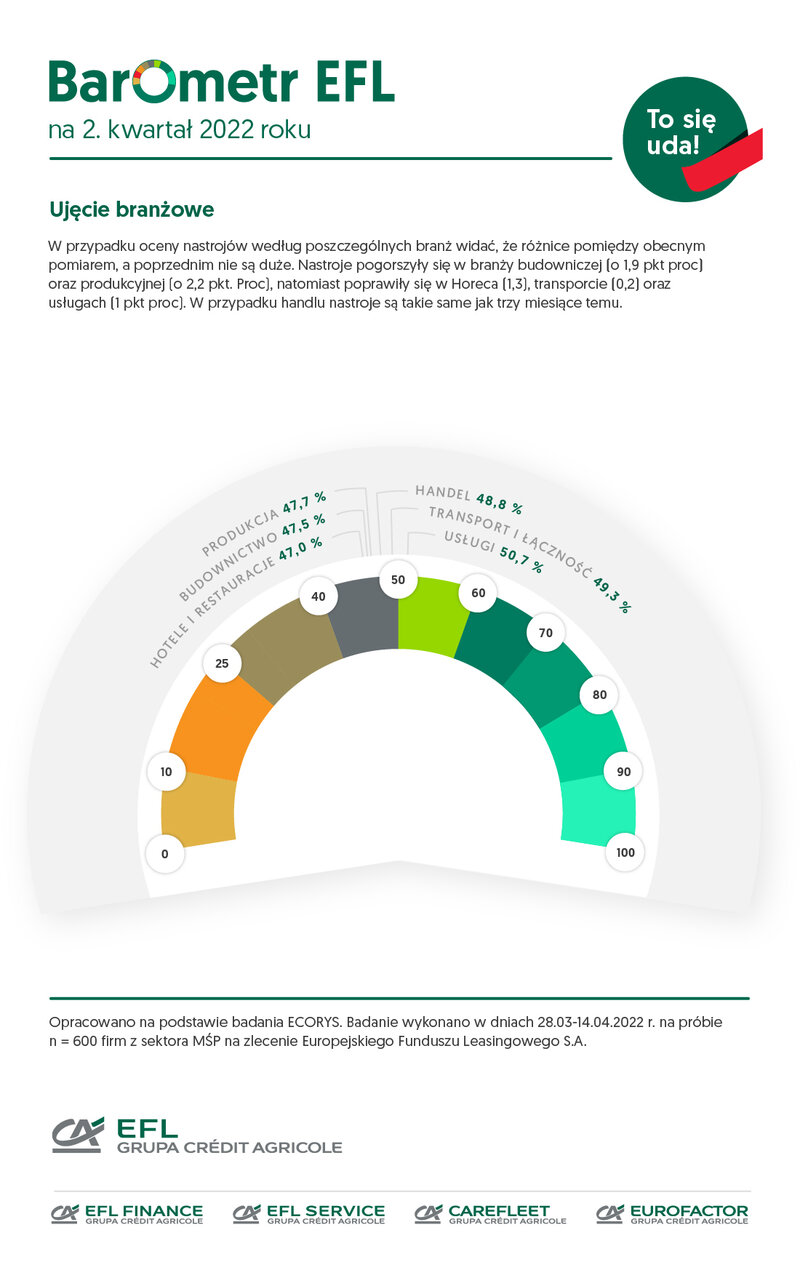
The EFL Barometer is a synthetic indicator informing about the propensity of companies from the SME sector to grow (i.e., development understood as setting goals related to sales and production growth, expansion into new markets, and profit maximization, which is associated with investments in fixed assets). The financial condition of SMEs forecast for a given quarter provides a reference point for inferring the assumed direction of changes that favor growth or act as a brake on company development. The study is prepared by Ecorys on behalf of Europejski Fundusz Leasingowy SA., and its results are published quarterly. Its participants are micro, small, and medium-sized companies from all over Poland. A representative group of 600 micro, small, and medium-sized companies took part in the study. The current edition of the study took place from March 18 to April 14, 2022.