








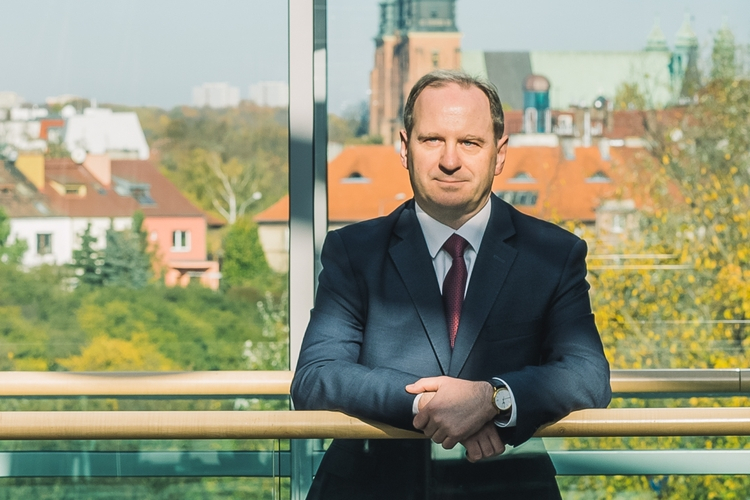
An interview with Prof. Ireneusz Pielecha, Editor-in-Chief of the journal “Rail Vehicles” (“Pojazdy Szynowe”).
Tomasz Janiak: The past year was the European Year of Rail. Which events were worth paying special attention to?
Ireneusz Pielecha: The initiator of the European Year of Rail (EYR2021) project was the European Commission. This project promoted environmentally friendly modes of transport and the achievement of climate neutrality by 2050. The European share of transport in carbon dioxide emissions is approximately 24%. In the European Union in 2018, passenger transport (passenger vehicles, two-wheelers, and buses) accounted for 45.1% of CO2 emissions, road freight transport – 29.4%, aviation – 11.6%, maritime transport – 10.6%, and rail transport only about 1%. In accordance with the Paris Agreement (COP21), the European Union has committed to reducing greenhouse gases. By 2030, emissions are to be reduced by 40% compared to 1990. By 2050, the European Union has set a goal of achieving zero net greenhouse gas emissions. These actions should be treated as an opportunity for the development of rail transport in the broad sense. In Poland, several dozen valuable events related to the EYR took place. They concerned scientific (conferences), industry-related, and popularization activities. It seems that the most valuable of them are those that contributed, even to a minimal extent, to the implementation of environmental changes towards climate neutrality. It is difficult to choose one initiative, but it seems that the multi-faceted and multi-level cooperation of legislative, local government, and industry bodies is the action that can initiate processes of change in the Polish railway economy towards its decarbonization.
The year 2021 was already a year of the COVID-19 pandemic, which significantly limited the possibilities of direct participation in many events planned as part of EYR2021. As part of local initiatives, an interesting event was the conference on hydrogen drives in railways “Hydrogen Railway” (“Kolej Wodorowa”), organized from June 29 to July 1, 2021, by Łukasiewicz – IPS “TABOR” and the Institute of Internal Combustion Engines and Drives of the Poznan University of Technology. The conference gathered many representatives of science, business, and the railway industry. It was conducted in the convention of plenary sessions and discussion panels, focused on the possibilities of legal and operational sanctioning of hydrogen use. The great interest in the conference topics led to the decision to hold its next edition in June 2022, despite the end of the European Year of Rail. Such actions indicate that the EYR was a long-term impulse encouraging action for a “green railway”. The EYR is not just an analysis of changes in rail transport towards reducing carbon dioxide emissions. It is also the promotion of railways in Europe. A very interesting initiative was the European “Connecting Europe Express” train journey. Unfortunately, its route did not pass through Poznań, but several cities in Poland were visited. Promotional activities in the field of cross-border rail transport can significantly reduce the large share of passenger transport in reducing carbon dioxide and exhaust emissions mentioned at the beginning.
T. J.: Along with the dynamic development and modernization of railways, railway professions are returning to favor. Whether the dream of many a boy, sitting at the controls of a modern Link or Vectron, comes true depends on a systemic approach to education, also in the context of such an important issue as safety. How can the attractiveness of this profession be presented?
I. P.: The continuous development of transport (not only rail) causes interest in it to grow, even from the youngest generations. After a few years of weakening importance of transport professions, the trend is reversing and stabilizing. This also means interest in railway professions among railway schools – in the 2021/22 school year, 53 technical secondary schools and 10 first-degree industry schools opened recruitment. More and more universities are resuming specializations related to rail transport. The very good preparation of current graduates on the domestic labor market is related to wide access to state-of-the-art teaching aids. Specialized software for design work is used for learning from secondary school onwards. A systemic approach to education requires acquiring knowledge in the field of rail vehicles at an early stage of education. However, knowledge should be confronted with practice in this area. A very important factor is the existence of industry and post-primary schools. The final stage should be universities with a railway profile. Acquiring knowledge in the field of rail vehicles should be possible at each of the above stages of development. Modern operation of rail vehicles is not just about mechanics. Currently, much more attention should be paid to energy management of the drive. Topics related to the safety of such drive systems are extremely important. And here, modern educational opportunities are very significant.
Issues related to the safety of rail transport require the full involvement of students in the didactic process. I mean the process of education using modern techniques, such as stationary simulators, cabin simulators, or European Train Control System (ETCS) trainers, enabling the reproduction of any driver’s desk or physical infrastructure. The next stage of development is Virtual Reality. Such virtual machines allow for increasing the efficiency and effectiveness of learning compared to traditional methods.
T. J.: Let’s move on to the issue of the transformation of Polish transport towards low-emission. The UN Global Compact Network Poland report “Green Railway in Poland” shows that by 2030, as much as 85% of traction energy used by carriers is to come from RES. What conditions must be met to achieve this ambitious goal?
I. P.: In Poland, over 65% of railway lines are electrified. This means that 35% of railway routes are operated by combustion systems. In this group, a significant number are vehicles of advanced technological age, which indicates a significant burden on the environment in terms of carbon dioxide and exhaust emissions. In this regard, two solutions are possible: the use of modern low-emission combustion engine solutions powered by hydrocarbon fuels or powered by hydrogen. Hydrogen can be used both in internal combustion engines or in the form of fuel cells. A widely promoted direction of low-emission is the use of fuel cells. However, an obstacle to the development of this technology is the storage and refueling of hydrogen and the structural durability of such systems in railway applications. Polish companies face problems both in the production of hydrogen and its use. It seems that the first stage should be legislative actions regarding hydrogen. Unfortunately, they have not been resolved yet, which significantly hinders the development of hydrogen energy, not only in the field of rail transport.
Currently, 80% of energy in Poland is produced from coal. Energy for railways in Poland is only 2% of the total energy drawn from the grid. The level of 85% of traction energy coming from RES in 2030 is a very ambitious goal in domestic conditions. Two directions seem realistic: wind energy and photovoltaic energy. In both cases, there are some domestic experiences, but it will be very difficult to obtain the required indicators without significant subsidies for these energy sectors. In addition to them, energy storage facilities should be included, which in current conditions almost do not exist. Current energy problems regarding coal, natural gas, and crude oil seem to outweigh the ambitious goals that are only seemingly long-term. Many European countries have similar (or higher) indicators of RES use in the railway sector in 2030.
T. J.: You recently became the Editor-in-Chief of the journal “Rail Vehicles” (“Pojazdy Szynowe”), published by Łukasiewicz – PIT. How does this periodical currently rank among journals (media) on railway topics?
I. P.: The journal “Rail Vehicles” has a very long, almost 50-year publishing tradition. Since 1975, it has been published by the Research and Development Center for Rail Vehicles TABOR in Poznań (later renamed the Rail Vehicles Institute TABOR). Currently, the journal under the name Rail Vehicles/Pojazdy Szynowe (railvehicles.eu) is published by Łukasiewicz – PIT. From the very beginning of its existence, the journal had aspirations to play an opinion-forming role and to convey primarily scientific and research knowledge. The Rail Vehicles Institute TABOR, acting as one of the main research centers (even before the creation of PIT), published the journal Rail Vehicles, which served as a link connecting scientific and research centers with industrial centers. The program board of the journal has been an international team of people for over a dozen years, acting as coordinators in the development of the journal. Such internationalization results in publishing activity, not only by domestic scientists and engineers but also by foreigners. We are increasingly observing international author teams. This is a very encouraging trend, as it indicates cooperation between various scientific and research centers, but also the interdisciplinarity of the research and scientific work conducted. Thanks to publications at a high scientific level and cooperation with experts in the field of rail vehicles, we hope that the journal plays a leading role in access to knowledge about the latest achievements in this field.
The current position of the Rail Vehicles/Pojazdy Szynowe journal, which has again found its place on the Ministerial List of Scientific Journals (with 20 points), seems to be developmental. We are still one of the few scientific journals with such a profile in Poland. Such a position means that the journal (publishing in an open access system) is treated as an expert one in the field of rail vehicles. Membership in the CrossRef system gives us international access to knowledge (currently published articles are bilingual or in English) and increases further possibilities for the development of the journal. We do not hide the fact that our goal is to further increase recognition on the national arena and to apply to the Scopus database, which can significantly increase the recognition of publishing authors on the European and global scientific stage.